Chinese embroidery stitches: start with their job
A stitch can describe an edge, fill a petal, or give a surface texture. The China National Silk Museum's teaching plan includes long-and-short stitches, chain stitches, outline stitches, and seed-knot stitches. These are useful terms to ask about when learning, rather than a complete vocabulary for every regional tradition.
The V&A notes that embroidery terminology varies between cultures. An English stitch name may help describe a visible structure without precisely matching a Chinese teacher's classification. Keep the original technique name when an object label supplies it.
Follow thread direction and silk sheen
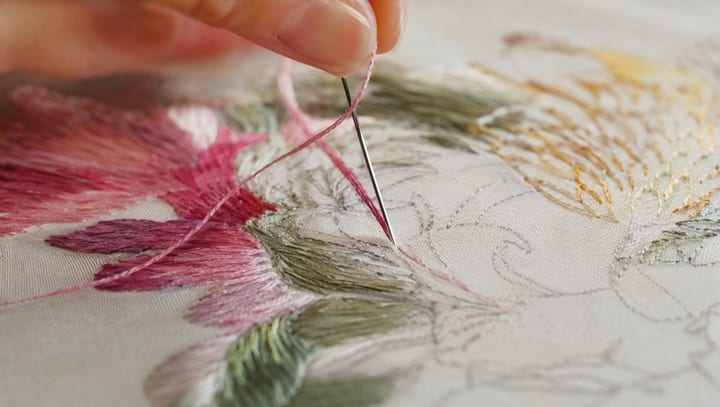
Trace a small area with your eyes: do threads run parallel, fan around a curve, or cross one another? Then step back and see how that arrangement contributes to the whole image. A petal's outline and its interior can tell different parts of the story.
The V&A describes untwisted silk as producing a rich sheen, while twisted thread gives stronger, bolder lines. When viewing a displayed piece, compare its appearance from permitted viewing positions. A bright patch may involve light reflecting from thread as well as a change of color.
Read density together with the ground
Density means how closely the stitches occupy an area. Look for places where the underlying fabric remains visible and places where thread covers it. Compare these within the same object: an open background and a filled flower may have deliberately different visual roles.
Dense coverage alone is not a quality score. Ask whether the spacing serves the design, whether an edge is meant to be crisp or soft, and how the stitched area meets the surrounding cloth. Judge those decisions in relation to the intended object.
Find where shading changes
Choose one flower or feather and follow it from light to dark. Are colors separated into bands, or do short passages of different threads meet within the form? Describe what you can see before assigning a technical name.
The China National Silk Museum's 2018 exhibition describes Jin Jingfen's pomegranate-and-bird hanging as combining two- or three-color gradations with several stitch techniques. This documented example shows why color and stitching should be read together: a finished image need not depend on one repeated stitch.
Keep regional attribution separate from observation
The Chengdu Shu record emphasizes a varied stitch repertoire and orderly thread arrangement. The Suzhou Su record distinguishes traditional fine embroidery, realistic embroidery, and random-stitch embroidery. Neither tradition can be identified reliably by one smooth petal or a bird motif.
For attribution, seek the maker, place, date, materials, and documented technique. For appreciation, ask how small thread decisions build the image. Our Shu, Suzhou, and Shu-versus-Su guides below explain regional context in more detail.
Illustration note
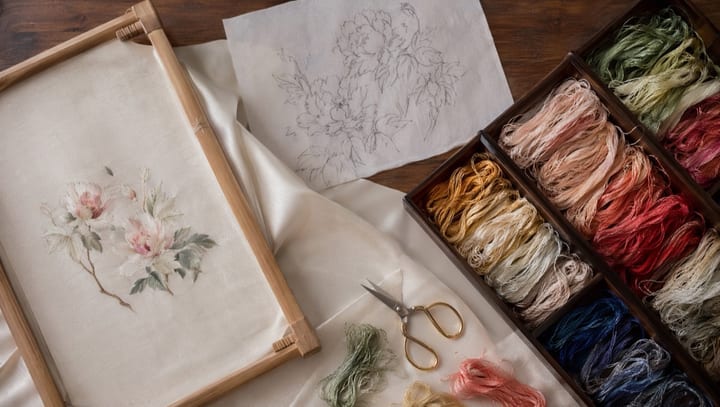
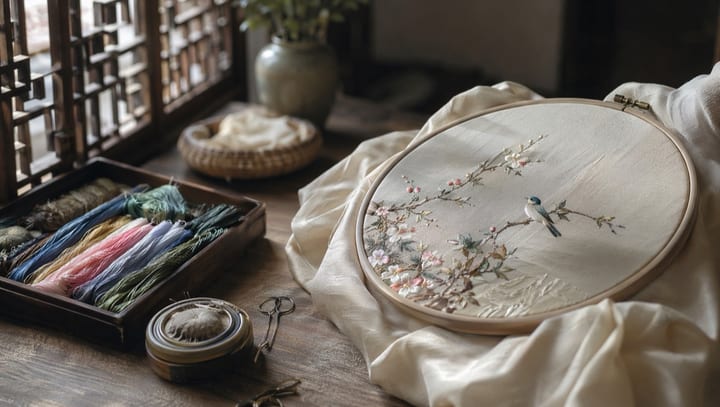
Images on this page are project-created illustrations of embroidery materials and needlework. They are not authenticated works by a named practitioner or evidence for identifying a regional stitch technique.