What makes Chinese scent sachets more than small bags
A sachet’s scenting role needs evidence. An embroidered purse or pouch should not automatically be described as containing fragrance. Museum names, descriptions and surviving construction are useful starting points; decoration alone cannot reveal what was once inside.
The Powerhouse Museum’s Scent bag from China, 92/708, makes this distinction concrete. Its record identifies a late-nineteenth-century hebao with petit-point silk embroidery, a pleated satin opening and porcelain beads. It was designed to hang from a man’s belt and would probably have contained aromatic wood. That probability belongs to this object, rather than establishing a universal filling for every hebao.
Qingyang: forming a shape and hiding the stitches
Qingyang sachet embroidery is a named regional tradition from Gansu, listed in China’s national intangible cultural heritage inventory in 2006. Its official record describes four broad groups: chuchu forms using concealed stitching, forms made by winding coloured thread, three-dimensional embroidery and flat embroidery. These approaches place different demands on the maker; the tradition is wider than a single rectangular pouch.
In chuchu work, the ideal is to suggest the subject through its shape while concealing the joining stitches. Winding coloured thread around a prepared form produces another effect. Some completed pieces are linked together and finished with tassels, suitable for wearing, hanging or giving. The official record connects the local making and wearing custom particularly with Duanwu.
Cloth, needlework and filling perform different jobs
The outline establishes the container’s shape. Embroidery establishes a pattern on its surface, while seams join the pieces into a usable form. Fragrant contents supply another dimension that cannot be read from the stitches. These tasks overlap in making, but they are not interchangeable.
A maker interview published by Gansu’s cultural-expo authority describes selecting silk fabrics or cotton cloth, careful cutting, embroidery, sewing and the later addition of aromatic material. It also discusses different embroidered textures and the combination of coloured fabrics. This supports a flexible sequence rather than one compulsory stitch or cloth for all sachets. Embroidery differs from a pattern woven into the cloth itself, so a richly patterned textile does not necessarily prove that its surface was embroidered.
Duanwu, gifts and regional variety
The Xuzhou tradition in Jiangsu has its own national heritage record, added as an extension in 2008. Its documented forms include hearts, butterflies, vases, water drops and figures. Auspicious motifs convey wishes for a good life, and newer designs include theatrical faces and other contemporary subjects. This variety should not be collapsed into Qingyang’s local terminology or making categories.
A Beijing cultural-heritage authority account of a Duanwu making activity likewise describes colourful cloth and thread, aromatic contents, and children wearing the finished sachets. Such accounts show the place of needlework within a festival shared through families and public activities. They convey hopes for safety and well-being within the festival.
Historical sachets and the limits of a court label
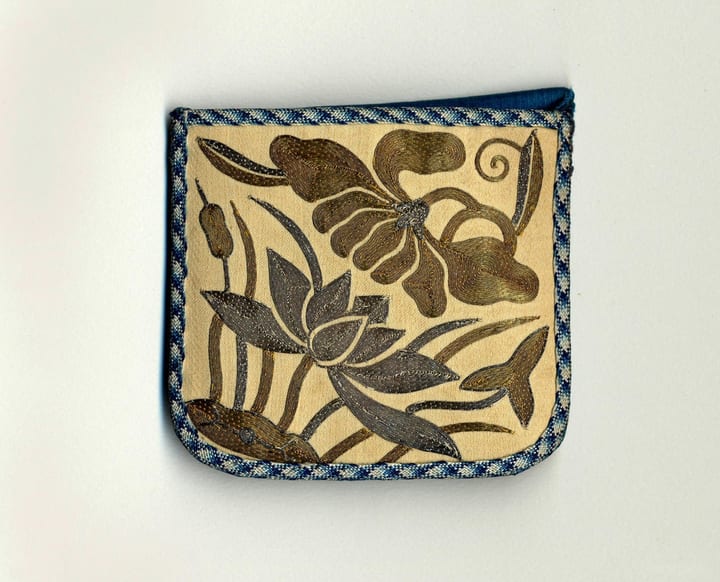
The photographed Sachet with lotus and chrysanthemum belongs to the Asian Art Museum, San Francisco, accession F2005.19.9. Its museum-supplied record gives Beijing, approximately 1875–1900, and gold and silver on silk. It describes this kind of bag as carrying fragrant powder and connects the floral designs with affection, harmonious marriage and longevity. Those meanings are attributed to the museum’s interpretation, rather than assigned to all floral bags. The object is a gift of John and Gladys Burke; the museum-supplied image is marked Public Domain.
A Qing date or Beijing attribution does not by itself identify a piece as an imperial court accessory. Nor should the photographed sachet be presented as a Qingyang workshop product. Historical scent containers could also differ sharply in construction: the National Palace Museum, Taipei, catalogues a Qing flower-basket sachet combining gilt filigree metalwork and kingfisher feather. Its materials distinguish it from the sewn textile forms discussed here.
A living craft, with object records kept distinct
China’s ICH authority documents a Qingyang workshop established in 2019, with training, design, production and display among its activities. This gives a specific example of continuing transmission without turning every modern scented pouch into the same heritage project.
The single photograph on this page shows a finished historical Beijing sachet. It does not show a current Qingyang maker, the bag’s interior or its manufacture. Reading it alongside the regional records makes both the shared idea of a scented container and the differences between individual traditions easier to understand.
Museum photographs and credits
Sachet with lotus and chrysanthemum, China; Beijing, approx. 1875–1900; gold and silver on silk. Asian Art Museum, Gift of John and Gladys Burke, F2005.19.9. Museum-supplied Google Arts & Culture asset marked Public Domain. Uncropped museum photograph of a historical finished sachet from Beijing.