A family name and a particular Shanghai history
Gu is a family name, rather than the name of one stitch. Shanghai Museum traces the tradition to the Gu household at Luxiang Garden in the late Ming period. The city’s heritage account locates the historic garden in the old Shanghai county town and associates the family with Songjiang prefectural history.
That historical setting should be distinguished from today’s administrative map. Songjiang is an important setting for present-day protection and teaching, but this does not place the original garden at every modern institution that teaches the craft. The Shanghai heritage listing identifies Gu embroidery as a national-level project recognized in 2006, within traditional fine arts.
What does painting embroidery involve?
Shanghai Museum’s account of its 2021 textile exhibition describes Gu embroiderers working with fine silk and needles while drawing on knowledge of painting. Subjects include figures, landscapes, flowers and birds. The relationship is more specific than choosing a pretty motif: color, line and the organization of the whole image must be reconsidered in thread.
Try following a leaf into a branch, or a bird’s body into its feathers. Changes of thread direction and coverage help build the visible image, while the ground contributes its own space. These are useful viewing questions, rather than a formula for identifying Gu embroidery. Regional attribution still needs a museum record or evidence about the maker.
Named makers brought different approaches
A Palace Museum lecture by researcher Zhang Qiong distinguishes women in successive generations of the Gu household. Its account associates Miao’s work with very fine strands and formats including small square pictures and sachets; Han Ximeng with pictorial albums as well as landscapes and figures; and a later Gu woman with screens and a broader commercial setting.
These differences prevent the tradition from becoming a single timeless style. Shanghai Museum separately catalogues Han Ximeng’s Embroidery of Flowers, Insects, and Fish as a late Ming silk work. Its 2007–08 Gu exhibition also included her Washing a Horse from the Palace Museum. These are documented historical examples, separate from the later Qing hanging photographed here.
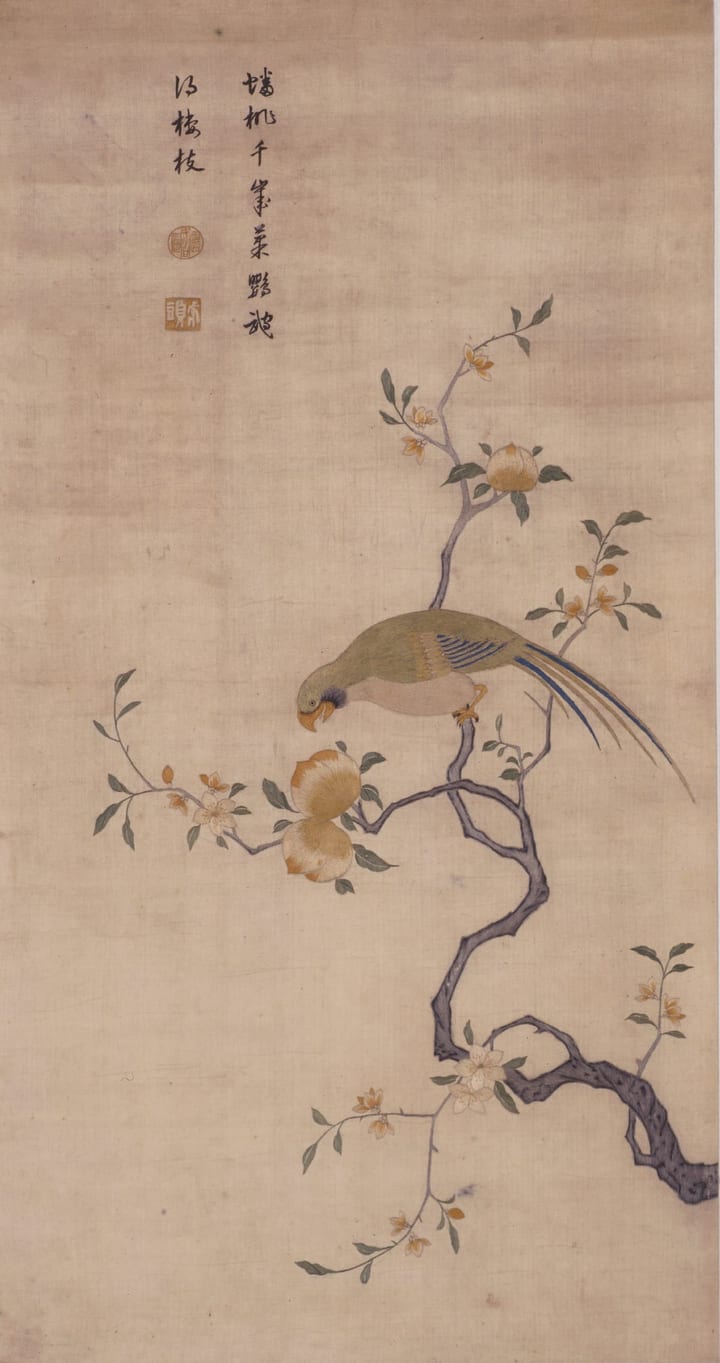
Read the parrot-and-peaches hanging closely
The photographed Shanghai Museum work is a Qing Gu-embroidery hanging from Shanghai. Its catalogue describes several stitch methods for the bird and plants, dazi zhen (打子针) for flower centers and gun zhen (滚针) for the bird’s eye. Ink strengthens parts of the branches and supplies moss dots.
This combination makes painting and stitch literal partners in one image. The picture is not an example of needlework imitating every visible mark. Its catalogue also identifies embroidered calligraphy and seal forms. The record supplies these distinctions; a reproduction alone would not reveal the technique of every small dark passage.
An inscription is part of the object, not a shortcut to its maker
The Qing hanging carries Luxiang Garden and tiger-head seal forms, according to the museum. Their presence belongs to its documented identity within Gu embroidery. It does not justify assigning the hanging to Han Ximeng: the catalogue identifies a later period and does not name her as its maker.
Shanghai Museum’s 2007–08 exhibition grouped Gu works through copied masterpieces, religious figures, flowers and birds, and narrative subjects. Paintings and calligraphy were shown alongside related embroideries. This helps explain why looking at the format, inscription and pictorial source can be as useful as naming a flower. Similar motifs alone do not establish authorship or a shared workshop.
A historical art continues through teaching
Shanghai’s culture and tourism authority reported in November 2024 on Gu embroidery studios in Songjiang. Its account describes embroiderers working at frames, experienced practitioners teaching younger makers, and outreach through schools and communities. It also records adult evening classes beginning in 2023. These are dated examples of transmission, rather than a current class-booking offer.
The same report recalls Dai Mingjiao teaching within a Gu embroidery group established in 1973, and a later training partnership led by Qian Yuefang in 2002. The craft’s continuity therefore includes institutions and apprentices as well as surviving pictures. Our Suzhou, Shu and embroidery-stitches guides offer neighboring contexts without treating their regional names as interchangeable with Gu.
Images and credits
Gu embroidery with a parrot and peaches, Qing dynasty, Shanghai Museum; maker unrecorded. Faithful reproduction via Wikimedia Commons, public domain (PD-Art). Full image retained.
