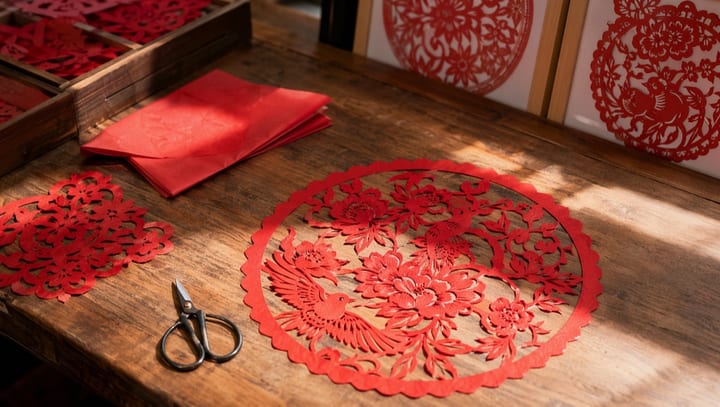
Illustrative Chinese paper-cutting worktable with red cut-paper designs, a paper stack, and scissors

Folk art and paper craft | 剪纸:折叠与徒手剪

Chinese Paper Cutting: Folded and Freehand Methods

Chinese paper cutting uses the paper that remains and the spaces removed to make an image. Folding can repeat a cut across several layers; freehand cutting can proceed without a drawn guide. These are different choices within jianzhi (剪纸), and they can be combined in the same work.

Chinese paper cutting: what folding changes

A fold brings parts of a sheet together. Cutting through the layers repeats the opening when the sheet is unfolded. One fold can produce a mirrored pair; further folds change the arrangement. The fold is part of the design.

The British Museum documents a paper flower from Cave 17 at Dunhuang. Its curator’s note describes square sheets folded twice, cut with scissors, opened, and assembled into a layered flower. This explains that object’s construction, not all Chinese paper cutting.

Freehand cutting can still use folded paper

Here, freehand means cutting without a pre-drawn outline. The paper need not stay flat. A 2025 Wuhan government account describes a no-draft flower lesson: the paper is folded first, shapes are cut directly, and unfolding reveals the repeated design.

“Folded versus freehand” therefore needs care. One describes preparation; the other describes the cutting guide. A work can be folded and freehand, folded with a drawn guide, or cut directly on an unfolded sheet.

Drawing and direct cutting have their own possibilities

An unfolded sheet lets the maker treat each area separately instead of repeating every cut. This can suit an uneven arrangement of figures, branches, or lettering. It is a practical design distinction, not a label for one whole regional tradition.

The China Paper Cutting Museum’s presentation of Yangzhou artist Zhang Muli shows drawing, developing details, then cutting. A drawn design is another working method, rather than a lesser version of freehand work. Scissors and engraving tools also offer different routes through paper.

Keep track of what must remain connected

For the exercise below, plan one connected shape. Remaining strips act as bridges. Removing a complete ring around a detail makes it fall out; cutting every bridge can separate the piece. Check what you intend to keep, as well as what you remove.

This exercise explores structure. It is not a reproduction of the Dunhuang flower or a lesson representing every regional practice.

A method belongs to a maker and an occasion

UNESCO describes a practice found across China, with varied techniques, motifs, and purposes. Yangzhou’s official record includes embroidery patterns. Smithsonian teaching materials connect paper cutting with household decoration, celebrations, and makers’ expression.

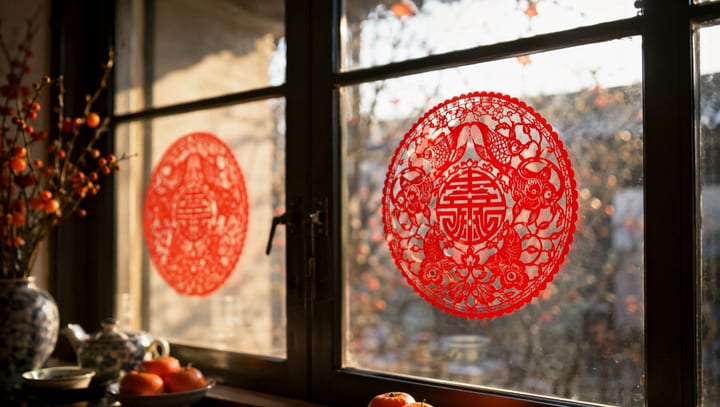
The images are project-created illustrations of a paper-cutting worktable, hands cutting, and finished designs on a window. They do not document the specific folding exercise below and are not authenticated historic paper cuts or works by a named artist.
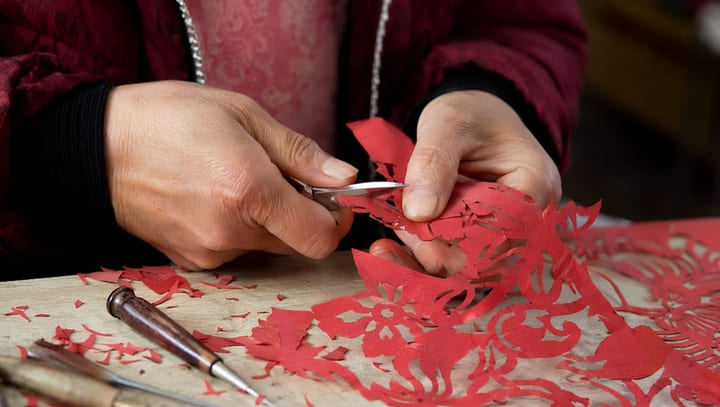
Illustrative hands cutting a red paper design with scissors

Chinese Paper Cutting: Folded and Freehand Methods in practice

Technique and purpose belong together. A maker may choose a motif for a household occasion, a local tradition, or an individual subject; its meaning needs that context.

Illustrative red paper-cut designs displayed on a window

Chinese Paper Cutting: Folded and Freehand Methods in practice

Technique and purpose belong together. A maker may choose a motif for a household occasion, a local tradition, or an individual subject; its meaning needs that context.

How Chinese Paper Cutting: Folded and Freehand Methods is practiced

  1. Choose one sheet and a simple goalUse a sheet that your scissors can cut comfortably. For a first exercise, aim for one connected symmetrical shape with a few broad openings.
  2. Fold once and locate the joined edgeFold the sheet in half. Keep track of the fold: cuts through both layers will repeat when opened. Leave some paper joining the two sides.
  3. Plan the openingsSketch a few simple shapes, or try direct cutting without a drawing. Leave broad strips between openings so the remaining paper stays connected.
  4. Cut a little, then open and checkMake small cuts from an accessible edge, stopping before the connecting strips. Unfold gently and see how one cut becomes a paired opening.
  5. Refine the resultAdd another opening only where enough paper remains. You can continue through a fold for repetition or work on the open sheet for a local change.

Place, craft, and cultural meaning

Technique and purpose belong together. A maker may choose a motif for a household occasion, a local tradition, or an individual subject; its meaning needs that context.

Chinese Name剪纸:折叠与徒手剪
Region or OriginChina; examples here come from a Dunhuang museum object, Wuhan in Hubei, and Yangzhou in Jiangsu.
CategoryFolk art and paper craft
MaterialsPaper suited to the design; plain or colored sheets. Red is common in festive examples, but it is not the only color used.
ToolsScissors; engraving knives for other methods; an optional pencil for planning. The beginner exercise below uses scissors.
UsesHome decoration, celebrations, and personal expression. Yangzhou paper cutting has also supplied patterns for embroidery.

Common questions

Is all Chinese paper cutting folded?
No. Folding is one way to organize repeated shapes. Makers also work from drawn designs and use direct cutting or engraving methods.

Does freehand mean cutting flat paper?
Here it means working without a pre-drawn guide. Wuhan’s documented flower example combines no-draft cutting with folded paper.

Why did part of my design fall out?
In a connected-paper exercise, a detail needs a paper bridge to the rest. A closed cut around it removes every connection, allowing it to separate.

Sources and further reading