What can be the same, and what can change?
A Jiangxi Institute of Fashion Technology Clothing Museum teaching article distinguishes ordinary double-sided work, different-color work and three-difference work within Su embroidery. Its explanation of the last category names differences in color, form and needlework. These are specific distinctions: changing a background color does not automatically demonstrate that the two faces carry unrelated subjects.
The Smithsonian’s Suzhou embroidery teaching resource describes images that can be the same or different when seen from either side. Taken together, these accounts offer useful questions for looking: do the outlines correspond, do the colors change, and is a different picture involved? A label should state the particular achievement rather than treating every reversible textile as the most elaborate category.
Why thread control matters on both faces
The Clothing Museum account explains the difficulty through the stitches and silk strands on both faces. In different-color work, colors must remain distinct across the two surfaces. Exposed stitch traces also require attention. The same needle movement therefore has consequences for a surface the viewer may not currently be seeing.
Smithsonian teaching describes the splitting of silk into extremely fine strands in Suzhou embroidery. That helps explain the scale of thread decisions, but fine thread alone does not prove that a piece is double-sided. Density, direction and color should be considered together with access to both faces. The separate Chinese embroidery stitches guide develops those general ways of looking.
An eighteenth-century hanging with two finished faces
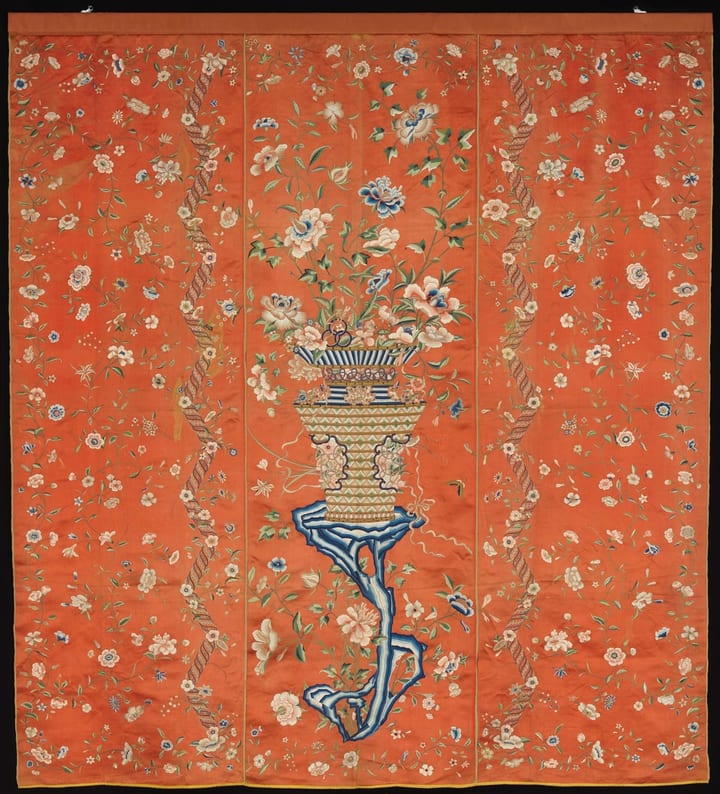
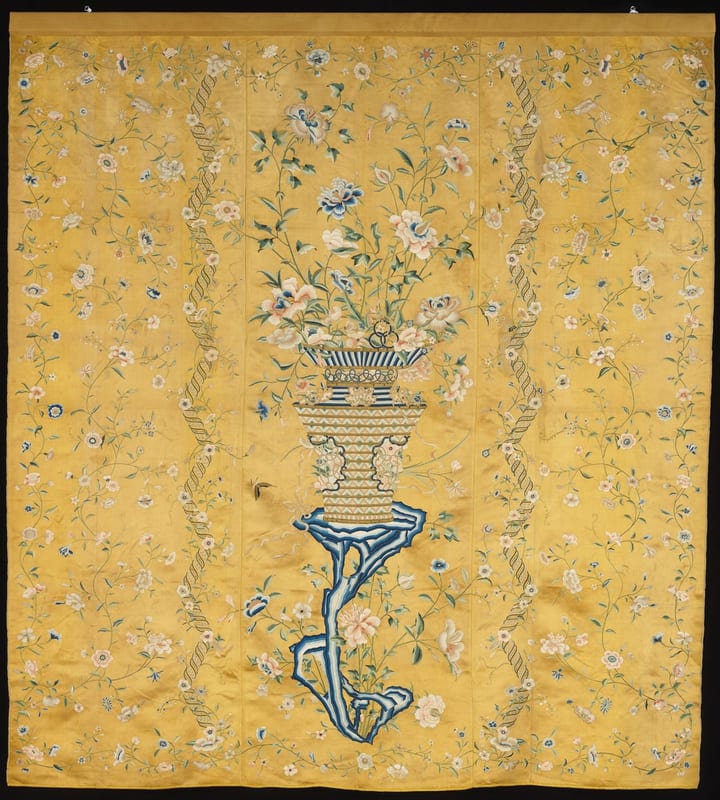
The Metropolitan Museum of Art’s Double-sided Hanging, accession 2011.112, provides a historical example. It is catalogued as Chinese work for the European market, from the second half of the eighteenth century. Its medium is silk embroidery on silk satin. The museum describes both sides as carefully finished.
The Met identifies yellow as the front because yellow selvages are visible on the red side. It suggests that the textile may have served as a bed curtain, with the red face turned inward. This proposed use remains a possibility. The record does not attribute the hanging to Suzhou or identify it as a contemporary three-difference embroidery.
Compare the two museum photographs
The paired photographs on this page show opposite faces of that same hanging. Start with the flower basket, then follow the branches and the garden rock beneath it. Match features across the two views before judging what changed. The red and yellow fields are immediately visible, while smaller details reward a slower comparison.
These photographs document two finished faces; they do not show an embroiderer making the work. They also cannot, by themselves, establish every hidden thread path or the complete construction of the ground. Keeping the object record beside the images lets us appreciate the surface without turning a photograph into unsupported technical evidence.
Double-sided embroidery also appears in Shu work
The China National Silk Museum catalogues a modern silk work titled Peonies and Koi as Shu embroidery, double-sided and different-colored. This is a concrete reason to avoid equating the broad term double-sided embroidery exclusively with Suzhou. The museum’s regional identification belongs to that object; the term describes another aspect of it.
The Suzhou and Shu guides explain their respective regional contexts, while the Shu-versus-Su comparison considers how those identities differ. Here the focus is narrower: the relationship between two viewing faces. A regional name and a description of two-sided workmanship answer different questions, and both may be needed in an accurate caption.
From the embroidery frame to a viewing arrangement
The Suzhou intangible-heritage account places embroidery within a sequence that includes preparing a design, organizing threads, working on a frame and mounting the completed textile. For a double-sided work, the important question running through those stages is how the second face will be seen. A display that conceals it limits what a visitor can compare.
When reading a museum record or a maker’s explanation, look for paired views and a precise account of what differs. Record material, date and regional attribution separately from visible color and composition. This gives the work a clearer identity than a claim of identical backs or miraculous invisible stitches applied to every example.
Images and credits
Double-sided Hanging, yellow face, identified as the front by the museum. China, for the European market, second half of the eighteenth century; silk embroidery on silk satin. The Metropolitan Museum of Art, 2011.112. Public domain/CC0. The two photographs show the same textile; the museum does not assign it to Suzhou or a modern three-difference classification. Full photograph, resized for display.
Double-sided Hanging, red face. China, for the European market, second half of the eighteenth century; silk embroidery on silk satin. The Metropolitan Museum of Art, 2011.112. Public domain/CC0. The two photographs show the same textile; the museum does not assign it to Suzhou or a modern three-difference classification. Full photograph, resized for display.