Batik vs tie-dye: wax protection or gathered cloth?
Both are resist-dyeing methods: the maker creates areas that resist color during dyeing. In wax-resist work, wax marks protect parts of the cloth. In tie-dye, stitching, gathering, and binding restrict dye access to selected areas. The resist is prepared before the pattern is revealed.
This distinction is more useful than calling one cloth pictorial and the other geometric. Either tradition can include natural subjects and repeated shapes. The question is how the design was formed.
Miao batik draws its resist onto the surface
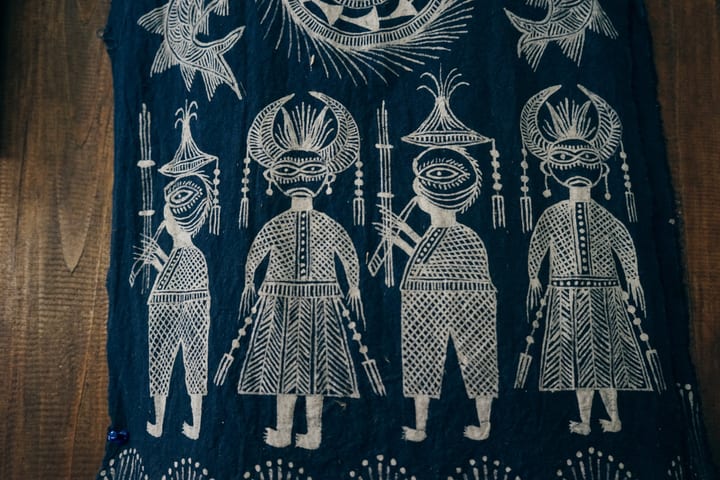
The official Danzhai record describes wax dotted or drawn onto prepared cloth using a copper wax knife. The cloth is dyed, rinsed, and heated in water to remove the wax. The protected marks become visible against the dyed areas.
This is a process description, not a single recipe for every Miao community. The separate Zhijin heritage record specifies both paraffin and beeswax among its wax materials. A label saying batik therefore does not, by itself, establish that only beeswax was used.
Bai tie-dye builds a resist through needlework
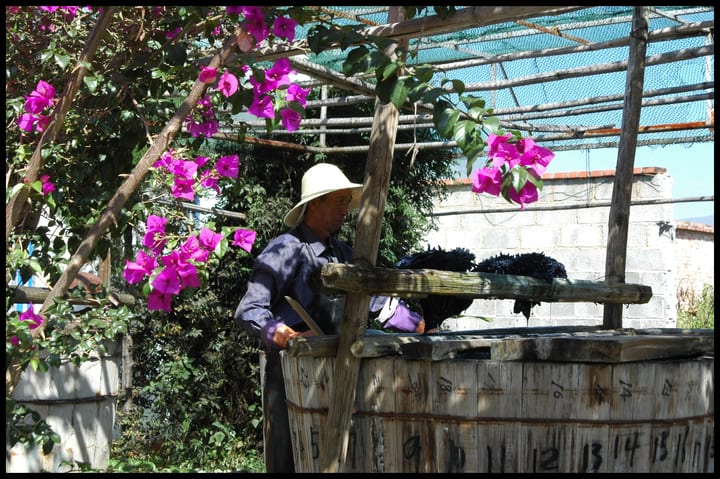
The Yunnan heritage center describes cloth stitched tightly into gathered bundles before dyeing. Its account includes folding, winding, binding, and other ways of gathering cloth. After dyeing, the threads are removed and the fabric opens to reveal the pattern.
Needle and thread are important here even though the finished object need not carry embroidery. Their work is temporary: they shape the resist rather than remain as a colored picture on the surface. Bai tie-dye is consequently more varied than a simple knot tied in a corner.
Shared blue and white does not mean the same method
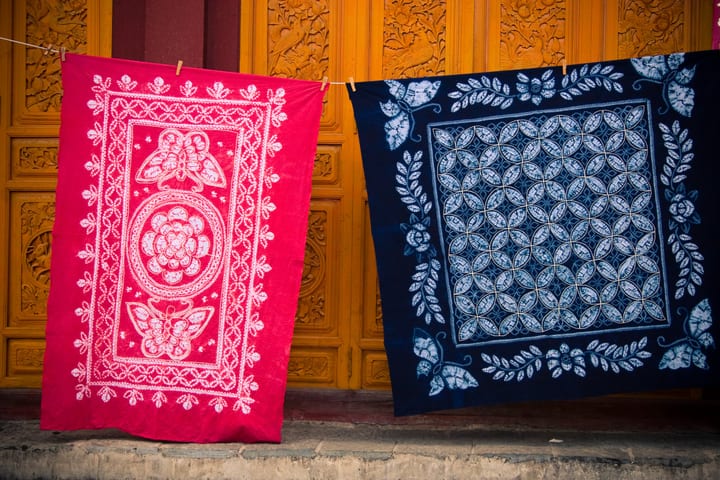
Plant indigo appears in the official accounts of both traditions. Color is one material choice; wax and binding are ways of controlling where color reaches the cloth. A blue ground and pale flowers cannot tell you which resist was used.
Nor does blue prove a particular dye source. A historical account of Zhoucheng records both plant-based and manufactured dyes in local production. Ask about the dye used for the particular textile rather than treating every blue cloth as naturally dyed.
Read edges, then ask for process evidence
A close look can suggest useful questions. Are pale areas arranged like drawn lines, or do they follow repeated gathered shapes? The Zhoucheng account describes shaded boundaries caused by differences in tying methods and tightness. Such transitions are part of the pattern-making process.
Use these observations to begin a conversation, not to authenticate an object from a photograph. Ask the maker or museum for the resist method, materials, place, and date. A familiar motif can travel between objects and techniques.
Keep the community names attached
The national records locate the Miao entry in Danzhai, Guizhou, and the Bai entry in Dali, Yunnan. These examples do not make all batik Miao or all tie-dye Bai. Technique names describe broad methods; community names give the textile a more specific context.
The records connect the crafts with clothing, household use, and transmitted knowledge. Learning about the maker and the intended use adds information that a pattern comparison alone cannot supply. Our Miao batik guide below develops that tradition's identity in more detail.
Photographs and credits
Photographs show Miao batik cloth in Guizhou (JL Cogburn, 2016, CC BY-SA 2.0), Bai tie-dye work at a Dali dye vat (Richard Weil, 2008, CC BY-SA 2.0), and Bai tie-dyed cloths in Dali Old Town (Alexander Savin, 2009, CC BY 2.0). File credits and license links appear below. Photograph locations do not establish where each cloth was made.
All three photographs are resized and JPEG-compressed for web display, without cropping. The JL Cogburn and Richard Weil derivatives remain under CC BY-SA 2.0; the Alexander Savin derivative remains under CC BY 2.0. No photographer endorsement is implied.