Chinese bamboo carving: stem, skin, and root
A bamboo tube already offers the cavity of a brush holder. Its surface layers and fibrous wall affect the image that can be made. Bamboo root offers a different starting point: an irregular mass for shaping a figure or group in three dimensions.
The Met’s nineteenth-century Chess playing in an immortal realm, accession 2015.500.6.1, is explicitly catalogued as bamboo-root carving. It provides a useful counterpart to cylindrical brush holders. The object’s material is established by the museum record, rather than inferred from its brown colour.
Shallow relief, deep relief, and openwork
Relief describes an image left above a lower background. In shallow relief, small changes in level can carry a distant landscape or fine line. Deeper carving makes greater use of the wall’s thickness. Openwork cuts through the material to create openings, while carving in the round develops a form that can be viewed from several directions. These approaches can coexist, but every object need not use them all.
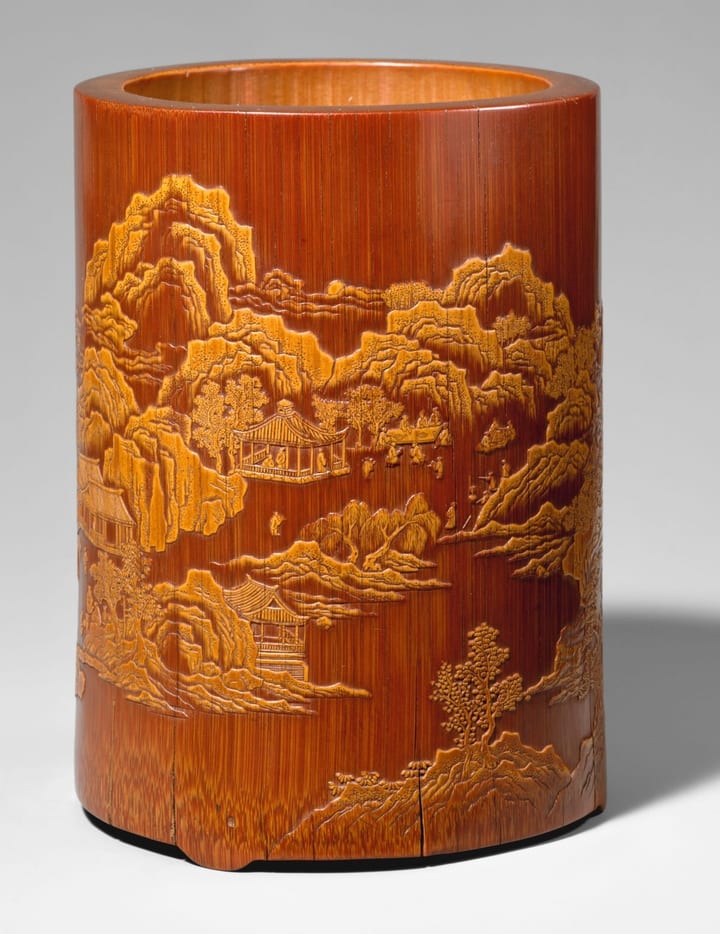
Liuqing, commonly translated as retained-green carving, keeps selected areas of the outer skin as part of the design. The term names a working approach, not a promise that an aged object will look green. By contrast, preparation for other forms of carving may remove the skin. Choosing what to retain is therefore part of designing the image.
Two brush holders inspired by the same writing
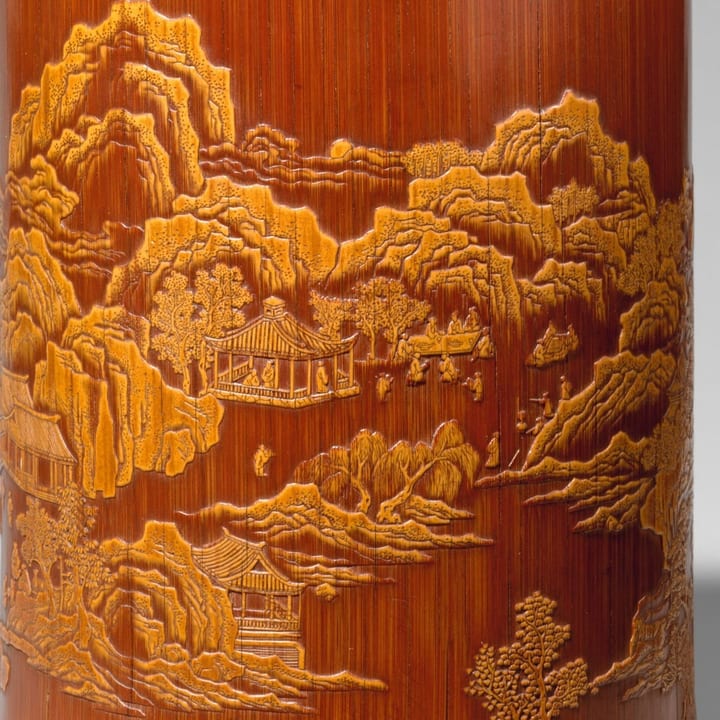
Zhang Xihuang’s early seventeenth-century brush holder in The Met, accession 1994.208, represents a scene connected with Ouyang Xiu’s Ode to the Pavilion of the Inebriated Old Man. The museum describes the lighter bamboo skin standing in relief against the darker fibrous stalk. Here the shallow surface contrast helps the landscape emerge without turning the whole wall into deep sculpture.
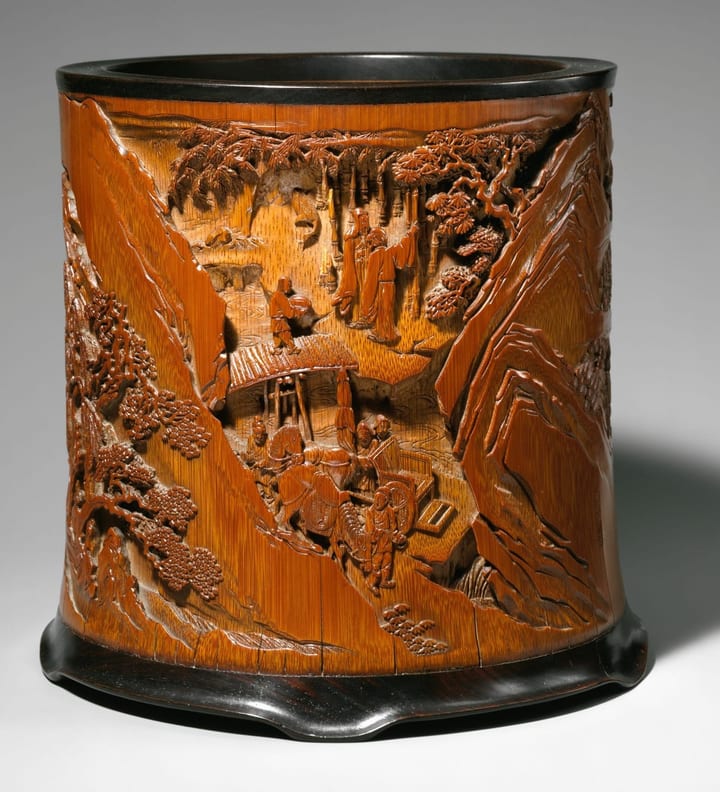
Gu Jue’s late seventeenth-century holder, accession 1994.382, draws on the same literary subject but develops a different treatment of the bamboo’s layers and textures. Its museum record specifies bamboo with a hardwood rim and base: those components should not be described as carved bamboo. Comparing the two objects shows how one text could prompt distinct material and pictorial decisions.
A regional craft connected with the scholar’s desk
Jiading, now in Shanghai, is one important centre of bamboo carving. Its official heritage record lists shallow and deep relief, openwork, and sculpture in the round, alongside objects for the desk and small ornaments. This regional account should not be treated as the origin story of every bamboo carving practice in China.
The Met’s study of Chinese decorative arts connects bamboo carving with painting, poetry, and the scholarly studio, including important work in Jiading and Nanjing. A pot holding brushes could also invite slow reading of a landscape or literary reference. Its practical use and visual subject belong to the same object.
Compare Chinese jade carving for abrasive working, and Four Treasures of the Study for writing equipment. Porcelain-body bamboo weaving interlaces strips around ceramics, a separate process. Museum photographs show finished objects, not demonstrations of their original manufacture.
Museum photographs and credits
Gu Jue, brush holder with a scene of “Ode to the Pavilion of the Inebriated Old Man,” late 17th century. Bamboo with hardwood rim and base. The Met, 1994.382; public domain/CC0, cropped and resized.
Zhang Xihuang, brush holder with a scene of “Ode to the Pavilion of the Inebriated Old Man,” early 17th century. The Met explains that the lighter bamboo skin is cut in relief against the darker stalk. The Met, 1994.208; public domain/CC0, cropped and resized.
Detail crop from the same photograph of Zhang Xihuang’s 1994.208 brush holder shown above. The lighter skin and darker stalk distinguish the retained-skin carving. The Met; public domain/CC0, cropped, with no enlargement.