How Chinese hardwood furniture joinery carries a load
A tenon is a projecting part shaped to enter a receiving opening, the mortise. This provides an interlocking connection rather than relying only on two flat ends meeting. The joint is part of a larger assembly: the position of the leg, the surrounding rails and the surface above it all matter.
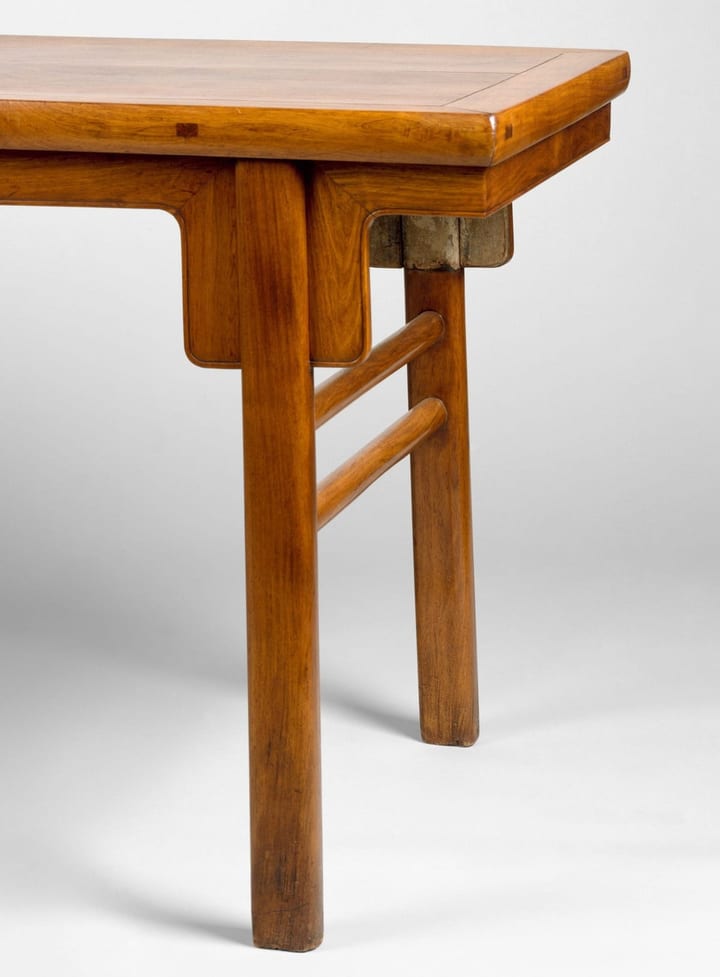
Shanghai Museum explains this particularly clearly through a Ming painting table with jiatousun, a connection that grips the apron. The leg’s upper end is cut with a tenon and a slot; it enters the long tabletop frame member while gripping the apron. The museum describes these elements as working together to direct weight from the tabletop into the legs. The carved apron below a top therefore deserves attention as a connected member, alongside its decorative outline.
This is furniture-scale joinery. Architectural timber frames also connect wooden members, but studying a chair or table requires following its own seat or top, rails, legs and stretchers, rather than treating it as a miniature building.
Why a frame and its panel do different jobs
A broad tabletop need not be one thick slab spanning directly between four legs. The Palace Museum’s Ming huanghuali square table, accession 故00206157, has a top made by assembling a frame, cutting grooves and fitting a panel into them. The museum defines this panel-fitting method explicitly: the board is seated in prepared channels.
The distinction also helps explain wood movement. Getty’s furniture conservation research describes how wide boards expand and contract across their width as relative humidity changes. In a floating frame-and-panel arrangement, a loosely fitted centre can move while the surrounding frame defines the assembly’s outline. This is a general construction principle; a photograph alone cannot establish the clearances or fastening of an individual Chinese tabletop. Nor does every Chinese furniture surface use the same construction.
A curved chair back can be assembled from several pieces
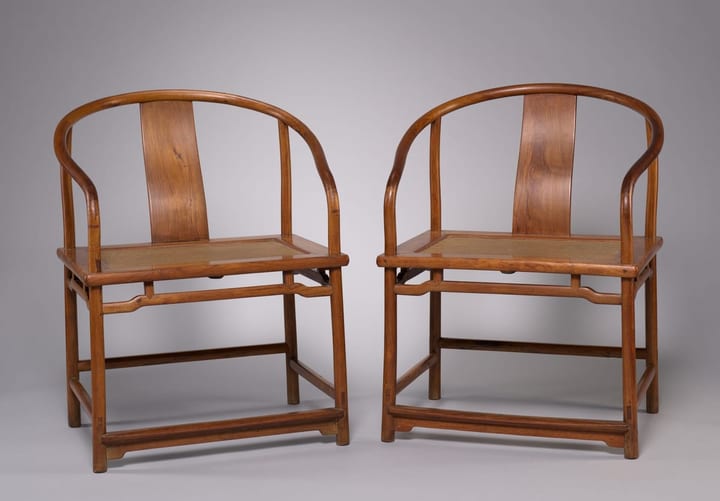
The Cleveland Museum of Art dates its Pair of Roundback Armchairs: Lohan Type to the 1600–1700s and catalogues the material as rosewood, or huanghuali. Its curatorial account places the chairs in Jiangsu and describes their backs as seven wooden pieces joined and secured with an inserted wooden pin. The apparently continuous horseshoe outline is therefore an assembled form.
The museum suggests that ownership in pairs points to formal settings for important guests or senior family members. That interpretation connects construction with social use without making every roundback chair a ceremonial seat.
Tables, cabinets and the limits of a finished photograph
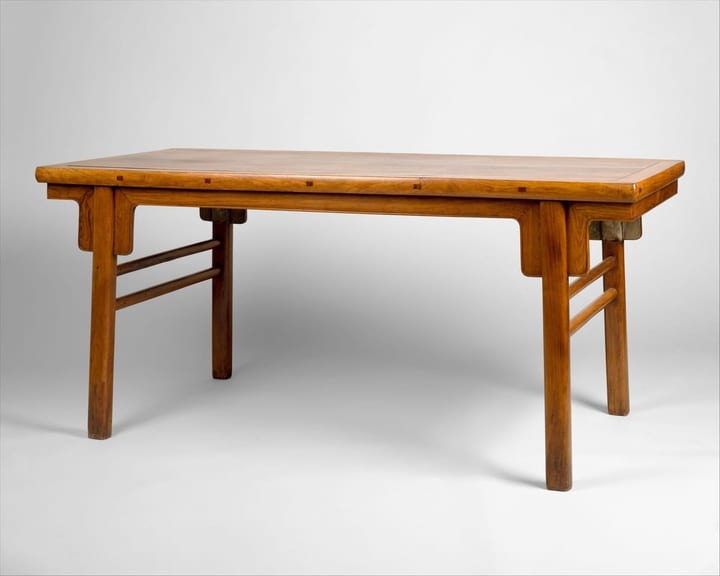
The Met’s late sixteenth- to early seventeenth-century Painting table, 1996.338, offers a different arrangement to examine: a long surface, apron, upright legs and paired side stretchers. Its huanghuali identification comes from the collection record. Colour and grain in an online photograph are insufficient grounds for assigning a wood species or declaring another piece to be huanghuali or zitan.
Cabinets add a different practical requirement. The Met’s sixteenth-century Wardrobe, 1976.193.8a–o, provided lower storage for clothing and bedding and an upper compartment for hats. The catalogue records both wood and metal fittings. Joinery thus coexisted with other materials; the term does not mean that every historical piece was entirely free of hardware.
The photographs here show finished historical chairs and a table. The table detail is cropped from the same museum photograph as its wider view. They illustrate visible exterior members, without exposing the internal joints or recording manufacture.
Furniture in the setting of the study
A painting table provides a useful bridge to the Four Treasures of the Study: it supplies a working surface, while brush, ink, paper and inkstone perform different tasks upon it. Bamboo carving belongs to this room-scale context through desk objects such as brush pots. Comparing those objects with furniture distinguishes surface carving and small containers from the fitted framework that supports a larger piece.
Museum photographs and credits
Pair of Roundback Armchairs: Lohan Type, China, 1600–1700s; rosewood (huanghuali). Cleveland Museum of Art, The Norweb Collection, 1955.40. Public domain/CC0. Complete museum photograph, proportionally resized. The finished chairs show their exterior members; the curatorial record supplies the description of the concealed connections.
Painting table, China, late 16th–early 17th century; huanghuali. The Metropolitan Museum of Art, 1996.338; Purchase, The Vincent Astor Foundation and The Dillon Fund Gifts, 1996. Public domain/CC0. Complete photograph DT4046, proportionally resized; the following detail uses this same photograph.
Detail cropped from the same DT4046 photograph of The Met’s 1996.338 painting table. The visible top edge, apron, legs and side stretchers show exterior relationships; hidden joint interiors remain unseen. The Metropolitan Museum of Art; Purchase, The Vincent Astor Foundation and The Dillon Fund Gifts, 1996. Public domain/CC0.