Chinese boxwood carving and the Yueqing tradition
Huangyangmu names the wood; Yueqing names a place and a documented carving tradition. The national intangible-heritage register identifies Yueqing boxwood carving in Zhejiang as an ornamental art particularly associated with sculpture in the round. The project entered the first national list in 2006. Its regional identity does not make every Chinese boxwood object a Yueqing product.
The wood’s fine texture gives a viewer reason to look closely at small transitions: a face set within hair, a hand emerging from a sleeve, or a figure separated from its background. Begin with the overall silhouette, then move to the surfaces that make the subject readable. A compact sculpture can reward both a distant view of its pose and close attention to individual cuts.
A figure model, a root and a split surface
The official Yueqing account distinguishes three approaches. Traditional figural work may begin with a clay composition and a suitable piece of wood. Root carving responds to a root’s existing form and need not begin with a clay model. Split carving develops an idea from the exposed natural texture of split wood, with a different emphasis from finely finished figures.
This distinction explains why a single rigid sequence would misrepresent the craft. For model-based work, ChinaCulture describes sketching and clay modeling before selection and carving, followed by finishing and arranging a base. It also notes that experienced makers may work directly in wood. A model is one method of resolving the form, rather than a test that every boxwood sculpture must pass.
A late Ming Guanyin: making drapery legible
The Palace Museum’s Boxwood Guanyin, accession 新00044652, is dated to the late Ming dynasty and stands 23.5 centimeters high. The catalogue describes a slightly turning body, bare feet, a raised hairstyle and a scripture scroll held in the right hand. The left hand gathers a corner of the garment. These small actions establish a poised figure rather than a front-facing column.
The museum particularly praises the treatment of the clothing, whose folds suggest the fabric’s weight and drape. Follow a fold from the torso toward the lower body, then consider how the quieter face and more elaborate clothing work together. The sculpture demonstrates a specific solution to representing a clothed body in wood; its catalogue does not identify it as the product of a Yueqing workshop.
A Qing ruyi shaped as a fungus
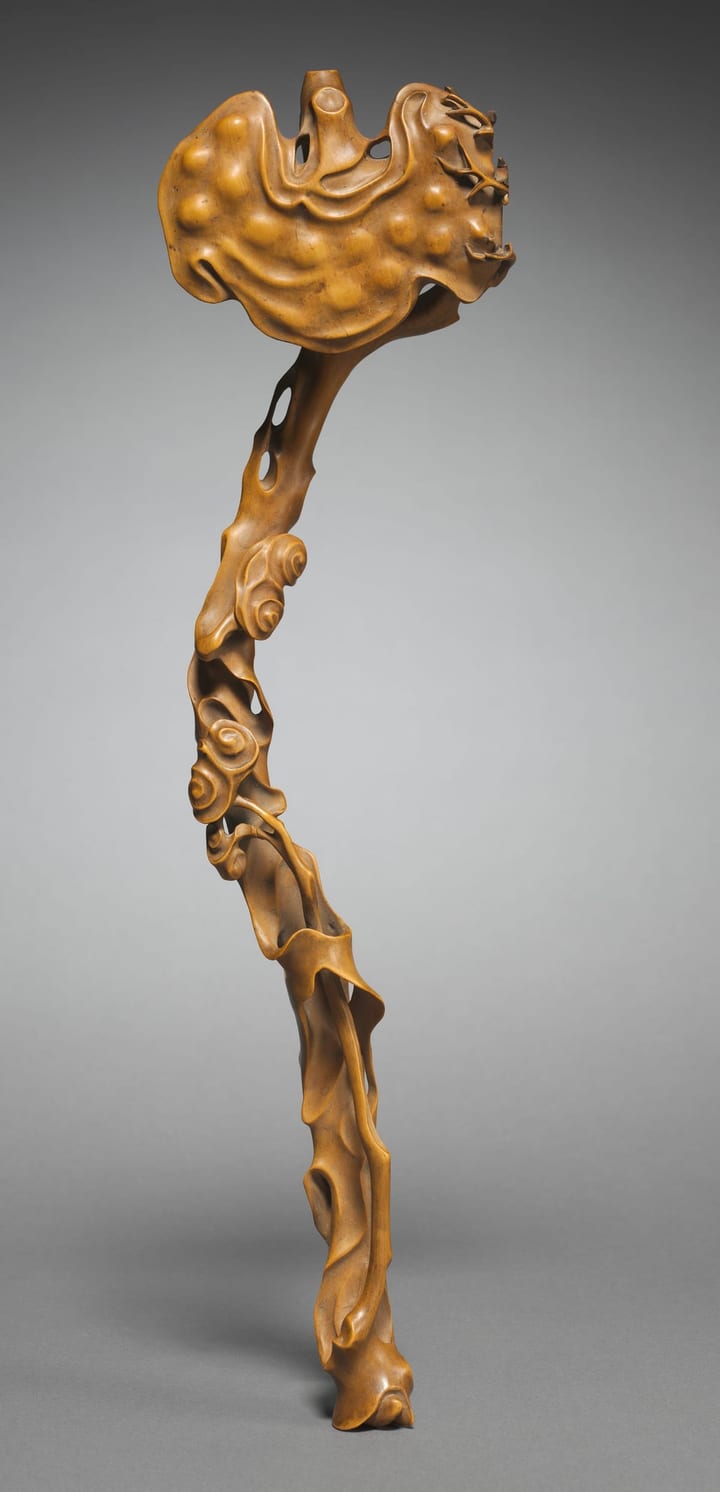
Cleveland Museum of Art’s Scepter in the Shape of a Ruyi Fungus, accession 1970.155, is a Chinese Qing work dated to the 1700s. The recorded medium is carved boxwood, and its overall measurement is 38.1 centimeters. It expands the guide beyond human figures: the object’s identity depends on a winding handle and a fungus-shaped head.
The museum connects ruyi with wishes being fulfilled and describes the head as an emblem of immortality. It also places such scepters among objects collected by Chinese literati. Read the long outline before the smaller details, following the movement from handle to head. The subject transforms a plant-like form into an object carrying a social and symbolic purpose.
He Xiangu and the boundary between components
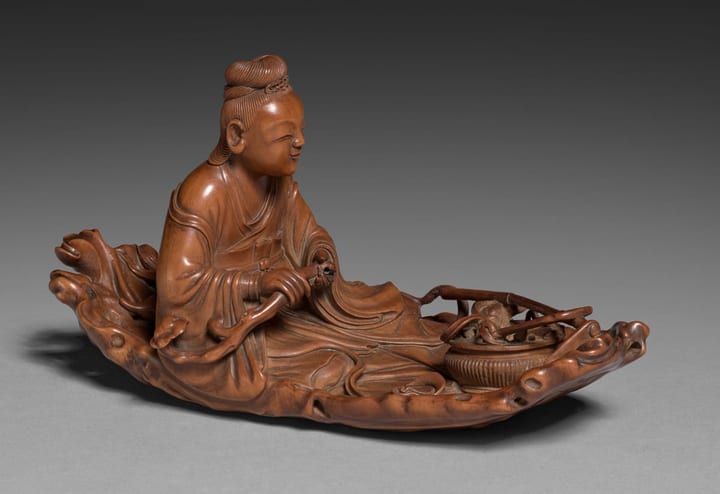
Cleveland’s Figure of Daoist Immortal He Xiangu, accession 1976.60.a, is another Chinese Qing work of the 1700s, catalogued in boxwood. The curatorial description places her in a gnarled wooden raft, holding a lingzhi branch like an oar. A basket in front contains objects associated with Daoist immortality. Her seated position and the raft create a different composition from the standing Guanyin.
The museum also describes green-tinted ivory waves associated with the sculpture. Those waves are a separate material, and they are not shown in the photograph used here. The pictured figure and raft should therefore be read as part of the catalogued ensemble, without calling its every component boxwood. Compare the handling of drapery, posture and surrounding forms across the two figures.
Placing boxwood beside other carving guides
The Dongyang woodcarving guide explores a separate regional tradition. Keeping that place-name distinct from the material term boxwood helps make comparisons precise. The bamboo-carving guide follows another plant material through documented objects, while the coconut-shell guide considers a curved shell and assembled vessels. Together, these guides show why material, region and object type each deserve attention when describing a carved work.
Museum photographs and credits
Figure of Daoist Immortal He Xiangu, China, 1700s. Boxwood figure and raft; the museum’s associated ivory waves are not shown in this photograph. Cleveland Museum of Art, 1976.60.a. CC0; cropped and resized.
Scepter in the Shape of a Ruyi Fungus, China, 1700s. Carved boxwood. Cleveland Museum of Art, 1970.155; Cornelia Blakemore Warner Fund. CC0; cropped and JPEG-optimized.