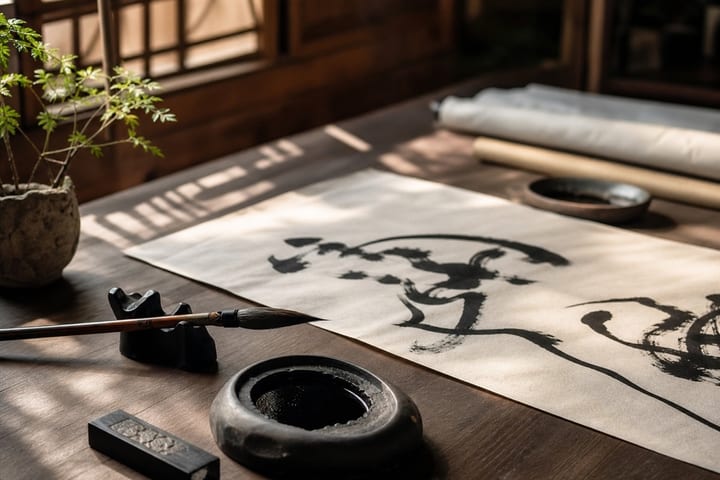
What are the Four Treasures of the Study?
The phrase names a set of working materials, not four particular museum objects. The Asian Art Museum’s calligraphy introduction identifies the brush, paper, inkstick, and inkstone as the essential implements. Their value lies partly in how they work together.
An inkstick and an inkstone are separate objects. The solid stick provides the ink material; the stone supplies a surface on which it can be ground with water. Confusing the two makes the preparation of brush ink harder to understand.
The brush: a point that can change its width
A calligraphy brush has a flexible hair tip. It can make a fine line or open into a broader mark. The museum’s teaching guide describes different brush sizes and hair combinations, so a brush is better understood as a responsive tool than as a pen with a fixed-width point.
When looking at a sheet, follow where a stroke narrows or expands. This provides a useful question for a teacher or demonstrator: how did the brush movement contribute to that change? It is a way to observe the work, rather than a rule for identifying every script.
Ink and inkstone: preparation before the first stroke
Traditional solid ink is made from soot mixed with a binder. Grinding an inkstick with water on an inkstone produces liquid ink. The Metropolitan Museum explains that the amount of water and grinding affect the density of the resulting ink.
The inkstone is therefore a working surface as well as an object that can be carved and collected. The official Huizhou inkmaking record also describes differences in soot preparation, glue, and workshop methods. An inkstick carries manufacturing knowledge before a writer begins to use it.
Paper: a material with its own craft history
Xuan paper is one important paper tradition associated with Chinese brush arts. The official China ICH overview locates its craft in Jing County, Anhui, and identifies blue sandalwood bark and rice straw as principal materials. It describes fiber preparation, pulping, sheet forming, drying, and cutting.
This is why paper deserves attention alongside the brush. Learning the name, maker, and material of a sheet is more informative than treating every pale sheet in a writing set as the same product.
A group of tools connected to several living crafts
The Four Treasures is a convenient name for the working set; it should not be presented as one single UNESCO inscription. The individual practices have their own histories and records. The China ICH overview records Xuan papermaking’s UNESCO inscription in 2009; the Huizhou inkmaking page records its national listing in 2006.
Our illustration is a project-created view of a writing desk, not a photograph of an authenticated historic writing set. Use it to locate the four materials, then explore the calligraphy, paper, inkstick, brush, and inkstone guides linked below.