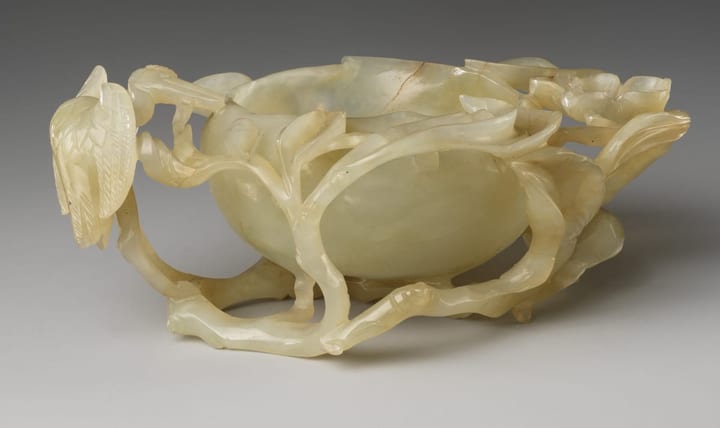
Chinese jade brush washer shaped as half a peach, with a waterbird handle, curved branches and leaves

Traditional craft | 玉雕(yùdiāo)

Chinese Jade Carving: Abrasives, Tools, and Forms

Chinese jade carving shapes hard stone through controlled abrasion: sawing, grinding, drilling, and polishing. The word carving can suggest a knife slicing a soft material, but jade working depends on a different relationship between tool, abrasive, and stone. A pierced disk and a hollow brush washer reveal very different decisions, even when a museum identifies both as nephrite.

How Chinese jade carving removes stone

The abrasive is central to the process. The British Museum describes sands worked against jade with carriers that could include wood, bamboo, or cord. A tool need not itself be harder than the stone when it carries particles that do the grinding. This helps explain why a soft polishing wheel can belong to a hard-stone workshop.

The Met preserves a twentieth-century polishing wheel made from dried gourd peel, accession 1981.296.27. Its description explains that fine abrasive mixed with water was spread on such wheels before they were mounted on a rotating shaft. Foot treadles supplied motion while the worker held and adjusted the jade with both hands. This is evidence for one documented tool arrangement, not a reconstruction of every earlier workshop.

Jade is a material category, not a single green stone

Nephrite and jadeite both appear in Chinese collections, and neither name should be assigned by colour alone. The Met identifies its eighteenth-century peach-shaped brush washer as jade, specifically nephrite; its eighteenth-century water receptacle, accession 02.18.355, is catalogued as jadeite. Those identifications belong to those objects. They do not make every similar-looking vessel the same material.

The shape and colour distribution of a rough piece also affect design. Qiaose describes an approach that incorporates differing natural colours into the image. It is one option among many, rather than a rule that every carving must display contrasting colours or retain its outer surface.

Two museum objects, two different problems

The Met’s annular disk, or bi, accession 17.118.43, is attributed to Liangzhu culture and dated to the middle of the third millennium BCE. Its record identifies nephrite. The plain ring asks us to notice proportion, the central opening, and the continuous worked surfaces. The museum cautiously suggests ritual use or a role in displaying status; the exact purpose of this individual disk should not be presented as settled.

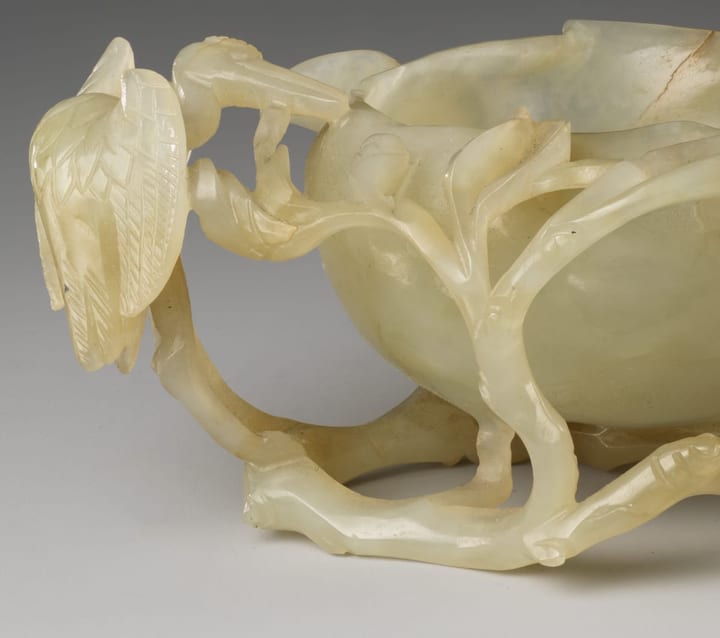
The eighteenth-century brush washer, accession 65.86.181a, b, takes the form of half a peach supported by branches and leaves, with a waterbird forming its handle. Its shallow cavity makes the stone into a vessel while the surrounding forms make it sculpture. The Met connects its design with fifteenth-century metalwork. A familiar desk function could therefore support imaginative borrowing between materials.

A living craft with changing equipment

Research published by GIA documents contemporary carving centres and both manually controlled powered tools and computer-controlled engraving. Equipment changes do not make all works follow one sequence or design logic. The maker still has to relate a proposed form to the available material, and tool transitions occurred gradually rather than neatly at the boundary of a dynasty.

Compare the companion guide to Chinese bamboo carving for a material worked directly with edged tools. The Four Treasures of the Study guide places vessels such as brush washers beside the brush, ink, paper, and inkstone. Museum photographs show finished objects; they do not document the working sequence of the particular historical maker.

Museum photographs and credits

Brush washer, China, 18th century; catalogued by The Met as jade (nephrite). A waterbird forms the handle of the peach-shaped vessel. The Met, 65.86.181a, b; public domain/CC0, cropped and resized.

Annular disk (bi), China, Liangzhu culture, mid-3rd millennium BCE; catalogued as jade (nephrite). The Met, 17.118.43; public domain/CC0, resized. This finished object provides historical and material context, not a photograph of drilling.

Detail crop from the same photograph of The Met’s 65.86.181a, b brush washer shown above. The waterbird handle and surrounding branches show its carved form. Public domain/CC0; cropped and resized.
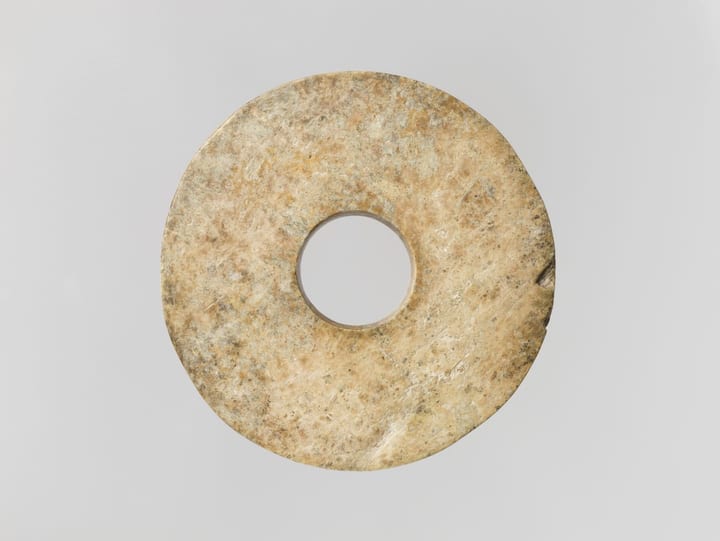
Flat Chinese annular jade disk with a central circular opening and a mottled pale-brown surface

Chinese Jade Carving: Abrasives, Tools, and Forms in practice

Jade has carried associations with moral character and social standing. These meanings changed across periods and uses; they should be read alongside an object’s form and documented context.

Detail crop from the same jade washer photograph showing the waterbird handle, curved branches and edge of the peach-shaped bowl

Chinese Jade Carving: Abrasives, Tools, and Forms in practice

Jade has carried associations with moral character and social standing. These meanings changed across periods and uses; they should be read alongside an object’s form and documented context.

How Chinese Jade Carving: Abrasives, Tools, and Forms is practiced

  1. Examine and planInspect the rough material and decide how its shape, texture, and colour can support the intended object. Sketch a design that fits those features. This is a general craft sequence, not an attribution of an undocumented method to the pictured objects.
  2. Saw and establish the formDivide the rough stone as required and remove material to establish the main outline. Sawing and grinding use abrasive action; the tool and drive system vary with the workshop and period.
  3. Drill and develop the designFor a vessel, remove material from the interior. For pierced work, form openings; then refine contours and surface decoration with appropriately shaped tools. The order depends on the form being made.
  4. Refine the surfaceUse finer grinding and polishing to develop the intended finish. A maker may choose different degrees of polish within one design, rather than giving every surface an identical shine.

Place, craft, and cultural meaning

Jade has carried associations with moral character and social standing. These meanings changed across periods and uses; they should be read alongside an object’s form and documented context.

Chinese Name玉雕(yùdiāo)
Region or OriginChina; historic and contemporary workshops in several regions, including Suzhou and Yangzhou in Jiangsu
CategoryTraditional craft
MaterialsNephrite and jadeite are two major materials grouped under jade. This guide follows each museum record’s identification; a green or pale surface in a photograph alone does not establish the stone’s mineral identity.
ToolsAbrasives, saws, drills, grinding wheels, and polishing tools. Historical rotary equipment could be driven by foot treadles; contemporary workshops also use powered tools.
UsesPersonal ornaments, ritual and status objects, vessels, small sculpture, and accessories for the writing table. Function depends on the particular object and its historical setting.

Common questions

Is Chinese jade carved with a knife?
Its main shaping methods use abrasion, including sawing, grinding, and drilling. This differs from directly paring bamboo with a carving knife. A historical tool may carry abrasive particles, while a modern grinding head can incorporate them.

Is every Chinese jade carving nephrite?
No. Museum records include both nephrite and jadeite. Use the identification attached to the particular object; appearance in a photograph is not a sufficient mineral test.

Were all jade disks used in the same ritual?
That would go beyond the evidence. The Met suggests ritual or status functions for the Liangzhu disk discussed here, but this does not establish one universal ceremony or the exact purpose of every bi.

Sources and further reading