Chinese bamboo basketry: structure begins before the pattern
The official Dongyang bamboo-weaving record describes both practical utensils and three-dimensional works for display or architectural decoration. Traditional baskets belong within that wider regional repertoire. The account also emphasises fine hand-split strips, connecting material preparation with the shapes that can be woven.
Dongyang is a documented example, not the manufacture location of every basket discussed here. The other records retain their own geography and uncertainty. Comparing their bases, walls and fittings gives a firmer account of construction than treating a decorative pattern as proof of one workshop or origin.
A base and wall can change shape together
The National Museum of Taiwan History’s basket, 2004.028.1264, has a square outer base, outward-sloping walls and an oval mouth. Its description follows a woven base, reinforcement with heavier bamboo, the rising wall and a thicker finished rim. Handles complete the container.
This sequence shows why a basket is more than a flat mat bent upward. The maker has to coordinate the change of outline with the interlacing material and its reinforcing elements. The museum records agricultural uses for related baskets, including holding fruit and vegetables; it does not identify this object’s maker or manufacture place.
Different strips can take different roles
Taichung’s Fiber Crafts Museum describes carrying basket 20170010344 with pairs of broad bamboo strips as the lengthwise elements and finer strips crossing them. Its square base and rounded mouth require changes across the body, while the neck and wrapped rim have their own treatment.
The handle is also constructed separately from broader material. Follow the basket from bottom to mouth before looking at the handle’s attachment: the base, body, finished edge and carrying parts do not have identical tasks. The museum lists uses ranging from storing belongings to carrying ingredients, crops or seeds.
Tiered containers bring several baskets into one arrangement
The National Museum of Taiwan History’s four-tier basket, 2001.001.0404, comprises a lid and four container sections, including the bottom section with its handle. The record places it in 1895–1945 but leaves maker and manufacture location unknown. Different woven patterns appear on the levels, and the whole group has brown lacquer.
The museum associates this kind of container with food and offerings, with more elaborate examples used as gift baskets. Consider the separate tiers, their meeting edges and the carrying arrangement together. A stacked container has to organise several parts, rather than simply enlarge one open basket.
Woven panels can also belong to a wooden frame
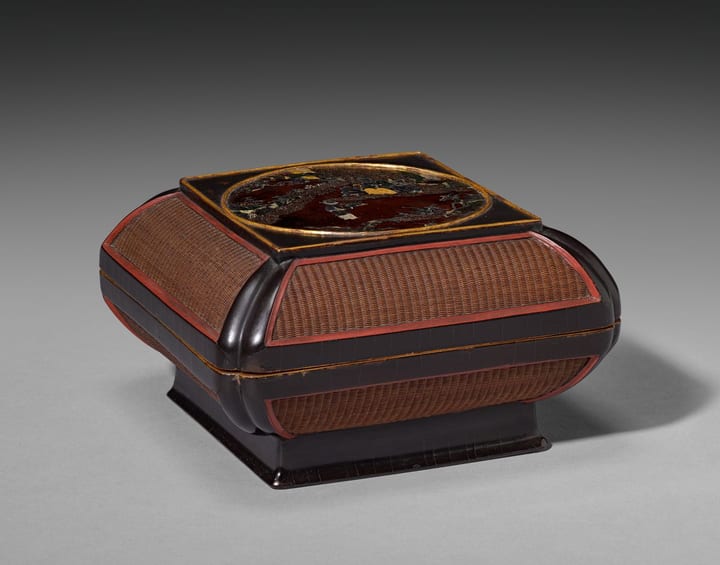
Cleveland Museum of Art’s Wickerwork Box, 1965.30, is dated 1609, in the Ming Wanli reign. Its medium explicitly identifies lacquered wickerwork made from woven bamboo, framed in wood, with a circular scene in mother-of-pearl and gold. It is a composite box, not a free-standing splint basket.
This object illustrates woven panels incorporated into a frame. Compare the bamboo fields, wooden edges and decorated lid as parts of one container, alongside the independent basket bodies described above.
A Guangdong basket has a documented life in Sydney
Powerhouse’s offering basket, 2003/114/4, was made in Guangdong in 1910–1920 and used by the Yiu Ming Society in Sydney. The record describes three circular basket sections with wooden bases, a lid and a metal ring handle. Its components sit together as a stacked container.
The museum documents its use for offerings at the Society’s temple during festivals and other occasions. That history gives the object a specific social setting without making every tiered basket a temple object. Our porcelain-body bamboo-weaving guide follows strips fitted over a ceramic support, while the bamboo-carving guide follows material removed from a stem or root. Here, interlacing and the container’s supports establish the structure.
Images and credits
Wickerwork Box, China, 1609, Ming dynasty, Wanli reign. Lacquered woven bamboo framed in wood, with a circular scene inlaid in mother-of-pearl and gold. The Cleveland Museum of Art, 1965.30, Edward L. Whittemore Fund. CC0. Uncropped museum photograph, resized for display.