Chinese coconut shell carving within Hainan yediao
Yediao is broader than shell carving alone. The national intangible-heritage record for Hainan yediao lists coconut shell, coconut wood and coir as materials and identifies Haikou as the submitting locality. The project entered the national list in 2008. This guide follows its shell-working aspect, keeping the hard shell distinct from the tree’s wood and fibrous material.
The official description includes useful household objects and works made for viewing. That range matters when considering a piece: a container must establish an inside and an opening, while a display object may concentrate attention on a modeled subject or ornamented face. The material’s local significance comes from what makers create with it, as well as from the coconut itself.
Selecting a shell and developing the design
A 2025 Sanya government account describes training led by practitioners including Wu Mingju and Ke Qiufeng. Material selection includes judging the shell’s shape, thickness and hardness through its fibrous covering. The teaching then moves through modeling, carving, polishing and finishing. Selection and design are linked decisions: different available shells offer different possibilities for a proposed object.
A programme account published by China’s intangible-heritage center lists additional operations, including openwork and inlay, and identifies high relief, pierced work and combinations with metalwork. These describe a repertoire rather than a requirement to use every technique on every object. Look for the relationship between the solid shell surface, any openings and any added components before concentrating on individual motifs.
A Qing bowl made from joined shell
The Palace Museum’s Qing coconut bowl with clouds, bats and gold, accession 故00122356-3/24, measures 4.5 centimeters high and 13.5 centimeters across the mouth. Its record explicitly describes an assembly of shell pieces. The vessel’s shape therefore extends beyond one opened coconut.
Shallow-relief clouds and bats decorate the exterior, with fret borders at the rim and foot. The catalogue interprets the ornament as auspicious and records gold covering the interior and base. Follow these surfaces separately: shell assembly, carved ornament and metal covering each contribute to the result.
The catalogue does not assign the bowl to a Hainan workshop. It can illuminate the material’s history alongside the local tradition without being given that provenance.
Shell and pewter in a plate dated 1917
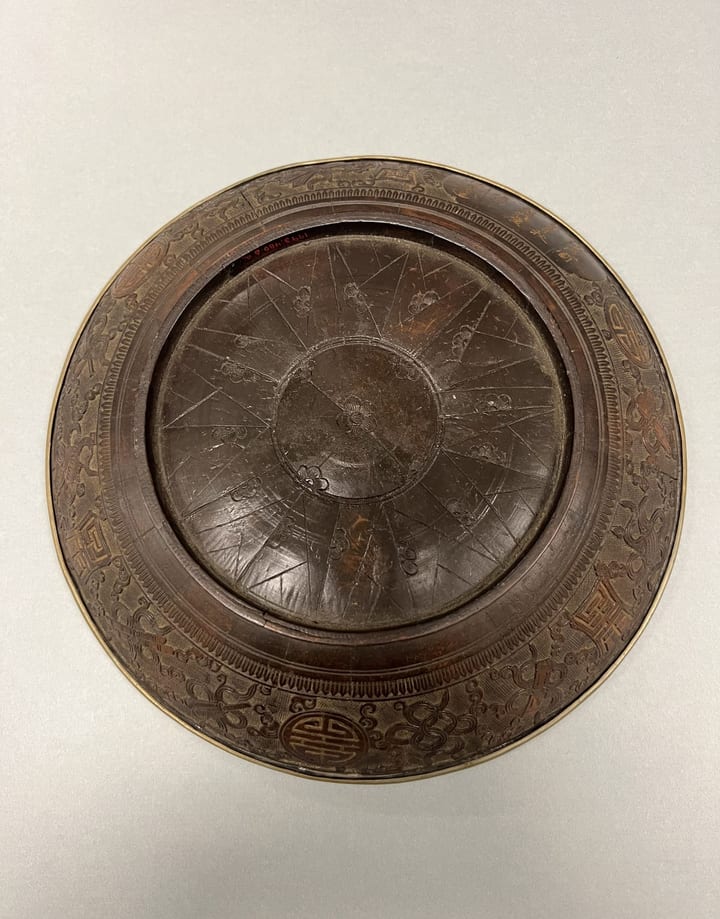
The Met’s Round Plate, accession 1993.480.6, offers another documented pairing of shell and metal. Its Chinese attribution, date of 1917 and medium of pewter and coconut shell are recorded by the museum. At 25.1 centimeters in diameter, it provides a broader circular surface for comparison with the smaller Qing bowl.
The photograph here presents the decorated shell exterior. The companion pewter guide shows the metal interior of this same plate, allowing the two surfaces to be considered together. These are views of one object rather than independent vessels. The museum record does not identify the plate as a Hainan product or a Qing court object.
Modern assembled sculpture and new uses
In a 2024 interview, Hainan carver Wu Mingju explains the challenge of turning hollow, brittle shell into a fully modeled subject. The report describes his adaptation of mortise-and-tenon ideas from woodcarving to solve problems of joining shell components. It identifies three-dimensional works including a crab and a cricket in his workshop. This is a named maker’s development, rather than a method attributed to every older vessel.
The same interview connects his work with local culture, including containers associated with weddings, and describes his teaching in educational settings. An official 2025 programme account also points to contemporary bags and bowls. These examples show a tradition being applied to familiar objects as well as to display sculpture, with design decisions extending beyond surface decoration.
Reading shell beside wood and gourd
Compare an assembled shell vessel with a carved wooden figure: the maker is organizing different kinds of starting material. The boxwood and bamboo guides follow their own documented approaches. The molded-gourd guide offers another useful comparison, explaining how a vessel’s shape can be established during growth. These distinctions help keep material, shaping and decoration clear when looking at small crafted objects.
Museum photographs and credits
Decorated underside of Round Plate, China, dated 1917. The catalog lists pewter and coconut shell. The Met, 1993.480.6; Gift of Paul Singer, 1993. Museum accession number retained. Public domain/CC0; resized without cropping.