How Chinese molded gourd vessels acquire relief
The Palace Museum uses pao for the gourd and paoqi for vessels made from it. Fanpao names a more specific intervention: growing the fruit in a mold. Instead of starting with a dry shell and removing the surrounding material to leave a raised motif, the maker prepares the pattern in the mold.
The Met explains that a young gourd is enclosed within several sectional wooden panels bearing engraved motifs. As it enlarges, it fills the available space and takes both the mold’s overall shape and its decoration. Recesses inside the mold become raised features on the shell, connecting the design of a container to the design of its surface.
The mold is a designed object too
A mold organizes the future vessel’s volume as well as its ornament. A tall brush holder and a rounded container need different spaces. Flat panels can provide places for writing; curved areas can carry continuous foliage. These decisions precede finishing the mature shell.
A modern patent by Huang Quanhua, published as CN112659321B in 2022, describes forming a casting around a wax model and removing the wax to leave a cavity for a small gourd. The proposal illustrates a different approach to mold-making from the sectional wooden panels described for the Qing brush holder.
Two brush holders bring writing onto a grown surface
The Palace Museum’s octagonal gourd brush holder, accession 故00125365, is dated to the Kangxi period. Its eight sides carry a Tang poem by Chu Guangxi in molded raised regular-script characters. The poem concerns a mountain spring, bringing a literary landscape onto an object used to hold brushes.
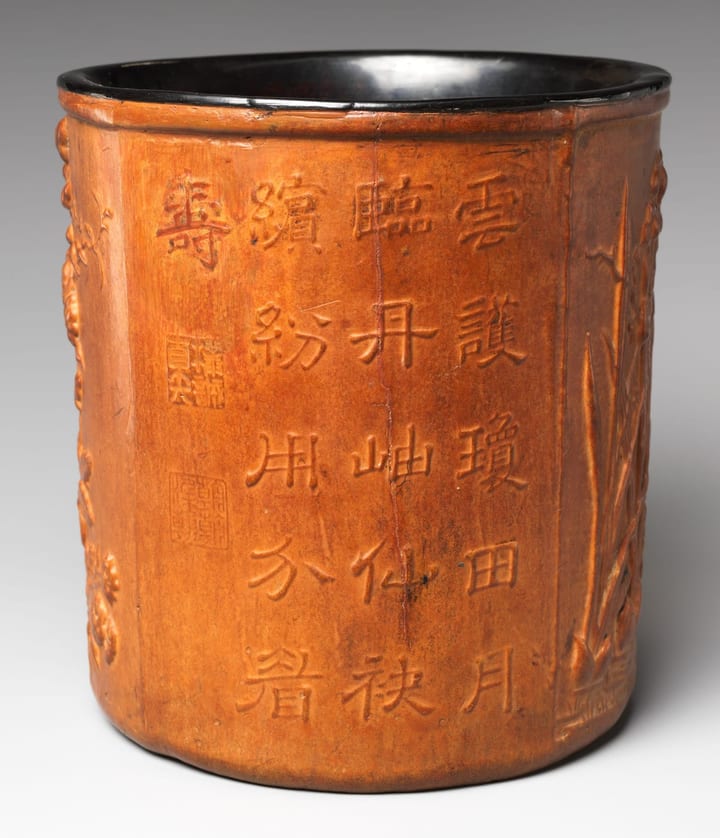
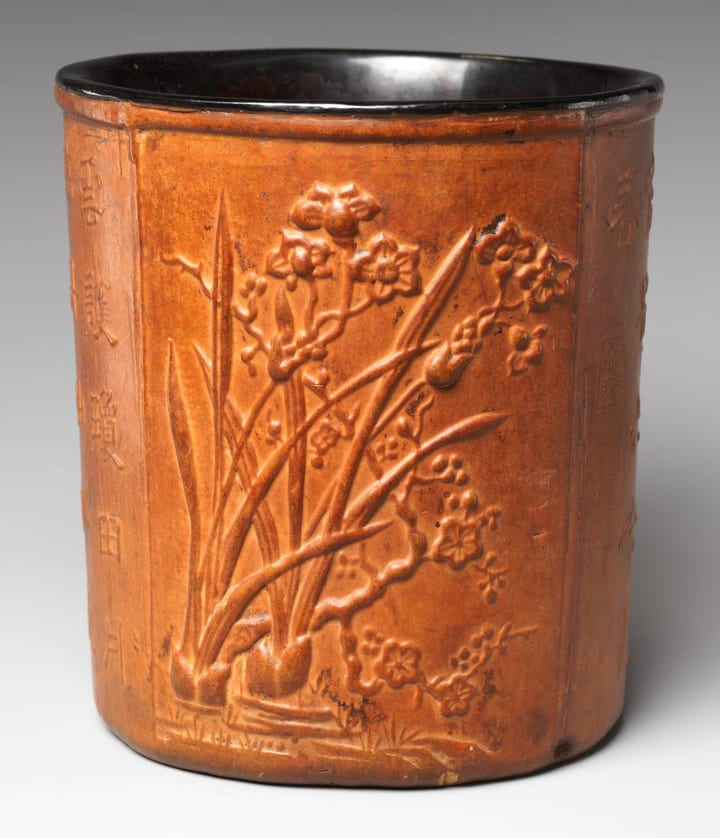
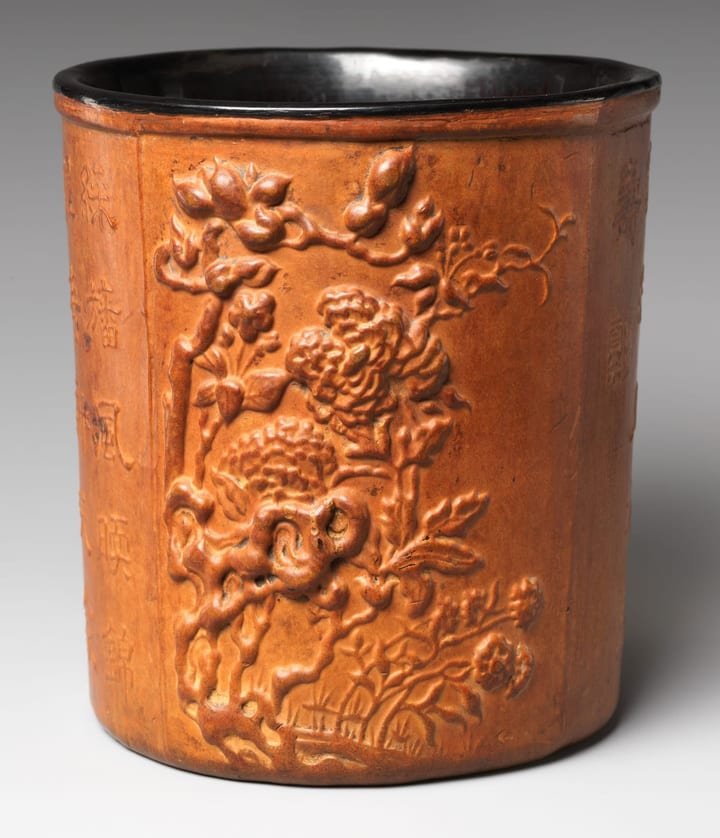
The Met’s Brush holder with flowers and poems, accession 2018.155, is catalogued as nineteenth century, with a Jiaqing mark and period attribution. Its medium is molded gourd and black lacquer. The museum places it within Qing imperial-workshop production. Together these records show that a brush holder can be a vehicle for text, ornament, and a deliberately controlled form.
From grown shell to assembled container
The body does not have to supply every part of a vessel. An opening may be completed by a separate rim or cover, while lacquer can form another material layer. Reading these parts individually reveals where cultivation gives way to other making skills, rather than imagining the whole finished object emerging ready-made from the plant.
The Met’s Chinese Cricket cage, accession 28.186.30, is dated to the eighteenth–nineteenth century and lists gourd and jade. Here it illustrates a combination of materials; its record does not identify a molding method. The material list describes an assembled object more precisely than calling the entire cage a gourd.
Molding, burning, pressing, and carving
The national heritage record for Tianjin gourd-making distinguishes molding from several other operations. Burning uses a heated tool to mark the surface; pressing forms ornament through pressure; carving produces relief or openwork by cutting. These can be understood as different ways of working with the fruit or its shell.
The Minneapolis Institute of Art’s (Mia) late seventeenth-century Cricket Container, accession 96.69.1a, b, provides a useful contrast. Its scene of scholars was burned into the surface with a heated stylus. The catalogue lists gourd with heat-incised decoration, ivory, and tortoise-shell. This is evidence for a different decorative method, rather than another example to label mold-grown simply because it is a Chinese gourd container.
Reading the finished vessel
Begin with the body’s geometry and the distribution of writing or ornament, then examine the opening and attached parts. This connects the mold’s control of the growing form with the later work needed to complete the vessel.
The bamboo-carving guide offers a comparison with another plant material used for brush pots, while the Four Treasures of the Study guide explains the writing tools around which such desk objects function. The lacquerware guide explores a finishing material that can accompany a gourd body.
Museum photographs and credits
Brush holder with flowers and poems, China, Jiaqing mark and period (1796–1820). Molded gourd and black lacquer. The Met, 2018.155. First of three museum photographs of the same vessel. Public domain/CC0; cropped and resized.
Poem-bearing side of the same brush holder, The Met, 2018.155. This alternate museum photograph shows its raised Chinese characters. Public domain/CC0; cropped and resized.
Another floral panel on the same brush holder, The Met, 2018.155. An alternate museum photograph of the same vessel. Public domain/CC0; cropped and resized.