A reed and pipe work together
A free reed sits near the lower end of a sounding pipe, inside the wind chamber. Air passing through the instrument makes the reed vibrate. In the traditional form described by Cambridge International, covering a selected pipe’s finger hole enables its note to sound.
The instrument can sound as the player exhales or inhales through the mouthpiece. Breath and hole covering work together, unlike blowing across the open ends of a row of pipes.
Visible pipes do not necessarily mean sounding notes
Yale’s mid-twentieth-century Chinese sheng, accession 3509.1973, gives a concrete example. The catalogue records seventeen pipes, but three have no reeds and are mute. It also describes five different pipe lengths. Counting the visible tubes alone would therefore give an incomplete account of that instrument.
The same record identifies bamboo pipes and brass reeds and wind chamber. These details describe a particular assembly. When comparing instruments, establish which pipes sound and what mechanism they use before inferring the musical resources from appearance.
The historical photograph has its own identity
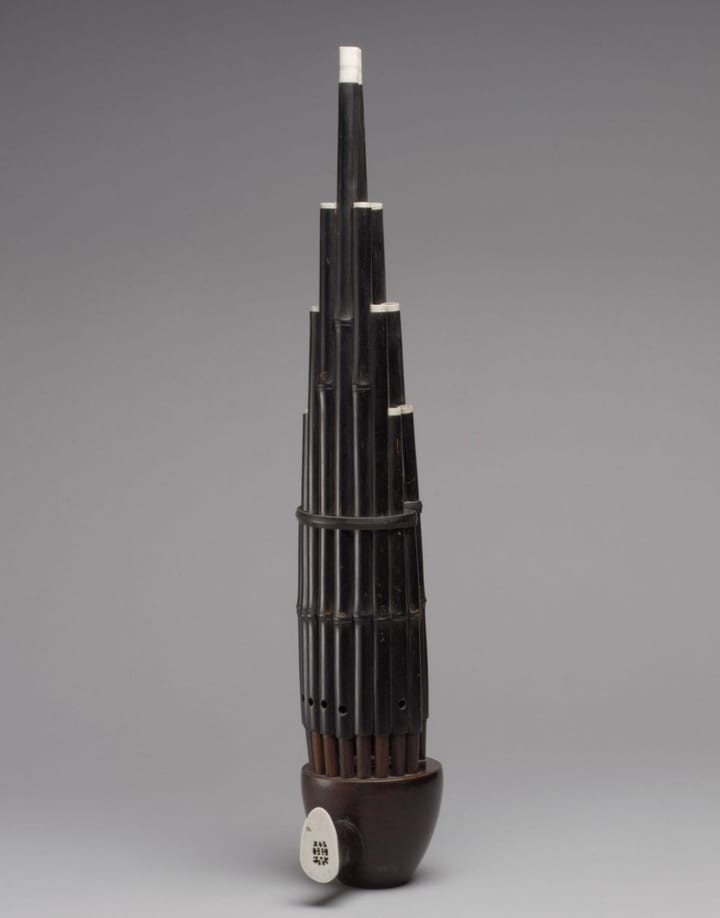
The photograph shows The Met’s Chinese sheng 89.4.96, dated to the late nineteenth century. Its catalogue names wood, metal and ivory as materials. It is a historical museum instrument; no named performer, modern tuning system or particular regional ensemble is assigned to this object here.
The Met interprets the rising arrangement of bamboo pipes as folded phoenix wings. This is a traditional symbolic association, rather than evidence that the instrument records an actual bird call. The photograph shows the exterior, while the reeds remain within the wind chamber.
Why an instrument with a wooden chamber can be called gourd
The Horniman Museum places the sheng within the gourd category of the historical bayin classification, referring to an earlier wind-chamber material. Its own example, museum number 12.5, instead has a wooden chamber. A classification name and the material of a surviving specimen can therefore preserve different kinds of information.
Horniman associates sheng practice with Han communities in central and northern China and notes solo and orchestral uses. That regional frame is more useful than treating all Chinese mouth organs, their construction and their performance traditions as one unchanging object.
Modern orchestral names identify different working forms
The Hong Kong Chinese Orchestra lists soprano keyed sheng, alto paisheng and bass baosheng among its wind instruments. These names distinguish roles and forms within that orchestra’s instrumentation. A low-register orchestral sheng should not automatically be read as the same physical model as the historical instrument pictured here.
The orchestra also separates the reed-based sheng group from flute-type instruments and from double-reed suona and guan. Looking at the sound-producing mechanism helps explain why instruments sharing the wind section can still demand different techniques.
Study connects breathing, fingering and harmony
Hong Kong’s Music Office sheng syllabus, revised in January 2012, begins with instrument structure and care, playing posture, staff reading and the foundations of exhaling and inhaling. Later stages strengthen the two hands’ hole-covering work and introduce melodies using two notes.
The same dated document progresses to different harmonic practices and offers study of a thirty-six-reed or tenor sheng. It demonstrates a structured path from basic control to more specialized work. Its levels are evidence of that teaching programme, rather than current enrolment or admissions instructions.
A recent programme keeps different reed traditions distinct
The Hong Kong orchestra’s Thousand Reeds, One Universe concerts on 19–20 September 2026 credited sheng, lusheng, khaen, shō and other instruments separately. The two days had different programmes. In one scheduled work, a sheng part was paired with organ; other works brought different reed instruments together.
These named parts show how a present-day concert can create encounters between traditions while preserving their identities. Read the particular piece and instrumentation before assigning every instrument the same playing method. The programme documents this event, not a permanent rule for sheng ensembles.
Images and credits
Sheng, China, late 19th century; wood, metal and ivory. The Metropolitan Museum of Art, 89.4.96, The Crosby Brown Collection of Musical Instruments, 1889. Public domain/CC0. Complete official photograph DP102103, uncropped and resized for display.