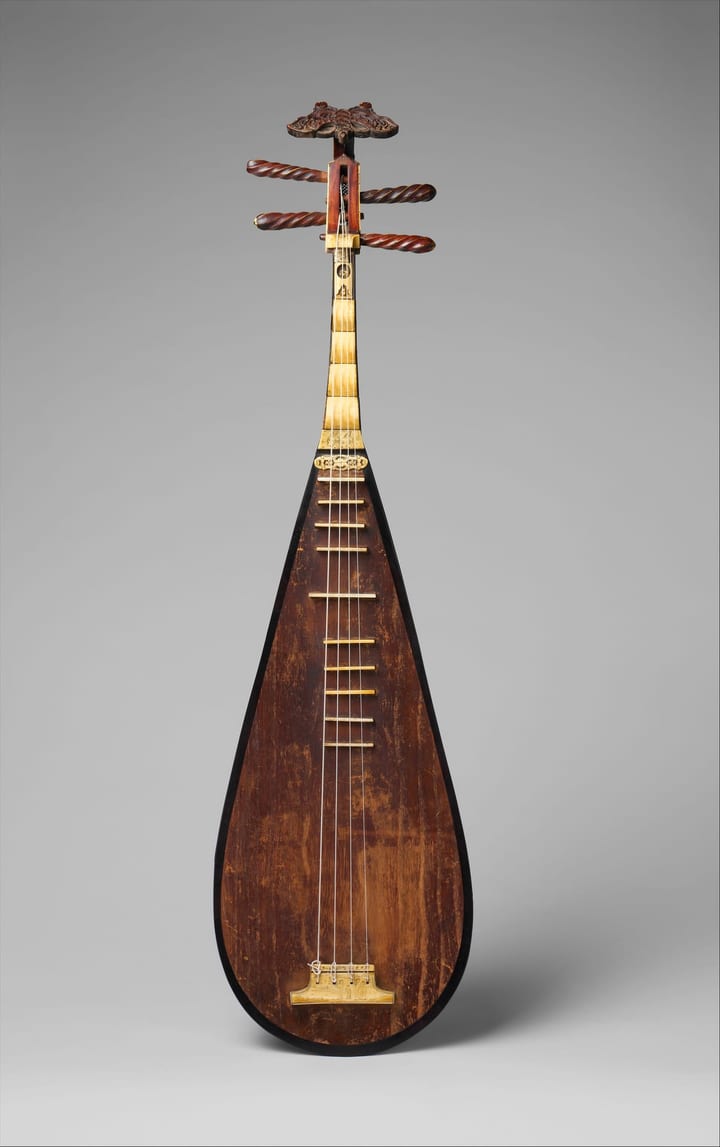
Recognize the lute through its working parts
Look for the relationship between the broad body, narrower neck and raised frets. On the pipa, the fret sequence extends onto the soundboard. This gives a visible way to distinguish its construction from the long playing surfaces of the guqin and guzheng, which are covered in the related comparison guide.
Counts and materials should accompany an identified instrument. The Paris centre introduces a modern form with four metal strings and thirty fret positions. Its teaching description is useful for that form, but it should not be imposed on every historical object or regional instrument bearing the name.
Two hands shape the sound after the first pluck
The Paris teaching account describes right-hand plucking, sweeps and rolling finger techniques alongside harmonics. The left hand works at the fret positions to produce slides, vibrato and ornaments. Listen for the relationship between the clear beginning of a note and the changes that follow it.
Follow how attacks connect into a phrase, then compare that effect with a sliding or ornamented note. Practical instruction develops control of these gestures.
An evolving instrument, rather than one unchanged ancient model
The Met’s historical essay relates the pear-shaped lute to West and Central Asian prototypes and movement along trade routes. It describes a gradual change from a horizontal playing position with a plectrum toward a more upright instrument plucked with fingernails. Musical practice and physical handling developed together.
The national Pinghu entry adds an important terminology boundary: pipa formerly named several kinds of plucked instruments. A very early reference to the word therefore does not identify every feature of the modern concert lute. When looking at a sculpture or painting, establish its date, instrument shape and playing position before making a comparison.
The museum photograph records one particular pipa
The illustrated instrument, The Met’s accession 50.145.74, is Chinese and dates to the late sixteenth or early seventeenth century. Its decorated reverse includes carved ivory plaques, although this photograph shows the plainer playing face. The surviving object brings instrument construction and decorative workmanship into the same history.
The collection page also provides a 2016 demonstration by Wu Man on a modern pipa. That audio is a separate listening example, rather than a recording of this historic object. Museum photography establishes appearance and identity; a modern demonstration addresses sound and performance.
Pinghu identifies a regional school of playing
China’s national heritage register lists Pipa Art (Pinghu School), 琵琶艺术(平湖派), as a traditional-music project announced in 2008, associated with Pinghu in Zhejiang. The entry describes its transmission in Jiangsu, Zhejiang and Shanghai, and its later movement into northwest China through teaching.
It connects the school with Li Fangyuan’s compilation of pipa music in 1895 and describes characteristic finger techniques. This makes a school more than a place-name attached to an instrument: repertoire, fingering and transmission all help identify the practice. The listing concerns this named tradition, rather than declaring every pipa or performance a single heritage element.
Nanyin gives the horizontal pipa a living setting
UNESCO’s Nanyin account identifies a crooked-neck pipa held horizontally within the music of Minnan communities in southern Fujian and overseas. It appears alongside dongxiao flute and other wind, string and percussion instruments. The instrumental part belongs within a tradition that also includes songs and accompanied ballads.
Here the performance setting changes how the instrument should be understood. The related Nanyin guide explains the Quanzhou-language singing and community context in more detail. Nanyin’s UNESCO inscription applies to that musical element; it is not a blanket inscription for the instrument in every use.
A concert programme can bring different forms into dialogue
For its Silken Notes of the Pipa concerts on 12–13 September 2025, the Hong Kong Chinese Orchestra separately credited four-string pipa, five-string pipa and Nanyin pipa. Satsuma-biwa and oud also appeared. The programme identifies the instruments and performers rather than treating all the lutes as interchangeable.
This is evidence of a specific contemporary arrangement. It offers a useful way into listening: identify which instrument takes a passage, which others join it and how the combination changes. A programme’s named forces describe that concert; they do not establish a compulsory instrument list for pipa music.
Images and credits
Pipa, China, late 16th–early 17th century; wood, ivory, bone and silk. The Metropolitan Museum of Art, 50.145.74, Bequest of Mary Stillman Harkness, 1950. Public domain/CC0. Complete official front photograph DP216710, uncropped; a historic object, not a modern performance. Resized for display.