Graduated bells make an organized set
The Smithsonian’s Resound object gallery identifies six dragon-decorated yong bells, S1987.4–.9, as a graduated bianzhong. It dates them to about 525–475 BCE. Their heights range from 28.7 to 43 centimetres.
Those linked collection records make the grouping visible even when the pieces are photographed separately. Compare the shared form, changing dimensions and accession references before assuming that any group of old bronze bells originally belonged together.
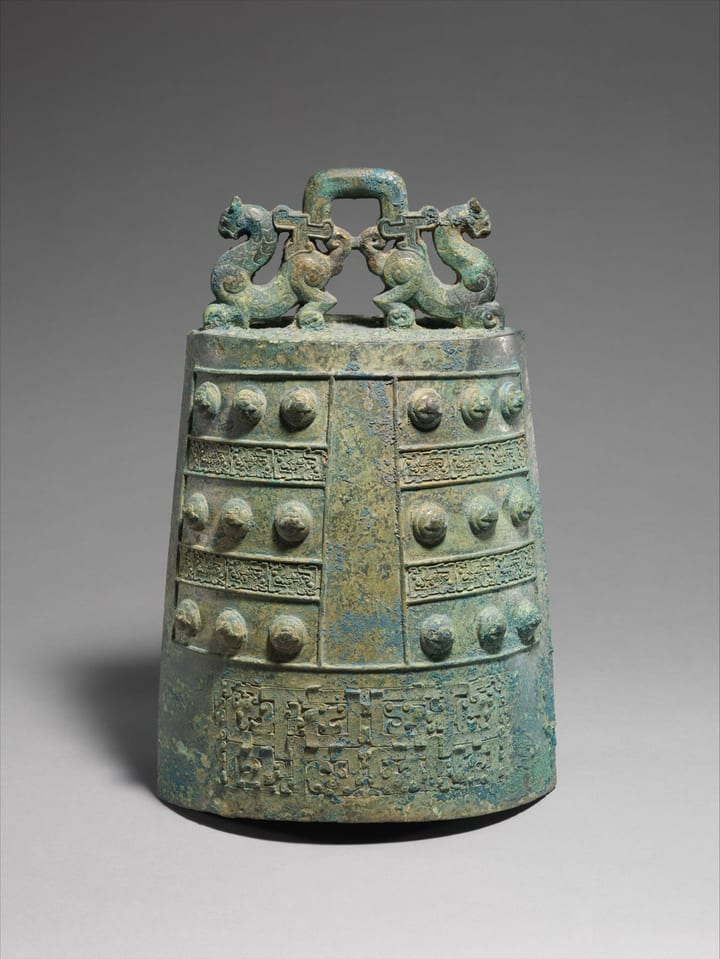
The photograph shows a single niuzhong
The illustrated Met bell, 1988.20.7, is Chinese bronze dated to the early fifth century BCE. It hangs from a ring rather than a long handle. Rows of raised bosses and patterned panels organize its surface.
This is one identified bell, not a photograph of a complete bianzhong or of Marquis Yi’s excavated ensemble. Its former arrangement is not reconstructed here.
Eight bells could carry a family’s dedication
Cleveland’s Lai Zhong, 1989.3, is catalogued at about 800–700 BCE and described as the second largest bell in a set of eight. The museum explains that its lens-shaped cavity permits two tones.
An inscription of 118 characters links the commission to Lai’s hereditary court position and an offering to his father, Gongshu. Musical organization and a family’s public identity meet in the same objects. This particular set’s count also shows why bianzhong should not be defined by the number of bells in a different, better-known discovery.
Marquis Yi’s set has its own scale and arrangement
Hubei Provincial Museum records sixty-five bells excavated in 1978 at Marquis Yi’s tomb in Suizhou. The early Warring States ensemble occupies an L-shaped bronze-and-timber rack, with eight groups across three tiers.
Its description distinguishes nineteen niuzhong, forty-five yongzhong and one bozhong. It also describes dual pitches and a central register containing twelve semitones. These are musical resources of the documented ensemble, not a promise that every surviving bronze bell has the same range or tuning.
Inscriptions can be compared with measured sound
The museum’s account of the Marquis Yi inscriptions counts 3,755 characters across bells, suspension fittings and frame. Much of their content concerns numbering, pitch names and relationships between notes.
The significance lies in comparing text with sounding objects. The marks are evidence for a musical system as well as decoration or ownership. Read which surface bears an inscription and what the account says it records, rather than treating every ancient bronze text as the same sort of dedication. Lai’s family offering and this detailed musical notation answer different historical questions.
Replication and research belong to a later history
Hubei’s 2023 documentary exhibition reviewed excavation records, pitch measurement and replication research. Its account dates the successful replication of the Marquis Yi bells to 1984 and describes archives including letters, manuscripts, notes and photographs.
That later work matters when reading a performance caption. An archaeological original, a research replica and a modern concert instrument are different objects with different histories. The exhibition connects replication with acoustics, casting research, public presentation and conservation. It does not make every present-day bell performance a performance on the excavated originals, or establish that a modern composition preserves a specific ancient piece.
Compare struck sound with breath-powered instruments
The related sheng guide follows airflow through free reeds, while the xun guide follows a blown pottery vessel. Bianzhong instead invites attention to an organized set of sounding bodies and the selection of bells through striking. Instrument mechanism makes these neighboring musical topics distinct.
Images and credits
Bell (niuzhong), China, early 5th century BCE; bronze. The Met, 1988.20.7; Charlotte C. and John C. Weber Collection, Gift of Charlotte C. and John C. Weber through the Live Oak Foundation, 1988. CC0. A single bell, not a complete bianzhong set; full photograph, uncropped and resized.