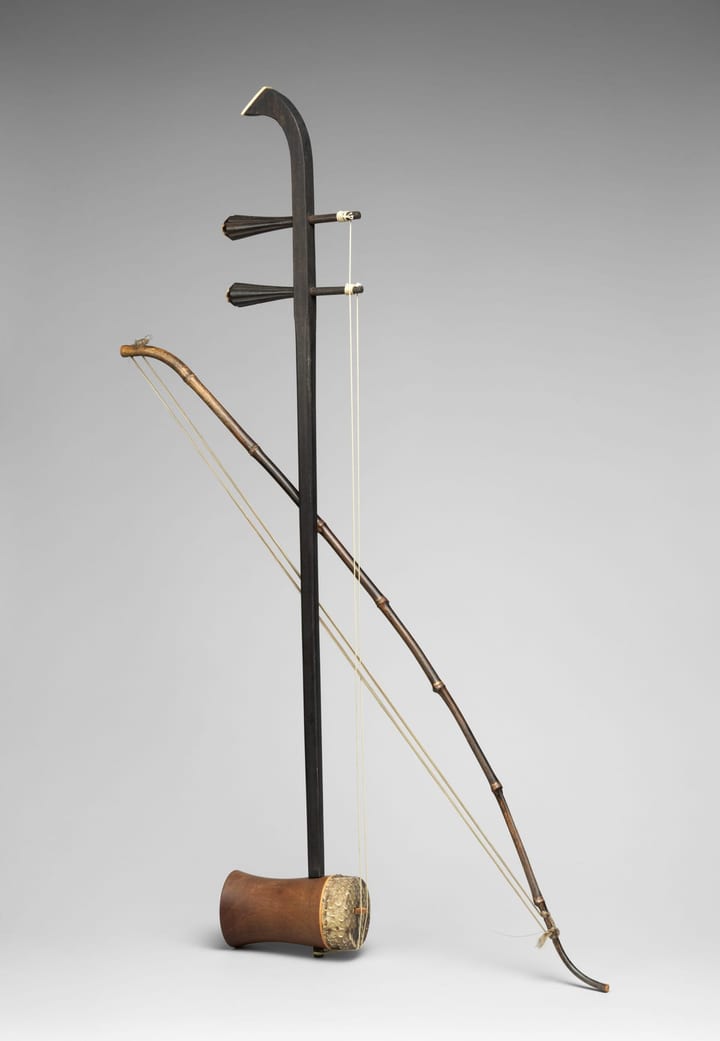
A bow threaded between two strings
The Vancouver Inter-Cultural Orchestra’s instrument guide explains that bow hair, rosined on both sides, passes between the strings. In ordinary playing the musician sounds one string at a time. This arrangement differs from a violin bow moving freely over a set of strings.
Watch the right hand as the melody changes strings. The guide treats double stops as an extended technique to discuss with the performer, rather than routine two-note harmony.
Pitch without a fingerboard
Yale’s early-twentieth-century erhu, accession 4503.1973, has a hardwood neck and hexagonal body with a python-skin front. Its record specifically notes that the strings are stopped in the air, without a fingerboard beneath them. The instrument rests upright in the player’s lap.
That description explains a useful visual distinction: the left hand does not press the string down onto a wooden playing surface. Notice where the fingers touch the strings, then listen for the pitch changes. Yale’s carved six-pointed-star back and inlaid details belong to its particular instrument, not every erhu.
Tuning, register and tone colour
In her guide for composers, performer Lan Tung describes the usual tuning as D4 and A4, a fifth apart. D is the inside string, nearer the player; A is the outside string. A pitch available on both strings can have a different colour according to the chosen string.
Very high playing becomes softer and harder to tune. Slides, vibrato and phrase feasibility depend on register, fingering and bowing.
The photograph shows one historical erhu
The Met dates the pictured Chinese instrument, 89.4.39, to the nineteenth century. Its catalogue lists wood, python skin, cane and possible ivory; the question mark attached to ivory is part of that identification. The body has an hourglass profile, although the museum describes round or hexagonal bodies as more typical.
The object documents one construction, not a standard for every modern erhu or evidence of a particular performance.
Erhu is one member of the huqin family
Hong Kong Chinese Orchestra uses huqin as the broader name for Chinese bowed-string instruments. Its account lists erhu, gaohu, zhonghu, gehu and bass gehu in its orchestral configuration, with other types brought in according to repertory.
Instrument names therefore matter. Seeing a small upright fiddle does not establish that it is an erhu. Read the ensemble’s actual instrument list, especially in opera, where a named jinghu or jing’erhu has a specific identity and musical task.
Repertoire can change the instrument’s possibilities
An LCSD programme note offers a concrete example in Sun Wenming’s Plucked-string Music, also called Tan-Liu. It dates the piece to 1951 and describes its relationship to Jiangnan sizhu and the sanxian and pipa sounds of Suzhou pingtan.
According to the note, Sun removed the qianjin and used the tuning peg in its place, changing the erhu’s timbre to suggest the sanxian. This is a particular compositional experiment, not ordinary setup advice. The example shows why an instrument guide should distinguish conventional construction from the demands of an individual work.
Modern materials are part of the story
Hong Kong Chinese Orchestra’s Eco-Huqin research describes replacing python skin with selected PET membranes. Its work on erhu, gaohu and zhonghu sought expanded physical capabilities while retaining traditional timbre and playing methods.
The orchestra describes a cycle of design, stage testing, adjustment and assessment. This makes the adaptation a documented institutional project, rather than proof that all contemporary erhus use synthetic membranes. A museum instrument and an orchestra’s remodelled instrument can represent different choices within the same continuing musical practice.
An older composition in a new concert setting
The China National Traditional Orchestra’s January 2026 announcement for its European tour lists A Pleasant Night by Liu Tianhua, arranged by Li Bochan as an erhu concerto. Its programme names different erhu soloists for Montpellier, Geneva and Paris.
The announcement documents an orchestral arrangement of inherited repertoire. Compare a solo version with an orchestral setting to hear how accompaniment frames the erhu’s line.
Images and credits
Erhu, China, nineteenth century; wood, python skin, cane and possible ivory. The Met, 89.4.39, The Crosby Brown Collection of Musical Instruments, 1889. Public domain, CC0. Complete museum photograph, uncropped and resized for display.