A reed, rather than a trumpet mouthpiece
Hong Kong Chinese Orchestra places suona and guan in its double-reed group, separate from flute-type dizi and the sheng family. A metal bell does not make the suona a lip-vibrated brass instrument.
How breath and finger holes shape the sound
Grinnell College describes the suona as a shawm with a conical air cavity and finger holes. The reed controls the passing air, while uncovering holes changes the effective sounding length. Overblowing gives access to further pitches.
Breath control and special fingering can bend pitch, so a written note leaves room for a performer’s inflections.
Traditional and keyed suona are different working forms
Singapore National Youth Chinese Orchestra distinguishes traditional suona from adapted keyed instruments. Its guide includes the high-pitched haidi among the traditional family and explains why players may bring several instruments in different keys to an orchestral performance.
Keyed adaptations provide chromatic playing and lower-register voices. Their mechanism offers different possibilities from a traditional high suona; it should not be assumed that one pictured instrument can replace every named part in an orchestral score.
Qinyang connects the instrument with local musical life
China’s national heritage register lists Suona Art from Qinyang, Henan, as project II-37 in the first batch, announced in 2006. The account describes high, middle and low suona, active in weddings, funerals, temple events and other local celebrations.
It also distinguishes traditions on the two sides of the Qin River and identifies several influential family groups. Those details make place and lineage meaningful musical information. A label such as Chinese suona is the starting point; it does not replace the name of the local style or ensemble.
Southwestern Shandong ensembles organize different combinations
The separate national heritage project Southwestern Shandong Guchui Music, II-45, was also listed in 2006, with Jiaxiang County as its applicant. Its account describes a suona-led tradition extending through Jining, Zaozhuang, Heze and surrounding areas.
One local combination has a single leading suona with instruments including dizi, sheng, cymbals and drum. Another uses two leading suona with a different percussion grouping. The same record names repertory including Hundred Birds Paying Homage to the Phoenix. Ensemble forces and named pieces help locate a performance more precisely than the broad phrase folk music.
Qingshan repertory changes with the occasion
Qingshan Suona from Xiangtan County, Hunan, appears as a 2008 extension of project II-37. The official account distinguishes funeral repertory, processional music and a seated ensemble tradition connected with local theatre.
These categories link music to social use rather than a single mood. The record also lists techniques such as slides, tonguing and circular breathing. A sustained tone or an ornament is one part of the performance; the chosen tune and occasion give it a wider setting.
Read register names in the actual score
Singapore Chinese Orchestra’s current music-score catalogue gives concrete examples. Eric Watson’s The Ceilidh lists gaoyin (soprano) and zhongyin (alto) suona, with cizhongyin (tenor) and diyin (bass) suona marked optional. The simplified Grasslands Fantasia lists gaoyin and zhongyin parts.
These are choices for particular arrangements. Read the register and optional markings in the relevant score, rather than assuming a fixed suona lineup for every orchestral work.
The museum photograph preserves one historical example
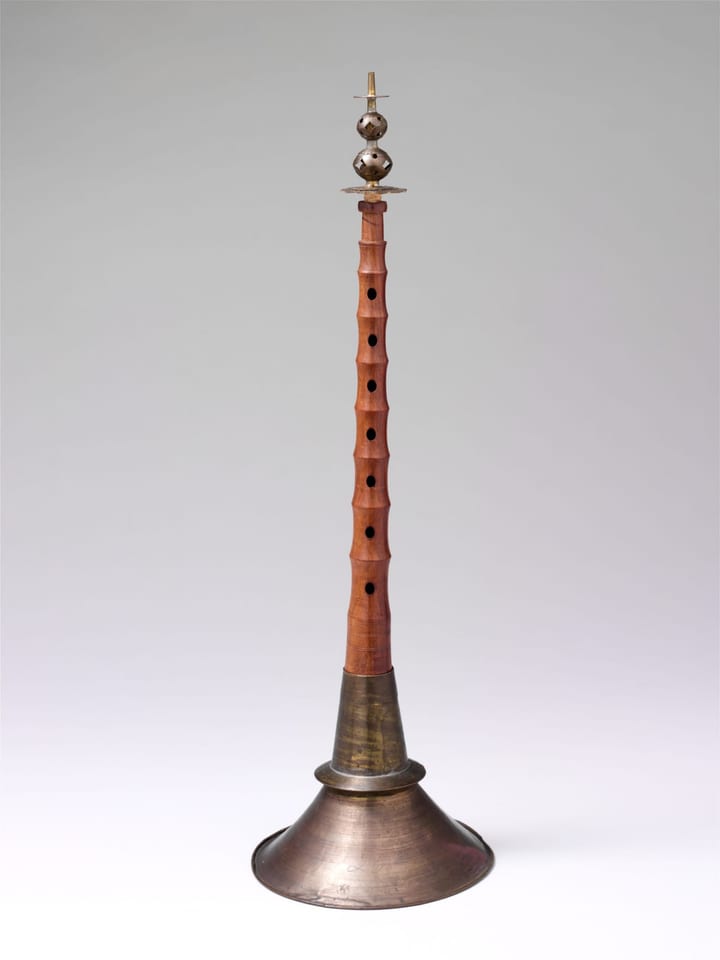
The Met identifies the illustrated suona, accession 89.4.20, as Chinese and nineteenth-century, made of rosewood and brass. Its location is recorded as Beijing with a question mark, so that attribution remains uncertain.
The photograph presents one historical instrument, rather than the keyed mechanisms or local ensemble practices discussed here.
A concerto gives the suona another musical setting
Hong Kong Chinese Orchestra’s programme for Realms, dated 11 July 2025, lists Li Bochan’s suona concerto Centennial Nirvana with soloist Liu Wenwen. The programme places the solo instrument within a concert of orchestral works.
Compare a local ensemble passage with a concerto: follow the melody and the changing accompaniment around it.
Images and credits
Suona, China, nineteenth century; rosewood and brass. The Met, 89.4.20, Crosby Brown Collection, 1889. Public domain, CC0. Complete photograph, uncropped and resized.