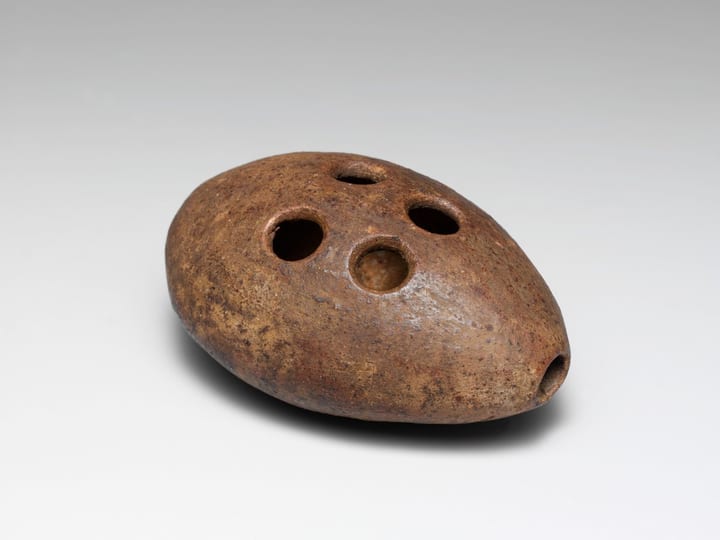
The photograph records a particular pottery xun
The Met identifies the illustrated instrument, accession 2005.14, as Chinese pottery dated to 206 BCE–220 CE. Its catalogue gives a length of 10.5 centimetres, width of 7.1 centimetres and depth of 4.8 centimetres. The complete photograph preserves the rounded body and its openings.
This dated object is a different example from the later court instrument discussed below. The image establishes appearance and identity rather than a modern fingering chart.
An open blowing edge differs from a duct
ChinaCulture’s introduction describes xun as resembling an ocarina but lacking its fipple. The player works at the blowing opening rather than through a built-in wind duct.
The account includes different sizes. Its eight-finger-hole example documents one form, rather than every historical instrument.
A vessel flute need not have one standard outline
China’s Academy of Arts presents several unusual objects in its music collection. Its account identifies human-head-shaped pottery whistles and a ghost-head xun, with three openings recorded for these examples. Shape and opening arrangement have varied alongside the familiar egg-like form.
The same collection holds a red-lacquered Qing court xun formerly owned by Mei Lanfang. The catalogue describes six finger holes. Read each object’s own description before applying a modern teaching diagram to it; a shared instrument name does not erase the distinctions between these surviving examples.
A decorated court instrument belongs to a musical setting
The Palace Museum’s mid-Qing example, 故00170153, is pottery covered in red lacquer with gold cloud-and-dragon decoration. It has six finger holes, four at the front and two behind.
The museum places xun within Zhonghe Shaoyue, ceremonial court music, and the earth category of the historical eight-material classification. This identifies a particular use and symbolic framework, rather than every context in which someone plays xun.
Dezhou connects making, listening and transmission
Dezhou University’s account links local xun knowledge with Wu Tang and Li Yucun. It describes Wu studying a damaged pottery instrument and making a copy, then writing music for it. Li acquired a handmade instrument and a manuscript copy of the music.
For his own instruments, Li used clay bodies shaped with wooden moulds and had a local pottery works fire them. The account says he checked tuning with other instruments and his ears. Making therefore involved a sounding result as well as a vessel’s outward form; the account concerns this local practice, not all xun production.
A modern demonstration can explore a historical instrument differently
A University of Oregon notice for 30 September 2015 announced a lecture and demonstration by folklorist Juwen Zhang of Willamette University. It described fired-clay xun he had made and planned to present pieces whose artistic forms referred to earth, heavens and spirits.
The announcement offers a specific example of contemporary making and interpretation. It documents the planned event and its stated subject. It does not establish that these new pieces reproduced the Met object or followed the court instrument’s proportions. A performance example and an archaeological catalogue answer different questions.
Images and credits
Xun, China, 206 BCE–220 CE; pottery. The Met, 2005.14, Gift of Joseph G. Gerena, 2005. Public domain/CC0. Complete photograph, uncropped and resized.