Chinese amber carving begins with the individual piece
Amber can be clear, translucent or cloudy. GIA notes that abundant gas bubbles can contribute to cloudiness, and that plant or animal inclusions sometimes occur. These differences change what a viewer sees through a carved form. Transparency is therefore one aspect of the composition, alongside the outer silhouette and the modeled surface.
Suzhou’s official craft description emphasizes designing for the material. It discusses the combination of shallow and deeper relief, as well as sculpture in the round, in relation to amber’s effects of light. Relief leaves a design attached to a background; carving in the round develops a form that can be viewed from several directions. These choices establish different relationships between an image and its surrounding amber.
A Qing sculpture of harmony and friendship
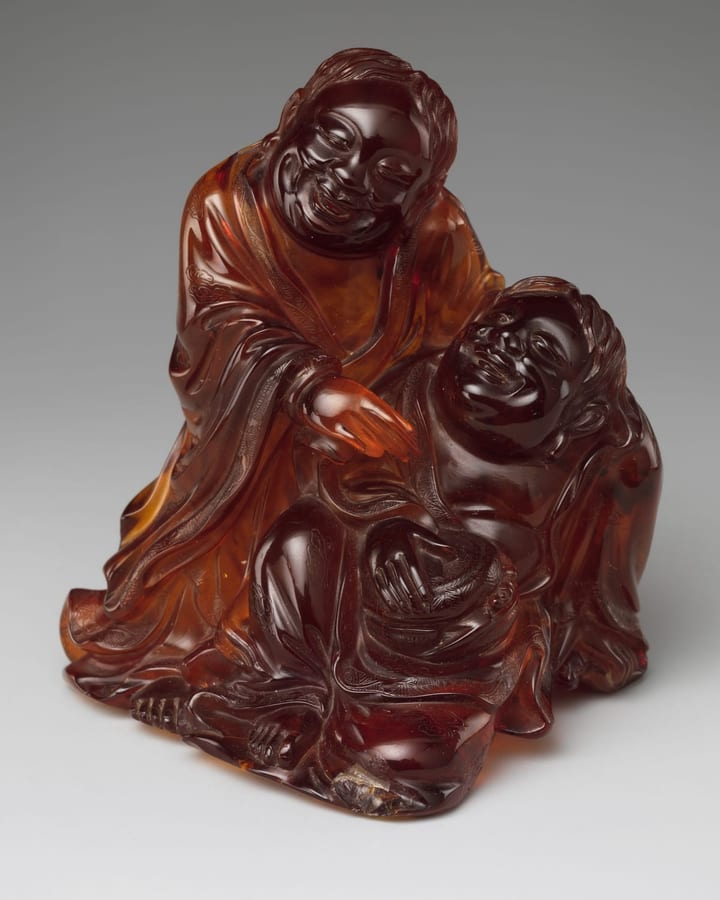
The Met’s Immortals of Harmony and Happiness, accession 50.145.152, is catalogued as Chinese amber from the eighteenth century, during the Qing dynasty. At 8.9 centimeters high, it brings two figures into a compact sculptural group.
The museum connects the pair, He-He Erxian, with the legendary monks Hanshan and Shide. Its account describes their later acceptance in folklore as emblems of harmony and lasting friendship. The eighteenth-century carving thus gives an older story a small, tangible form. The legendary Tang setting of the monks is distinct from the Qing date of this particular sculpture.
Look first at the group as a whole, then at the relationship between the two figures. Their shared space makes the paired subject legible before individual details are examined. This is a way to approach a small sculpture through its composition as well as its material.
Local working methods in Fushun and Suzhou
The national intangible-heritage database documents amber carving in Fushun, Liaoning. Its account describes changing a design as the maker works, clearing powder to inspect the material and respond to cracks. The work develops through repeated observation, rather than through an unalterable drawing imposed at the start.
Suzhou provides a different finishing detail: its official description names bamboo tools used to polish fine areas. It also stresses control of lines and the interplay of realism and suggestive atmosphere. Together, these records make the craft easier to understand at two scales: the overall design must suit a piece of amber, while its smallest transitions need careful finishing. The two accounts describe local practices; neither supplies a provenance for the Qing museum sculpture.
A plain body can be as deliberate as a carved scene
The Palace Museum’s Qing milā snuff bottle, accession 故00105557, offers a useful comparison. Its opaque amber body is described as plain, with a flattened rounded shape and a slightly swelling belly. The catalogue records yellow-red coloring and fine internal markings. Here the material and the vessel’s outline carry the visual interest without a carved narrative across the surface.
The same record identifies a gilt-copper cover set with red coral and an attached tortoiseshell spoon. These are separate components. Calling the object an amber bottle describes its body, not every part of the assembled vessel. This example also explains why an amber-craft guide should include shaping and finishing alongside elaborate figure carving.
Amber, copal and resin imitations
Copal is related natural tree resin at a younger stage than amber. Artificial resin can also imitate amber, and a single object can combine natural and manufactured material. In a published Beijing laboratory investigation, researchers identified a pendant containing both amber and polymer resin; its two insect inclusions had different origins.
These distinctions concern material identification, not artistic subject. Color, clarity or an apparently suspended insect is insufficient to settle them from a photograph. For historical objects, retain the museum’s material attribution. For comparison with another translucent carving material, the rock-crystal guide explains a different substance and its own documented objects; the coral guide follows animal-produced skeletal material.
Museum photographs and credits
Immortals of Harmony and Happiness, China, 18th century. Amber. The Met, 50.145.152; Bequest of Mary Stillman Harkness, 1950. Public domain/CC0; cropped and resized.