Chinese coral carving works with a biological structure
The hard material used for coral ornaments is produced by colonies of small animals called polyps. A Gems & Gemology study explains its skeletal origin and the presence of biologically formed carbonates alongside organic constituents. This is a more useful starting point than treating everything red and polished as the same kind of gem.
The word coral does not specify one universal color, species or mineral formula. The same study distinguishes different skeletal carbonate forms and examines both natural-color and dyed samples. Museum descriptions guide the material names used here; color in a photograph cannot establish species, place of growth or treatment history.
A Qing lion carved in the round
The Palace Museum’s Coral lion, accession 故00106075, is a Qing work measuring 23 centimeters long and 14.3 centimeters high. Its record explicitly identifies red coral and carving in the round. The animal stands with one foreleg raised, while its tail extends in a branching form. These are documented features of a particular sculpture, rather than a description applied to all coral work.
The lion rests on a separately made hardwood stand carved as openwork rocks. Distinguishing the two materials helps explain the composition: a modeled animal and a supporting landscape form an ensemble. Follow the relationship between the feet and their support, then the contrast between the animal’s rounded body and the open spaces in its stand.
A coral ruyi and a change of scale
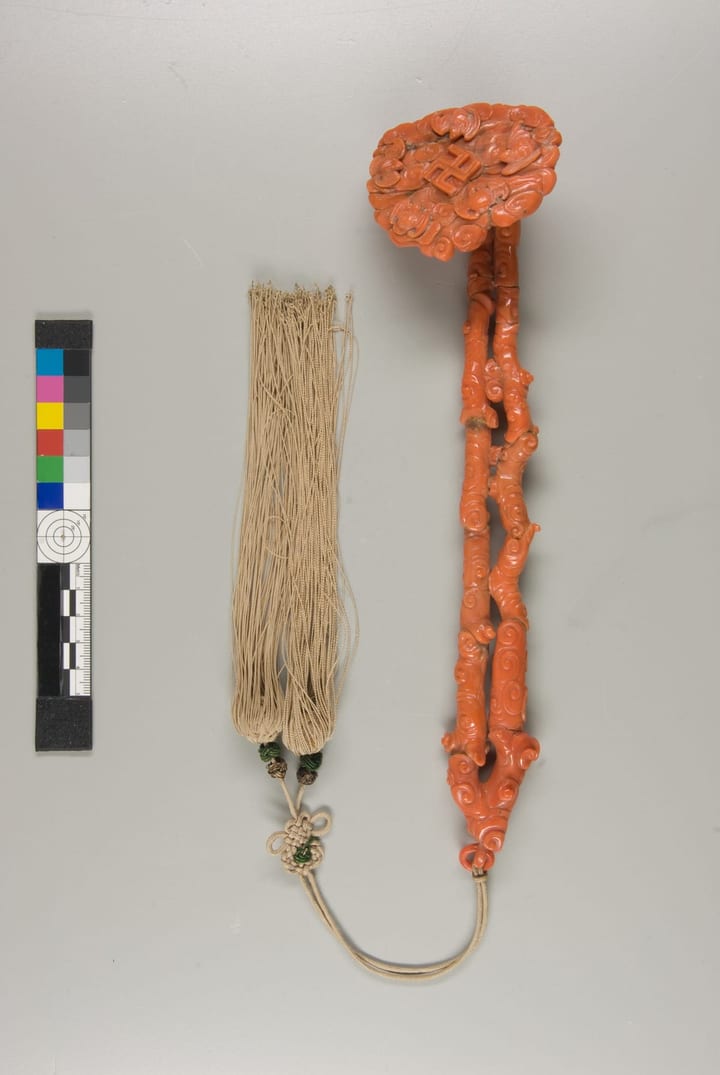
The Met’s Ornament (ruyi), accession 02.18.623d, is catalogued as Chinese, eighteenth century, with coral as its medium. Its recorded length is 27.9 centimeters. This offers a different sculptural format from the lion: an elongated ornament whose shape can be followed from end to end.
Read the ruyi as a whole before concentrating on its surface decoration. Then compare its long outline with the compact volume of the lion. These two museum records establish coral in different object types without requiring the assumption that the same maker, source material or tool sequence connects them. The accompanying ruyi photograph includes a tassel; the catalogue’s coral designation does not identify that attachment as coral.
Carved beads within an assembled court necklace
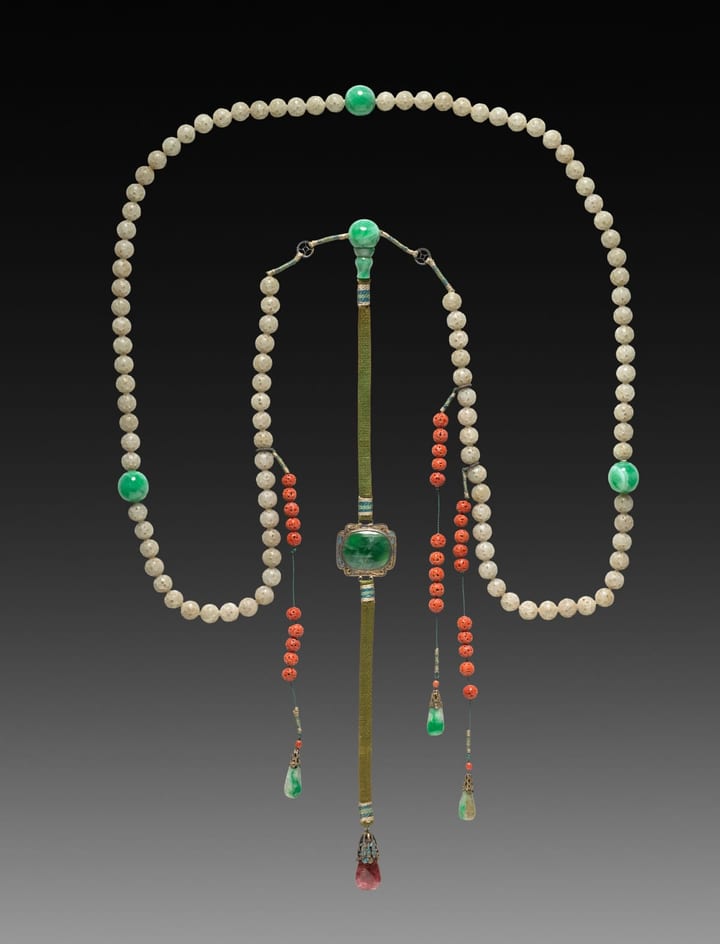
Cleveland Museum of Art’s Mandarin Necklace, accession 1952.472, is dated to the 1700s in Qing China. The museum records 30 coral beads and 108 white jade beads and explicitly describes the beads as carved and perforated. A bead therefore involves both surface work and a hole that allows it to join the larger construction.
Its other components matter: the central pendant is amethyst, and green jade pendants are mounted in gold and enamel. This is a mixed-material necklace, rather than one continuous coral carving. The museum explains that necklaces of this kind were worn by high-ranking women and men, with strings arranged across the chest and back. Small worked pieces contributed to a much larger pattern of dress.
Compare the necklace with the freestanding lion. In the former, repeated components establish rhythm; in the latter, the viewer follows a single modeled figure. Both are useful ways to understand the craft beyond a simple association with red color.
What modern workshop records explain
Lanyang Museum’s account of the Coral Dharma Realm Museum in Yilan draws on interviews with its makers. It describes removing the outer surface before assessing a piece’s possibilities and emphasizes grinding more than knife-like cutting. Its photographs are captioned as preliminary sanding and polishing stages. These are observations of that workshop, distinct from the finished Qing objects above.
An interview published by Taiwan’s craft research institute records another practical challenge. Carver Huang Chung-shan describes discovering internal cavities while working and changing his original plan in response. His design drawings and adjustments make clear that the subject is developed in conversation with the material. New Taipei’s cultural bureau likewise emphasizes this adaptability and identifies Guanyin as a recurring subject in his work.
For a comparison with another material that calls for attention to internal features, see the amber-carving guide. The jade-carving guide explains a separate mineral-working tradition. These comparisons help distinguish the material being worked while keeping the individual object and documented practice at the center.
Museum photographs and credits
Ornament (ruyi), China, 18th century. Coral body with a tassel shown beside it. The Met, 02.18.623d; Gift of Heber R. Bishop, 1902. Museum record photograph retains its color chart and ruler. Public domain/CC0; JPEG-optimized.
Mandarin Necklace, China, 1700s. Jade and coral beads with gold and enamel mounts; a composite object. Cleveland Museum of Art, 1952.472; Gift of Helen B. Warner. CC0; resized and JPEG-optimized.