Chinese agate carving begins with the material
The Natural History Museum identifies agate as a type of chalcedony, itself a variety of quartz. Its mineral account explains how impurities can contribute different colours to agate’s banding. This establishes a material category; it does not identify the geological origin of a carved museum object.
Agate should not be relabelled jade. GIA describes jade through materials including nephrite and jadeite, which are distinct from agate. The Chinese jade-carving guide provides that related craft context. In this guide, material names follow the cited museum records, not an inference from a pale, green, or translucent appearance.
Qiaose: locating a design within existing colour
Qiaose, 俏色, is the use of a stone’s different colours in designing and making an object. The Palace Museum also calls this approach qiaozuo, 巧做. The important decision is where to place a feature within the material, rather than simply adding a coloured detail after the form is finished.
The distribution is three-dimensional. A promising surface patch may not continue far into the rough. The Met describes hardstone carvers adjusting their designs as previously hidden variations emerge during work. Selection and design therefore remain connected to the shaping process, rather than being completed once and left unchanged.
An agate crane and a peach-shaped water pot
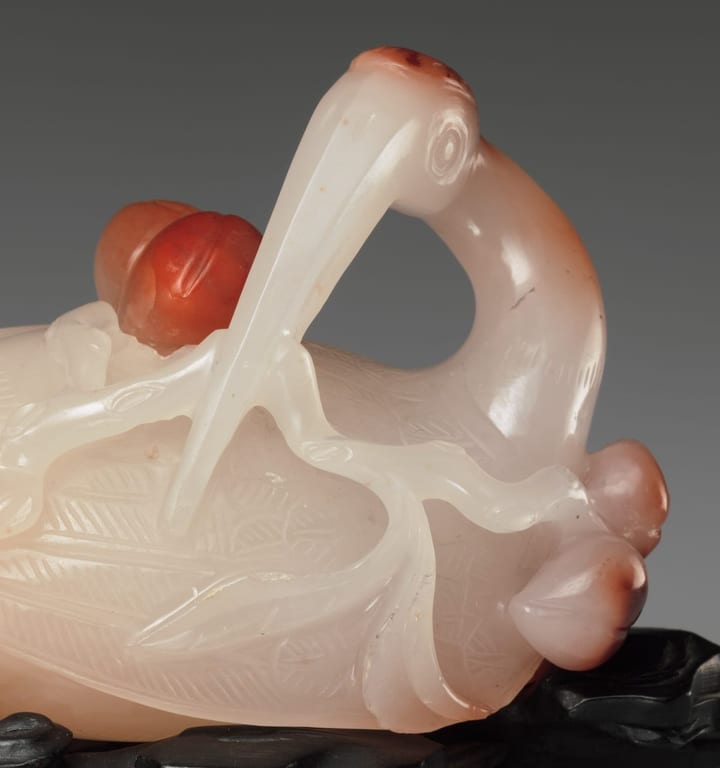
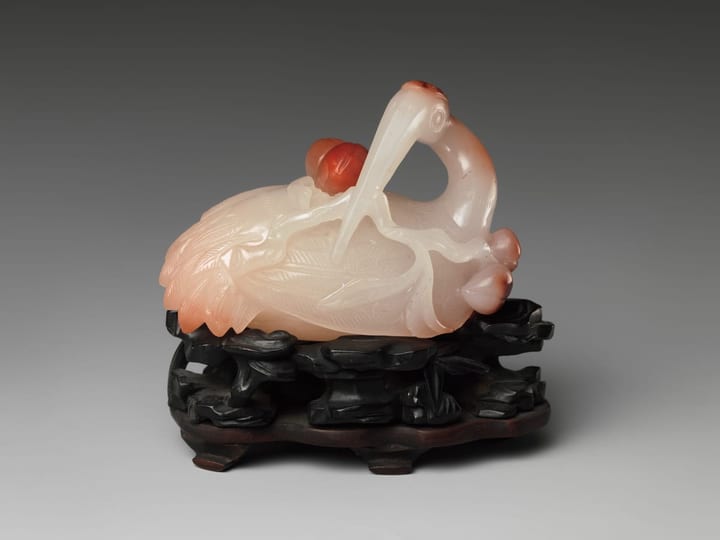
The Met’s eighteenth-century Water dropper in the shape of a crane, 02.18.876a, b, is catalogued as agate from China. Its hardstone essay explains that red streaks were used for the bird’s crown and the blush of the peaches. The turned neck positions the crown within the appropriate coloured area of the stone.
The Palace Museum’s Qing peach-shaped water pot offers a second documented example. It describes translucent white agate with local red colour, placing that red at the peach’s tip. The hollow vessel and its openwork branch-and-leaf decoration are made to work with this colour placement. This is a specific design decision, not a rule that all agate must become fruit or birds.
Shaping through cutting, grinding, and drilling
In hardstone work, carving involves gradual material removal by abrasion. The Met explains the role of abrasives carried by tools through rough shaping, detailed working, and polishing. A historical GIA study likewise documents rotating tools in Chinese gemstone carving. These accounts describe a different working relationship from slicing a soft material with a knife.
The Fuxin heritage record lists selection, surface removal, design, rough and fine work, polishing, and mounting among its operations. It also records drilling and hollowing skills. A vessel needs an interior; a solid sculpture presents another problem. These operations should not be turned into one identical sequence for every piece.
Function and the choice to leave a surface quiet
A water dropper belongs among writing-desk utensils, while other agate objects take the form of bottles, vessels, or small sculptures. The related Four Treasures of the Study guide explains the brush-and-ink setting in which a water container can be understood.
Elaborate relief is not required. The Met also discusses an agate snuff bottle with a deliberately smooth surface that emphasizes natural inclusions and lustre. Its contrast with the modelled crane shows that displaying the material can involve restraint as well as detailed carving.
Fuxin practice and the limits of a heritage label
China’s national heritage directory records Fuxin agate carving, in Liaoning, as a first-batch project announced in 2006. It describes a particular regional craft and its skills. That recognition does not mean every Chinese agate object was made in Fuxin, or that every maker and historic carving carries the same official status.
The photographs here show the Met’s finished crane water dropper, with a detail cropped from the same original photograph. They make its colour placement and carved form easier to examine. They do not document a workshop, prove an unknown object’s mineral identity, or show the stages of manufacture.
Museum photographs and credits
Water dropper in the shape of a crane, China, 18th century, agate. The Metropolitan Museum of Art, 02.18.876a, b; Gift of Heber R. Bishop, 1902. Public domain/CC0. Complete composition of museum photograph DP267509, proportionally resized; the closer view below is cropped from this same photograph. A finished historical object shown on its stand, not a workshop or process image.
Detail crop from the same DP267509 photograph of The Met’s 02.18.876a, b crane water dropper shown above. The red-toned crown and peaches illustrate the colour placement discussed in the museum’s hardstone-carving essay. The Metropolitan Museum of Art; Gift of Heber R. Bishop, 1902. Public domain/CC0. Cropped and JPEG-encoded without retouching, recolouring or upscaling; the same object and photograph, not a second carving or a process stage.