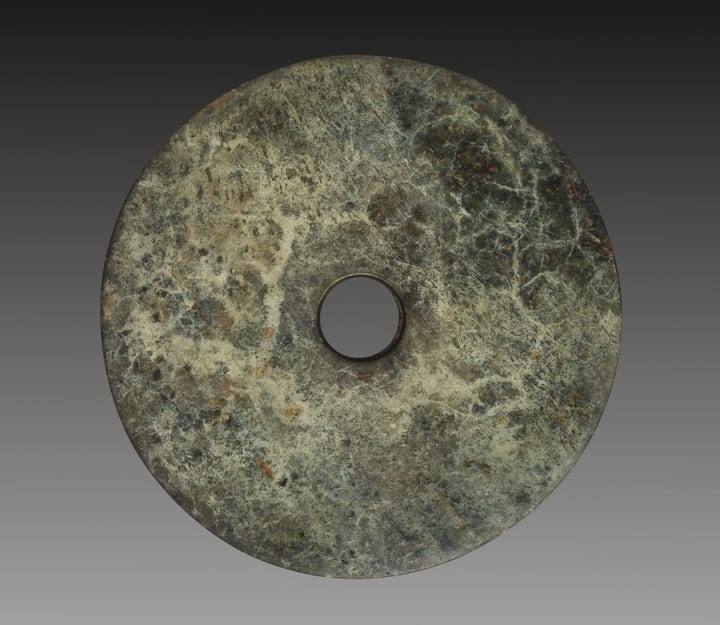
A recognizable form does not settle the material
The name bi, written 璧, identifies a circular object with a central hole, but a catalog must still establish its substance. The Met’s Disk (bi), accession 2006.404, is Chinese and Western Han, dated within 206 BCE–9 CE. Its medium is glass, not jade. A familiar outline can therefore cross material categories.
For a jade example, notice the balance between the outer circumference and the opening, then read the material field. A photograph can show mottling, reflections and an uneven edge without supplying a mineral identification. Our jade-carving guide follows the wider material-working tradition; this guide concentrates on the particular disc form.
Liangzhu is an important context, not the whole story
The photographed Cleveland disc, accession 1917.974, is attributed to East China’s Liangzhu culture and dated to 3300–2200 BCE. Its recorded nephrite body measures 32 centimetres across, with a 5.4-centimetre opening. The museum relates exceptionally large discs of this kind to prominent placement on the chest in burials.
A separate disc in the Montreal Museum of Fine Arts, accession 1955.Ed.2, is attributed to Qijia culture in Gansu and dated about 2000 BCE. Its material is mottled dark grey-brown nephrite. This northwestern example broadens the comparison beyond the East China setting, without making every circular jade a Liangzhu object.
A worked disc can preserve evidence of making
Montreal’s account describes nephrite being sliced and hand-drilled with abrasive sand. The important distinction is between shaping the stone and merely describing its finished outline. Cutting away material, establishing an opening and refining the remaining surfaces are related tasks, even when polishing later conceals their traces.
The Smithsonian’s Jades for Life and Death proposes that hollow tubular bits, water and mineral abrasives could have opened Liangzhu discs from both sides. Imperfect alignment can leave a ridge within the hole. The account retains uncertainty about ancient equipment: proposed tool arrangements should not become a universal recipe.
The same museum’s disc F1917.345 supplies object-specific evidence. Its description records boring from both sides, a substantial ridge inside the opening, and saw marks surviving on a smooth surface. These observations explain why a worked object can remain informative without being perfectly regular or uniformly polished. They do not establish the drilling sequence of Cleveland’s photographed disc.
Burial evidence and the later association with heaven
UMMA distinguishes early objects from later explanations of them. Its account says that original Stone Age names, functions and meanings remain unknown. It then discusses Han aristocratic burials and painted shrouds showing dragons passing through a jade disc, suggesting a connection with the soul’s journey.
UMMA cites the later Zhou Li, or Rites of Zhou, for the bi–heaven and cong–earth associations, without establishing Neolithic beliefs.
Grain patterns add another surface history
Cleveland’s Ceremonial Disk with Grain Pattern, accession 1952.567, belongs to the Warring States period, 475–221 BCE. The museum identifies nephrite and describes raised dots with finely incised spirals in diagonal rows. Here the circular field carries organized relief rather than remaining plain.
The same object also has a later intervention: a 47-character seal-script poem on its outer rim, dated 1770 in the Qianlong reign. Its principal object date and its inscription date should be read separately. The label grain pattern describes the recorded ornament; it does not establish one agricultural ritual or symbolic meaning.
An ancient object can receive a new interpretation
The British Museum’s collared jade ring, accession 1937,0416.140, is dated around 1200–1050 BCE, with an inscription added in Beijing in 1790. Its record identifies nephrite. The later writing connects the ancient stone with Qianlong’s study of antiquity and with calligraphy.
The museum notes that the emperor’s identification of this object as a cup stand was mistaken. That error remains part of its later history rather than proving its ancient function. When reading an inscribed bi, ask whether the words were made with the object or added centuries afterward, and whose interpretation they preserve.
Images and credits
Ceremonial Disc (Bi), East China, Liangzhu culture, 3300–2200 BCE. Nephrite. Cleveland Museum of Art, 1917.974, Worcester R. Warner Collection. CC0. Complete photograph, uncropped and resized for display.