What makes Chinese carved lacquer a distinct technique?
The Metropolitan Museum defines carved lacquer as a three-dimensional design cut into many thin coats that have been built up. This separates the technique from simply carving a wooden shape and painting over it. In a carved-lacquer object, the coating itself supplies material for the relief.
Carving also differs from painting or mother-of-pearl inlay. A painted line adds a surface mark; inlay inserts another material. Carving removes lacquer from the buildup. These are working distinctions within a wider lacquer tradition.
The support and the lacquer layers do different jobs
The core establishes the object’s underlying form. A China ICH field study of Beijing carved lacquer documents wooden and copper supports, as well as cloth structures made over removable forms. A covered box need not have the same construction as a different vessel.
The Met describes thin coats setting in a warm, humid environment. Repetition produces thickness for carving. A carved-lacquer label does not reveal a fixed coat count, identical core, or completion time for every object.
A red dish with birds and flowers
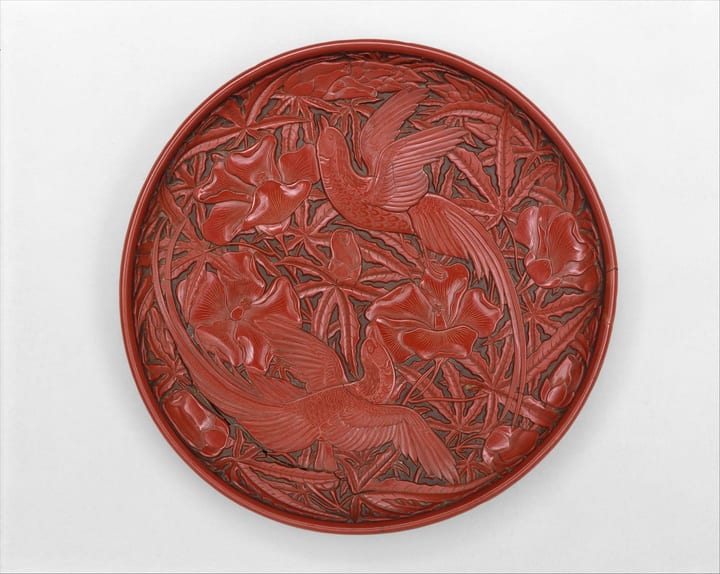
The Met’s Dish with long-tailed birds and hibiscuses is dated to the mid-fourteenth century and attributed to Zhang Cheng. Its recorded medium is carved red lacquer. Keeping the word attributed preserves the museum’s distinction between an attribution and a certain maker identification.
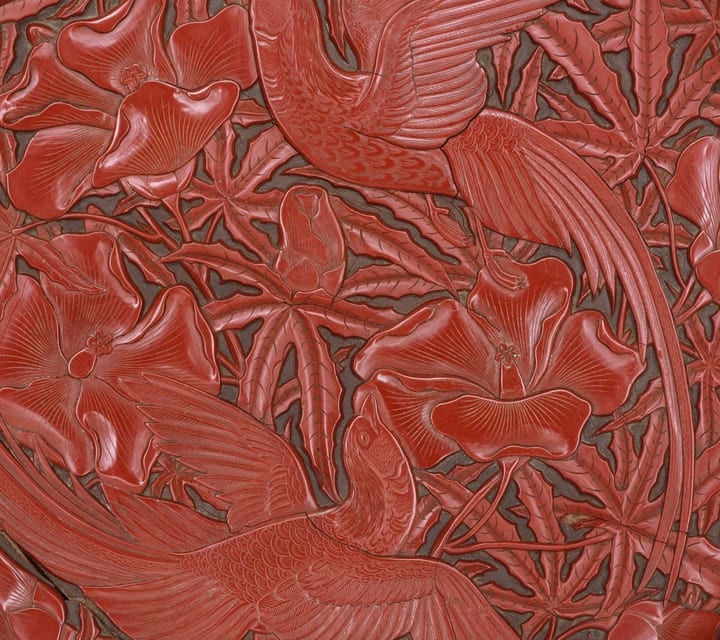
The museum explains how two birds fit the circular composition and how overlapping petals and successive levels of leaves enrich its depth. The unworked dark background also plays a part. The example shows relief built through relationships between foreground shapes and the spaces left behind them.
Carved lacquer is not always red
The Met also records a Hexagonal box with inverted corners, dated to the fourteenth–fifteenth century, as carved black lacquer with red layers. This material description is stronger evidence than a viewer’s guess from a photograph.
Another object, the late-fourteenth-century Tiered box with a praying official, is catalogued as carved black lacquer on a gilded ground. Red, black, and differently colored underlying areas can therefore appear in distinct documented arrangements. Color alone does not define the category.
Read the vessel as well as its relief
A dish presents a broad field bounded by its rim. A lidded or tiered box distributes decoration across separate parts and curved walls. These forms change how a viewer encounters the pattern. They should not be reduced to interchangeable examples of a red surface.
Start with the collection’s title, date, attribution, and material line. Then look for depth, background, borders, and the relationship of the design to the form. These observations help explain an identified work; they do not authenticate an unrecorded object or establish its pigment composition.
Following a workshop sequence
The Beijing field study separates support preparation, ground work, repeated coating, design, carving, and finishing into connected stages. The sequence below condenses that account rather than prescribing one recipe. Preparation and finishing remain part of the craft even though carving supplies its name.
The lacquerware overview and ceramics comparison supply broader material context. The companion inlay guide explains another way to use lacquer in making an image.
Museum photographs and credits
Dish with long-tailed birds and hibiscuses, mid-14th century, attributed to Zhang Cheng; carved red lacquer. The Met, 2011.120.1. Public domain/CC0; resized. Changes: Full original composition retained; downscaled proportionally and JPEG-optimized. No content retouching, recoloring, compositing, rotation, generative editing or upscaling. Source and rights links appear below. No museum endorsement is implied.
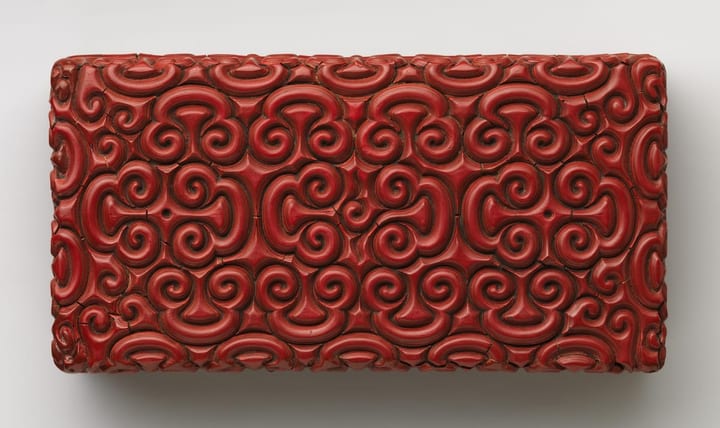
Rectangular box with pommel scrolls, first half of the 14th century; catalogued as carved red and black lacquer (tixi). The Met, 2015.500.1.1a, b. A finished object illustrating material and cut ornament, not a process photograph. Public domain/CC0; cropped and resized. Changes: Cropped from the original museum photograph to the recorded native-pixel crop box; downscaled proportionally and JPEG-optimized. No content retouching, recoloring, compositing, rotation, generative editing or upscaling. Source and rights links appear below. No museum endorsement is implied.
Detail crop from the same photograph of The Met’s 2011.120.1 dish shown above. Relief carving separates feathers, petals and leaves from the dark ground. Public domain/CC0; cropped and resized. Changes: Cropped from the original museum photograph to the recorded native-pixel crop box; downscaled proportionally and JPEG-optimized. No content retouching, recoloring, compositing, rotation, generative editing or upscaling. Source and rights links appear below. No museum endorsement is implied.