Chinese ruyi sceptres: a shared name, several kinds of use
The Met explains that ruyi-shaped sceptres were given as gifts because of the good wishes their name implied. Its account also describes their place in displays, sometimes on stands and sometimes in vases or brush pots. The object belongs to a wider setting of furnishings and collected things, not only a moment of ceremonial presentation.
Penn Museum’s eighteenth-century jade example, C147, adds a court context: its description discusses officials presenting ruyi to an emperor on important occasions. These accounts support several uses. They do not make every surviving sceptre an imperial possession or the record of the same ceremony.
The head, handle and intermediate fields organise the design
Penn’s C147 has a stylised fungus-shaped head, with a bat-dragon and a bird among its recorded motifs. The Nelson-Atkins Museum’s Qing lacquer sceptre, 2012.9.2, instead has an S-curved profile, a broad ogival head and thickened middle and end sections. Those descriptions show why the outline should be read with the particular object.
Follow the shape from head to handle end, then locate the principal decorated fields. A broad head can carry a scene, while narrower connecting passages carry smaller ornament. The design has to work across an elongated object rather than fill the continuous circular field of a dish.
A jade sceptre asks a stoneworking question
Penn identifies the material of C147 as greenish-white jade. It does not specify nephrite or jadeite in the cited record, so the more general identification should remain intact. The material is not established simply by a pale or green appearance.
Compare the carved forms with the underlying profile: how does a projecting motif meet the handle, and how much of the outline remains open to view? Our jade-carving guide explains the abrasive shaping and finishing involved in jade working. That material-based account complements the object’s gift history without turning every jade carving into a ruyi.
Carved lacquer builds material before it removes it
The Nelson-Atkins account describes lacquer accumulated in layers and then carved in high relief. Its sceptre has Daoist immortals on the principal panels, with fungi and peaches included in the scenes. Butterflies, melons and plum blossoms occupy connecting sections. The recorded medium is lacquer on wood with fibre.
The Met’s Ruyi scepter, 2015.500.1.110, supplies another red-lacquer example, catalogued to the Qing Qianlong period, 1736–95. Its record does not provide a narrower object date. Compare these material descriptions with the jade example: a carved lacquer surface is worked in built-up coating, rather than being the same kind of solid stone construction.
Metal and enamel can make a composite object
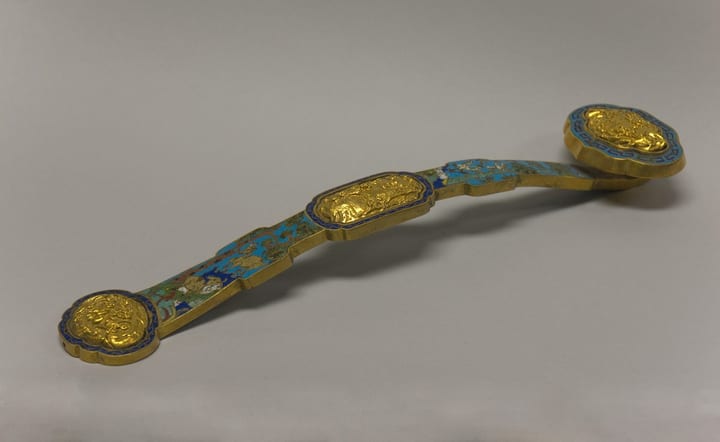
The Met’s 29.110.45 is dated to the eighteenth–nineteenth century and catalogued as cloisonné enamel with gilt-bronze medallions. The enamelled areas and medallions belong to a composite construction. Its recorded medium gives a better basis for discussing those parts than calling the complete sceptre jade or solid gold.
The Smithsonian’s F1937.45 is a different court example, recorded as gold, turquoise and silk and presented to the Qianlong emperor in 1783. The museum identifies turquoise bats and peaches on its head and connects them with good fortune and immortality. Keep that interpretation with this documented gift, rather than assigning one identical meaning to every motif on every ruyi.
Compare the craft route as well as the symbol
A useful comparison asks three questions in order: what is the sceptre made from, how is its ornament constructed, and what does the record establish about its use? A gift history cannot explain every join or carved passage, while a material label cannot identify a recipient.
The carved-lacquer and jade-carving guides develop two of the making routes. The cloisonné comparison explains another role for metal boundaries and coloured enamel. Our kingfisher feather-work companion follows a surface-decorating method used on other historical objects. These connections distinguish an object form from the many techniques that can give it its finished appearance.
Images and credits
Ruyi Scepter, China, 18th–19th century, Qing dynasty. Cloisonné enamel with gilt-bronze medallions. The Metropolitan Museum of Art, 29.110.45, Gift of Edward G. Kennedy, 1929. CC0. Uncropped museum photograph, resized for display.