Chinese tixi lacquer: colour bands inside the cut
The Palace Museum defines tixi as coloured lacquer applied in a regular sequence, built to sufficient thickness, and then carved so that different colours appear on the sides of the pattern. Those exposed sections are essential to understanding the technique.
A red surface with black decoration is not automatically tixi. The colours might have been painted or arranged through another method. For a catalogued example, look at how the colour lines follow the carved channel, alongside the museum’s material description. A photograph alone cannot authenticate an unrecorded object.
Plan the colour sequence before carving
The Jiangzhou heritage account describes successive coatings, with several applications contributing to a colour band. A visible band therefore need not correspond to one brushstroke or one application. The later carving depends on a colour structure already built beneath the surface.
The relative thicknesses also matter. The Palace Museum describes a dark-surfaced vase whose thicker black layers contain thin red ones, visible as red lines within the cuts. In another arrangement, dark lines appear within a predominantly red surface. Neither effect requires equal quantities of every colour.
Curves, cut depth, and a documented Yuan box
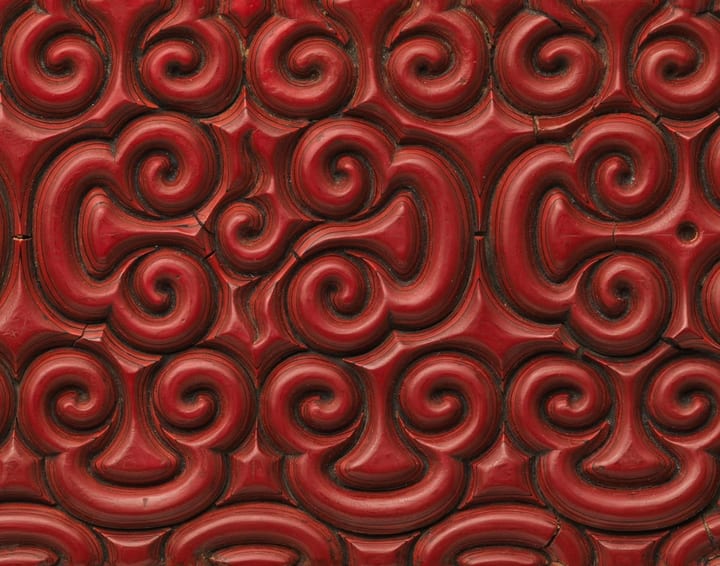
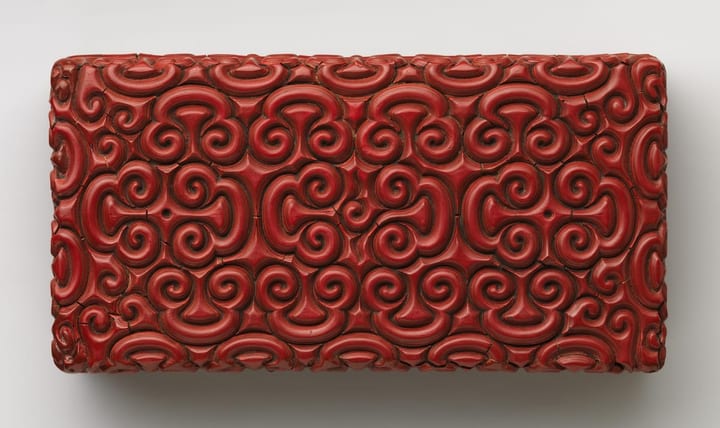
The Met’s Rectangular box with pommel scrolls, accession 2015.500.1.1a, b, is dated to the first half of the fourteenth century and catalogued as carved red and black lacquer, tixi. The lid photograph shows repeating curved units and dark bands following their carved contours.
The Met explains that the pommel-scroll name refers to resemblance to a Chinese sword pommel. It also notes that the reason for the motif’s creation and popularity is not known. Recognizing a resemblance does not establish a single symbolic meaning or a certain origin story.
Cut depth and profile affect the revealed lines. In discussing its own spiral-patterned lacquer box, the National Gallery of Victoria explains that coloured layers could help a carver judge the consistency of a gradient. The bands can be understood as evidence of control as well as visible ornament.
The lacquer structure and the supporting body
Carving takes place in the accumulated lacquer rather than simply decorating a carved wooden surface with paint. Wood can provide the core: the Smithsonian’s Small table, S1997.36, is recorded as tixi lacquer on a wood core. Its top and borders adapt related scrolls to a furnishing object.
The core is not always wood. The Palace Museum’s early-Qing vase has a porcelain body beneath its tixi coating. This unusual example makes a useful distinction: the body establishes the vessel, while the lacquer layers provide the material in which the coloured carving is formed. The general carved-lacquer guide explains that broader relationship.
Reading tixi and guri in museum language
English-language museum writing sometimes uses the Japanese term guri when discussing related scroll-patterned lacquer. The NGV uses that term alongside tixi for its box, while The Met explicitly records tixi in the rectangular box’s medium. Treat the words in their catalogue context. A guri label does not by itself establish a Chinese origin or an identical making method for every Japanese object.
Jiangzhou craft knowledge and the photographs
China’s national heritage directory records Jiangzhou tixi techniques in Xinjiang County, Shanxi, as a 2011 extension of the lacquer-decoration project. Its account connects support preparation, coating, design, carving, and polishing. This records a specific regional tradition; it does not assign that production place to all historic tixi objects.
The wider view and detail on this page come from the same museum photograph of the Met box’s lid. They show a finished historical object, with the closer crop revealing its carved contours. They do not show the underside, interior, or a workshop sequence. The lacquerware and inlay guides below place this method within a wider range of lacquer practices.
Museum photographs and credits
Rectangular box with pommel scrolls, China, first half of the 14th century; carved red and black lacquer (tixi). Wider view of the lid, The Met 2015.500.1.1a, b; Gift of Florence and Herbert Irving, 2015. Public domain/CC0. Cropped and resized from museum photograph DP222091. The detail below comes from this same photograph; this is a finished object, not a making sequence.
Detail crop from the same DP222091 photograph of The Met’s 2015.500.1.1a, b box lid shown above. Dark bands trace the curved carved channels. The Metropolitan Museum of Art; Gift of Florence and Herbert Irving, 2015. Public domain/CC0. Cropped and JPEG-encoded; no retouching or colour change. This is the same historical object and photograph, not a second object or a process photograph.