How Chinese gold-incised lacquer holds its pattern
The Palace Museum defines qiangjin through a clear sequence: incise the planned ornament, apply gold adhesive in the recessed pattern, then add gold powder. The cut determines where the gold design sits. Its appearance depends on both the line and the surrounding lacquer surface, rather than on a layer of gold spread across the entire object.
Follow a motif around a vessel or across a box lid. Small curls and close-set lines can organize a larger scene. Identify the main outlines first, then the finer details that give texture to clouds, foliage, or an animal’s body.
From the incision to a clean gold line
A technical lecture published by the Chinese Arts and Crafts Society describes lines of different widths cut into the lacquer. Gold-binding lacquer is placed in the grooves; when it has the required tack, leaf is applied and worked into the incisions. The excess is swept away, leaving the intended drawing in gold.
Powder and leaf appear in different technical descriptions, so both belong in an explanation of the craft. The practical constant is their relationship to the recessed design. The workshop sequence makes the narrow line legible again after the broader application of gold, allowing the colored ground to remain part of the composition.
When colored lacquer and qiangjin work together
The Palace Museum describes tianqi qiangjin as a combined process. Recessed areas are filled with colored lacquer and leveled to form a smooth pattern. Outlines and internal details are then incised, supplied with adhesive, and given gold leaf. The colored shapes and gold details therefore result from related but distinct operations.
This combination can create broad areas of color edged or articulated by fine gold. Tokyo National Museum’s exhibition record includes a Chinese qiangjin-and-colored-lacquer box with boys, dated 1736–1795. It places such work alongside carved lacquer and shell inlay, demonstrating the range of approaches within Chinese lacquer decoration.
A Yongle scripture box with dragons amid clouds
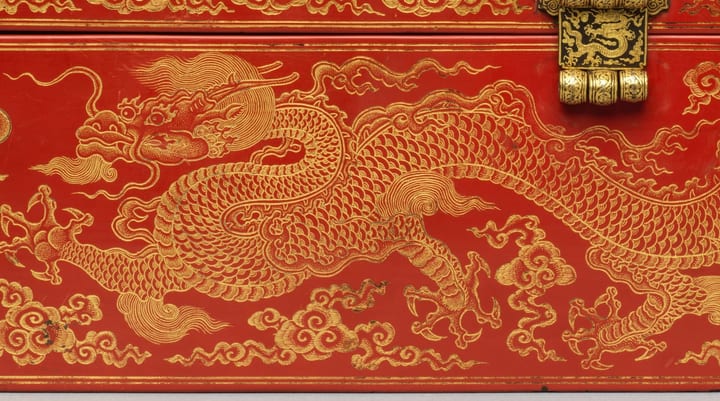
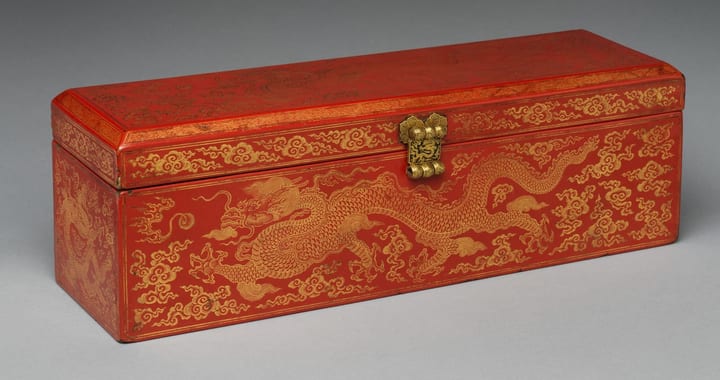
The Met’s Sutra box with dragons amid clouds, accession 2001.584a–c, belongs to the Yongle period, 1403–1424. The museum identifies it as an imperial-workshop container for Buddhist scriptures in Chinese handscroll form. Its gold dragons move through clouds across the red box and lid, joining a pictorial subject to a particular religious use.
The current record explicitly identifies the incised red surface and gold-filled design. It also lists a damascened brass lock and key. These fittings help explain the box as an assembled object: its lacquer ornament and metal hardware have their own materials and working methods. The gold decoration in the lacquer should be read separately from decoration on the fittings.
Another box, another purpose
LACMA’s Seal Box with Lotus Scrolls and the Eight Buddhist Symbols, accession AC1993.139.1, is also dated to the Yongle period. Its catalogue identifies red lacquer with incised and gold-filled qiangjin decoration, together with gilt-bronze fittings. This offers a second documented use for the technique, at a more compact scale.
Compare the long handscroll container with the seal box’s proportions and ornament. Their designs respond to what the containers hold and how their surfaces are divided, showing the same decorative method adapted to different objects.
Placing qiangjin beside related techniques
Carved lacquer develops relief within a built-up lacquer surface. Qiangjin uses incisions to locate a gold drawing, while the colored-lacquer combination adds another stage of filling and leveling. The companion carved-lacquer guide explores that different relationship between surface depth and ornament.
Gold and silver inlay on metal, covered in a separate guide, works with a metal body. Gold painting or scattered gold on lacquer also needs its own description. For a museum object, use the recorded technique to guide close looking; gold color alone cannot identify how its decoration was made.
Museum photographs and credits
Sutra box, China, Yongle period (1403–24). Incised red lacquer with gold-filled decoration and damascened brass fittings. The Met, 2001.584a–c. Public domain/CC0; cropped and resized.
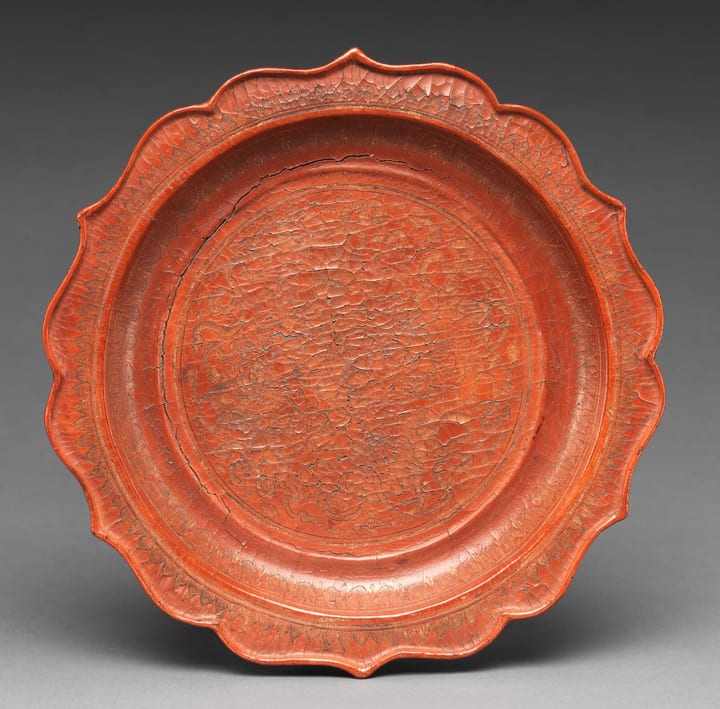
Pedestaled dish, China, 13th century. The Met identifies its engraved gold decoration as qiangjin. Surface cracks and worn lines remain visible. The Met, 2015.500.1.51. Public domain/CC0; cropped and resized.
Dragon and cloud detail from the same sutra box, The Met, 2001.584a–c. Cropped from an alternate museum photograph of the box. Public domain/CC0; cropped and resized.