She County, Wuyuan and the name Sheyan
The national intangible-heritage register has separate entries for She inkstone making in She County, Anhui, and Wuyuan County, Jiangxi. Both belong to project Ⅷ-74, included in the first national list in 2006. The official account explains that Wuyuan formerly belonged to Huizhou, so its products also carry the She name.
This history helps a reader understand why a modern provincial boundary does not define the whole tradition. For comparison, the Duan inkstone guide follows a different regional craft associated with Zhaoqing in Guangdong. The shared purpose of grinding ink leaves room for distinct stone sources, workshops and design traditions.
Stone patterns and the choice of a blank
The heritage record’s pattern names are part of the language used to discuss She stone. Luowen (罗纹), meiwen (眉纹), jinxing (金星), jinyun (金晕) and yuzi (鱼子) distinguish families of appearance. They offer a vocabulary for looking at a surface rather than a mineral analysis of every dark slab.
Material selection also concerns the shape and condition available for carving. The Shezhou production account describes preparing a blank by sawing and grinding, then fitting a design to its size, form and quality. The maker must resolve a usable object within that particular piece of stone, rather than impose the same layout on every blank.
The grinding area and the ink pool
The Palace Museum’s rectangular She-stone inkstone with a bottle-shaped pool, accession 故00133837, makes the functional layout unusually clear. Dated to the Qianlong period, it measures 15.5 by 10 centimeters and is 2 centimeters thick. Its face depicts a vase with two chi-dragon handles: the vase mouth becomes a deep oval ink pool, while the belly becomes the grinding area.
The museum distinguishes yantang (砚堂), the open central area for grinding, from yanchi (砚池), the recess for liquid ink. Here the depicted vessel organizes those practical spaces. Follow the change from the broad plane to the smaller hollow before considering the ornament. The catalogue also records eyebrow-like markings across the grinding area, star-like speckling and a plain back.
From hollowing to fine carving
The Shezhou account separates rough work from refinement. It describes forming the pools and hollowing the reverse before refining the carved forms; decorative outlines are developed before smaller details. The national heritage record places this within a broader sequence of selecting stone, conceiving the form, shaping, design, carving, smoothing and preparing a box.
These accounts explain the relationship between structural cuts and surface detail. A deep recess changes the object’s working form, while a border or inscription changes how it is read. Finishing and fitting a box complete the documented workshop sequence; the photograph of a finished museum object does not reveal which individual tools made each cut.
A roof-tile form with an inscribed base
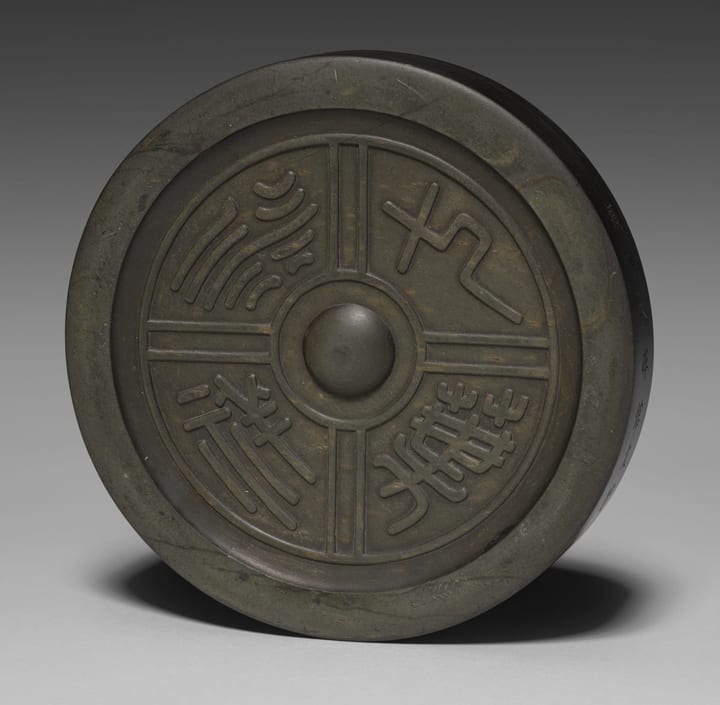
Cleveland Museum of Art’s Inkstone in the Shape of a Roof Tile with Seal Script Characters, accession 2023.50, is catalogued as She stone. The museum dates it to the 1700s–1800s and attributes it to the Workshop of Jian Guzhai. Its diameter is 14.9 centimeters. The photograph here shows the base, with four characters arranged around a central circle.
The museum identifies those characters as seal script and reads them as a wish for enduring good fortune over seven generations. Standard-script inscriptions on the side record the workshop and a collector’s studio. The roof-tile reference is therefore a chosen historical form, not a claim that this Qing object is an excavated Han tile. Its decorated base is also distinct from its ink-grinding face.
Reading a catalogue and a photograph together
A museum’s She-stone identification supplies information that the photograph alone cannot establish. The image lets you examine lettering, edges and composition; the catalogue supplies material, date and attribution. Keeping those roles clear avoids identifying a quarry from color or treating every attractive marking as proof of grinding quality. The Four Treasures guide places this specialized object back beside the brush, inkstick and paper used with it. The Huizhou inkstick guide follows the manufacture of the solid ink used with it.
Images and credits
Base of a She-stone inkstone in the shape of a roof tile, Workshop of Jian Guzhai, China, 1700s–1800s. The grinding face is not shown. Cleveland Museum of Art, 2023.50; Norman O. Stone and Ella A. Stone Memorial Fund. CC0; cropped and resized.