Water belongs beside the inkstick and inkstone
The University of Michigan Museum of Art describes this use beside a ninth-century bird-shaped earthenware example. Its account links the vessel with controlling ink consistency for calligraphy and painting. The dropper is consequently worth looking at as a working implement, alongside its decorative surface.
A turtle-shaped vessel makes the route of water clear
Hong Kong’s Antiquities and Monuments Office records a pottery turtle-shaped water dropper excavated at the Sung Wong Toi Station site. Its account identifies a small filling hole on the back. When the vessel is tipped forward, water leaves slowly through the mouth and reaches the inkstone.
The office places it among writing implements from the Song-period site, including inkstones and brush holders. This archaeological context is different from identifying an isolated vessel by resemblance alone. The animal shape and the practical arrangement of openings belong to the same object.
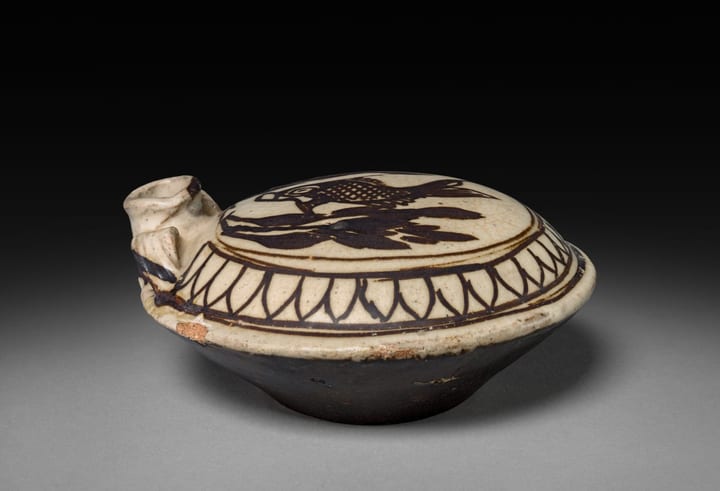
The photograph shows a Cizhou-ware example
Cleveland Museum of Art catalogues the illustrated water dropper, 1948.209, as Chinese Yuan-dynasty Cizhou stoneware, dated 1271–1368. Its diameter is 12.5 centimetres and its height 5.7 centimetres. These measurements distinguish a broad, low container from a tall pouring vessel.
The complete photograph shows a painted fish and plant forms across the light upper surface, a darker lower body and a projecting spout with visible losses. Follow the circular shoulder pattern before moving to the fish. The image records a surviving historical object; it does not demonstrate its flow rate or establish the condition of its interior.
A small ewer reveals a different making sequence
Princeton’s Small water dropper, accession 2019-320, is a Chinese Song-dynasty qingbai porcelain vessel. The museum describes two semicircular sides joined vertically, with molded floral relief and raised dots. A filling hole pierces one side; a spout and loop handle are added on opposite sides.
A light-blue glaze covers the exterior, while the flat base remains unglazed. That recorded construction explains how a maker assembled this particular small ewer. It should not be imposed on the differently shaped Cleveland stoneware vessel or on a cast-metal example.
Metal forms can carry another visual language
The Met’s fifteenth-century rhinoceros-shaped water dropper, 2015.294, is catalogued as copper alloy. The museum points to the animal’s horn and folded hide, interpreting the close rendering as possibly informed by a living rhinoceros. That possibility remains the museum’s suggestion, rather than a proven workshop model.
A separate fourteenth-century copper-alloy dropper in the shape of a three-legged toad, L.2025.30.3, connects a scholar’s implement with an auspicious subject. The Met associates that creature with prosperity and examination success. These are meanings attached to that documented form, not symbols to assign to every animal-shaped container.
A catalogue may preserve uncertainty about use
The Lowe Art Museum calls its early-eighteenth-century Chinese turquoise-glazed vessel Wine Cup or Water Dropper. The form recalls the ancient bronze jue. Its account explains that such archaistic objects could decorate a scholar’s desk, while retaining the possibility that this one dispensed water for preparing ink.
The word “or” matters. A historical-looking shape is not enough to settle how every vessel was used. Keep a catalogue’s uncertainty visible, and separate a familiar name from the evidence of an opening, spout, archaeological setting or documented function.
Compare the accessory with the craft of the inkstone
The She inkstone guide follows stone selection, carving and the relationship between a grinding area and an ink pool. This guide instead follows the separate vessel that supplies water. Considering them together reveals two complementary design questions: where ink is prepared, and how water reaches that surface.
When studying museum objects, use enlargements and catalogue descriptions to compare these arrangements. A photograph of an old dropper is an invitation to look closely at form and decoration, not a reason to test it with water or treat its historical surface as a modern classroom tool.
Images and credits
Water Dropper, China, Yuan dynasty, 1271–1368; Cizhou stoneware. Cleveland Museum of Art, 1948.209, Purchase from the J. H. Wade Fund. CC0. Complete museum photograph, uncropped and resized; the historical spout and surface retain visible losses.