Chinese calligraphy scripts: a useful five-part grouping
The Asian Art Museum distinguishes a script from an individual writer’s style. Seal, clerical, regular, running, and cursive are broad script categories; two artists working in regular script need not look alike. English labels also vary: regular may be called standard, and running may be called semicursive.
Five is a teaching framework, not an inventory of all historical writing. The Smithsonian’s overview separately includes oracle-bone writing. Here, “five major styles” means the familiar starting group.
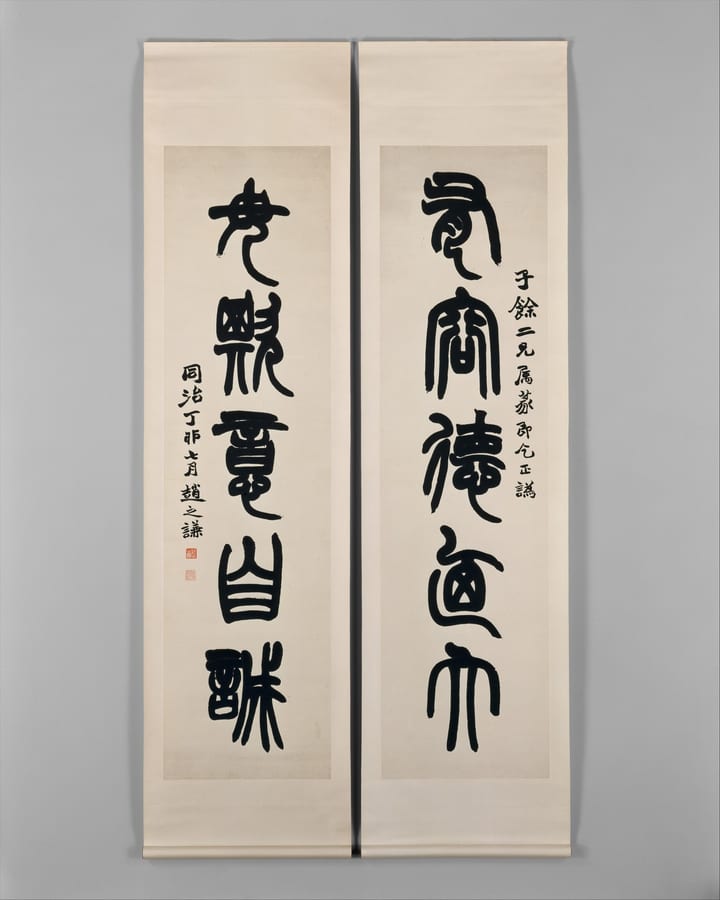
Seal script — 篆书, zhuanshu
Seal script preserves forms associated with early Chinese writing and appears in later brush calligraphy as well as seals. Do not assume that something described as seal script must be a carved stamp.
The National Palace Museum describes a Yu He album in which seal-script characters are elongated with slender lines. The same passages alternate with clerical script, giving a concrete comparison of form. That description belongs to the album; it is not a rule for every seal-script work.
Clerical script — 隶书, lishu
Clerical script is strongly associated with Han-period writing. Broad character shapes and extended horizontal or diagonal strokes are useful features to look for, rather than a requirement that every character have one decorative ending.
The Smithsonian’s account of He Shaoji’s later Kong Zhou Stele study highlights compact forms, emphatic horizontals, and long diagonals. Studying an older model means a later work’s script does not itself date the object.
Regular script — 楷书, kaishu
Regular or standard script articulates individual strokes within a balanced character. Look at how a stroke starts, turns, and ends, and how the separate parts occupy space. A clear structure can still contain strong differences in brush pressure and character proportions.
The Asian Art Museum presents regular script as readily legible. Clear structure helps learning, but does not guarantee that every viewer can read an unfamiliar inscription.
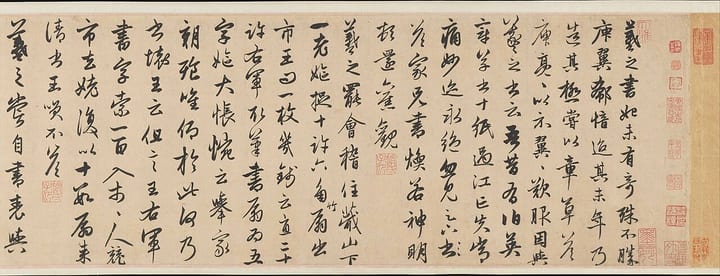
Running script — 行书, xingshu
Running, or semicursive, script reduces some separations and gives brush movement a more continuous flow. The museum’s teaching chart explains that strokes tend to join within a character while the brush is usually lifted between characters.
Treat this as a tendency. Follow the actual connections, changes of direction, and intervals between forms. A line can feel connected through its rhythm even where the paper shows a visible gap.
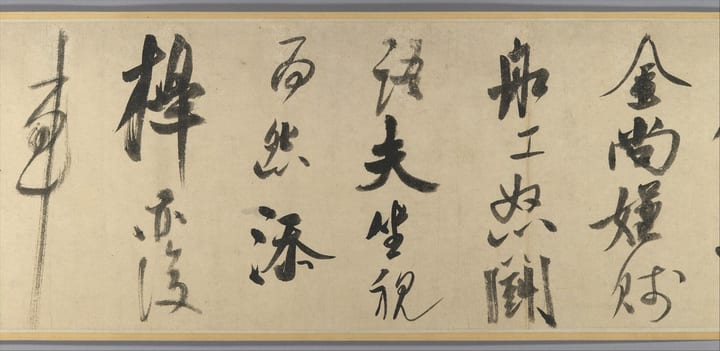
Cursive script — 草书, caoshu
Cursive script uses abbreviated character forms and may connect characters through continuous brush movement. Recognizing a character can require knowledge of its cursive conventions; it is not simply regular writing made untidy.
The Met explains that control and expressive movement work together. Notice changes in scale, dark and light ink, and the balance across a line. Apparent spontaneity does not mean that any freely drawn shape becomes a readable cursive character.
History continues inside later works
These headings are arranged for comparison, not as an invention timeline. The scripts developed through interrelated changes, and older forms remained available to later calligraphers. The Met’s Out of Character exhibition describes artists combining scripts and drawing inspiration from early stone and bronze inscriptions.
When examining a photograph, separate the script identification from the work’s title, artist, date, and material. A reliable collection record supplies context that visual resemblance alone cannot establish. The related seal-impression guide follows written forms into another medium.
Photographs, credits and reading boundaries
Mi Fu, Poem Written in a Boat on the Wu River, ca. 1095, detail. Cursive script (草書). The Metropolitan Museum of Art, 1984.174; CC0. Resized. Resized/JPEG optimized; image content unaltered. The museum source file is a section photograph where caption says detail. Source and license links are below. No photographer or museum endorsement is implied.
Zhao Zhiqian, Couplet, 1867. Seal script (篆書). The Metropolitan Museum of Art, 2000.345.1, .2; CC0. Resized. Resized/JPEG optimized; image content unaltered. The museum source file is a section photograph where caption says detail. Source and license links are below. No photographer or museum endorsement is implied.
Zhao Mengfu, Four Anecdotes from the Life of Wang Xizhi, 1310s, detail. Running script (行書, Chinese catalogue designation). The Metropolitan Museum of Art, 1989.363.30; CC0. Resized. Resized/JPEG optimized; image content unaltered. The museum source file is a section photograph where caption says detail. Source and license links are below. No photographer or museum endorsement is implied.