Pine soot vs oil soot ink: the source of the soot
Songyan mo, 松烟墨, names ink made with soot from burned pinewood. Youyan mo, 油烟墨, names the oil-soot route. The Huizhou heritage record discusses oils such as tung and hemp alongside pine-soot production. These terms describe the origin of a carbon material before it is worked into a stick.
Oil soot therefore identifies the fuel source, rather than saying that the writer applies an oil-paint medium. The finished solid ink is prepared with water on an inkstone. Keeping fuel, soot, binder and prepared liquid ink distinct makes the comparison easier to follow.
Different materials require different soot-making methods
The official Huizhou account emphasizes variation between workshops and raw materials. It names preparation, smoke generation, cooling, collection and storage as distinct operations for materials including oils. For pine soot, it mentions kiln construction, firing, adding pine branches and collecting soot. The difference reaches beyond substituting one ingredient in an otherwise identical recipe.
Glue selection and mixing are also workshop knowledge. The soot label identifies one production stage without disclosing every ingredient or decision. Huizhou provides a documented regional example of that variation.
Luster is a useful observation, with limits
A Palace Museum lecture on Chinese painting summarizes oil-soot ink as lustrous and pine-soot ink as matte. This gives a practical vocabulary for discussing a visible difference. It should be read as the lecturer’s broad comparison, rather than as a test that identifies every historic ink or ranks one category above the other.
Also distinguish the surface of the solid object from ink applied to paper. The Met’s materials guide explains that ink tone can vary with ingredient purity, concentration and dilution. A darker or lighter wash is therefore not simply a label announcing which soot source was used.
A pine-soot ink cake with a decorated coating
The Palace Museum’s Tianbao jiuru imperial ink cake, accession 故00131538-11/26, makes the surface distinction concrete. The catalogue dates it to the Qianlong period and explicitly calls it pine-soot ink. It also describes a lacquer coating over the original ink body, followed by gold and colored decoration.
Its appearance therefore includes a separately applied decorative surface. Reading a photograph of that coating as evidence for the writing ink’s soot would collapse two different parts of the object. The catalogue supplies the material identification and explains the finish; each piece of information contributes something that a simple judgment of shininess cannot establish.
Why conservation research goes beyond photographs
Smithsonian conservation scientist Jennifer Giaccai explains that pine soot and lampblack can be chemically very similar despite their different production conditions. Her 2021 symposium account describes samples collected from ten modern soot and ink workshops in China and Japan and investigated with several scientific methods.
The reported results identify Raman spectroscopy as a potential way to recognize lampblack ink on an artwork without taking a sample. The account also acknowledges that more remains to be studied. This is evidence of a research approach, not a visual shortcut for assigning every inkstick or painted line to a soot category.
A museum ink cake as a material comparison point
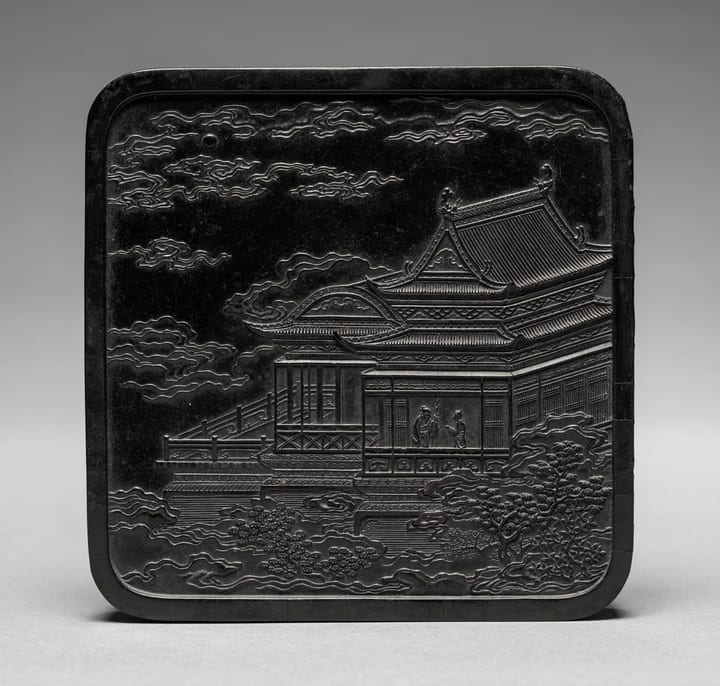
Cleveland Museum of Art’s Ink Cake with Architectural Design, accession 1942.212, is catalogued as Chinese molded ink, dated 1736–95. Its photograph shows the finished architectural decoration. The record does not specify pine soot or oil soot, so the image here illustrates an ink cake without standing for either side of the comparison.
The museum explains that an ink cake is ground with a little water on an inkstone. When considering a prepared ink, separate observations about its dark tone, diluted wash and surface reflection from a claim about its ingredients. The Huizhou guide follows the wider manufacturing tradition; the Four Treasures and She inkstone guides place solid ink beside the other working materials.
Images and credits
Ink Cake with Architectural Design, China, 1736–95. Molded ink; soot source unspecified in the catalogue. Cleveland Museum of Art, 1942.212; Gift of Henry W. Kent. CC0. The complete museum photograph is used uncropped and resized for display.