A fitted interior can organize more than one working piece
The National Museum of China describes a lacquered wooden box with a rectangular recess for a slab inkstone and a square recess for a grinding stone. Ochre lacquer coats the lid inside and outside. Coloured lacquer on the exterior forms cloud-and-animal designs, with black lines defining the animals.
The account connects this object with writing because brushes and wooden writing slips were found with it. The interior arrangement matters: the slab and its separate grinding stone have different places within one container. Archaeological association and fitted recesses together provide evidence for the working ensemble.
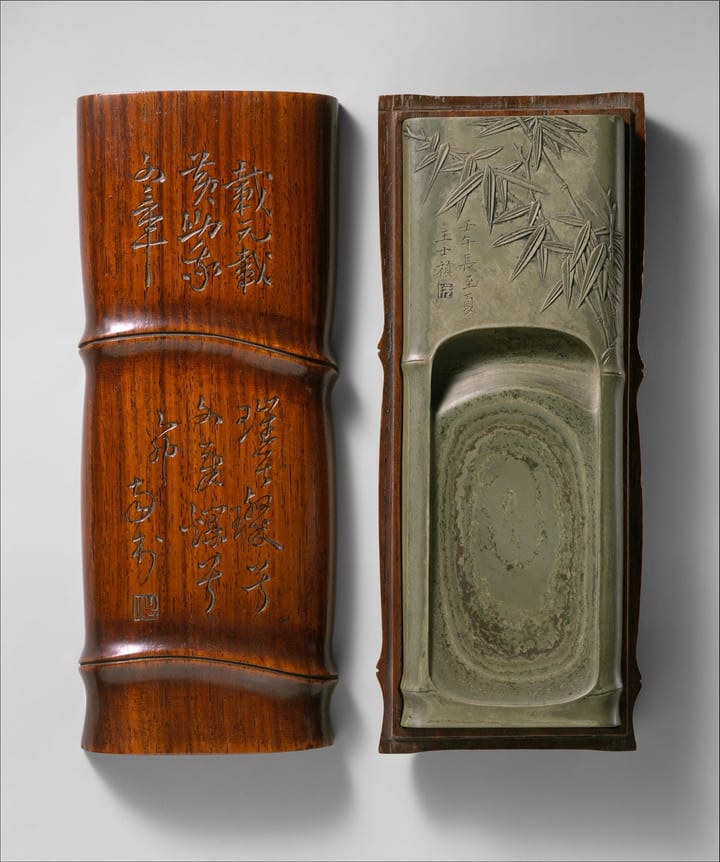
The photograph shows a bamboo-shaped lid beside its inkstone
The Met’s 1981.120.1a–c combines green schist with a wooden case. The photograph shows an inscribed bamboo-shaped lid beside the carved stone seated in its wooden surround.
The catalogue dates the work to the late eighteenth century while discussing questions raised by inscriptions carrying earlier dates. Keep those distinct kinds of evidence visible. A date written on a component does not by itself settle the making date of every part of an assembled object.
A qin-shaped stone receives a correspondingly shaped case
The Palace Museum’s late-Ming Duan-stone inkstone, 新00092133, follows the outline of a qin. Its accompanying hongmu-wood box follows that form and carries an inset bamboo carving of a picture about returning an inkstone. The box’s picture bears Cheng Tinglu’s name.
This object brings several surfaces into a small ensemble: stone, fitted wood and inset bamboo. Trace the relationship between the inkstone’s outer line and its container, then read the decoration on the lid. The case gives the object another place for a picture and an inscription, beyond the inkstone’s working face.
Gold decoration can extend across the inside and outside
The Palace Museum records a black-lacquered, gold-decorated box accompanying its Yongzheng Songhua-stone inkstone, 故00134310. The lid presents a landscape with pavilions, while flowering sprigs decorate the inside. The catalogue places this ensemble among Qing court objects.
Looking at both sides reveals how a container can organize more than one subject. A landscape on the closed lid and flowers within become visible at different moments of opening. These recorded decorative surfaces belong to this particular case; the photographed bamboo-shaped wooden case has its own material and inscriptions.
A stone box can incorporate an openwork cover and glass
Another Palace Museum Songhua-stone inkstone, 故00134706, belongs to the Kangxi period. It is accompanied by a purple stone box whose cover combines openwork with an inset flat glass panel. Coiled-dragon ornament runs around the border.
The museum records the box as 19.5 centimetres long, 13.8 centimetres wide and 5.3 centimetres high, alongside separate measurements for the inkstone. Those two sets of dimensions describe different components. The cover’s openwork, glass and decorated edge show why the surrounding case deserves examination as well as the grinding surface.
A living stone-working tradition describes choices for the box
The national heritage record for Songhua-stone inkstone making in Benxi, Liaoning, distinguishes material choices: green stone for inkstones, and purple-green or yellow stone for boxes. It lists rectangular and oval forms along with shallow, deep and openwork carving.
This account connects selecting colour, shaping and carving within a particular living tradition. It supplies a documented approach to stone boxes, rather than instructions for constructing the wooden case in the photograph.
Follow the case and the grinding implement as related objects
The related She inkstone guide follows a regional stone tradition and the arrangement of grinding area and ink pool. Here the focus is the fitted surround, cover and decoration around the implement. Reading both guides keeps the stone’s working surface and the container’s craft in view.
Images and credits
Inkstone with Bamboo Design, China, catalogued late eighteenth century; green schist and wood case. The Met, 1981.120.1a–c. CC0. Complete photograph, uncropped and resized for display.