Peking opera role types are performing specializations
The National Peking Opera Company explains hangdang as categories shaped by a character’s age, disposition, occupation and social position, with corresponding conventions of appearance and technique. Its account emphasizes that stage presentation transforms everyday life. A role type therefore offers an artistic vocabulary, rather than a realistic portrait of everyone in a social group.
Keep three things separate: the named character, the performing specialization and the actor. A programme’s character and cast lists identify the part and performer.
Sheng: different approaches to male characters
Sheng covers male-character roles outside the principal Jing and Chou classifications. Familiar branches include laosheng, usually mature or older men; xiaosheng, younger men; and wusheng, with a martial emphasis. Age is one part of the distinction, alongside the techniques needed for the character.
Beijing Opera Theatre distinguishes the vocal approaches of laosheng and xiaosheng, the latter combining vocal registers. Wusheng requires developed physical and combat skills. These differences make Sheng more useful as a family of specializations than as a translation meaning simply the hero.
Dan: female characters and contrasting techniques
Dan is the broad category for female characters. Its subdivisions include qingyi, also called zhengdan; huadan; laodan; wudan; and daomadan. The distinctions involve age, temperament and technical emphasis. Qingyi places particular weight on singing, huadan on lively characterization and movement, and laodan on the portrayal of older women. Martial branches develop their own physical requirements.
The boundaries have also developed through artists’ work. The National Peking Opera Company describes Mei Lanfang’s command of qingyi, huadan and daomadan and his contribution to combining their strengths in huashan. It records dances shaped for particular plays, including sword work in Farewell My Concubine. This example shows a specialization as an evolving artistic practice, rather than an unchanging checklist.
Jing: painted faces and several kinds of emphasis
Jing, often called hualian, usually portrays male characters and is strongly associated with patterned facial makeup. Beijing Opera Theatre distinguishes singing-centered tongchui hualian, movement-centered jiazi hualian and martial wujing. These branches place different demands on the performer. The category is broader than the appearance of a striking face pattern: voice, physical presence and characterization also contribute to the stage image.
Read a painted face with the named character and the performance. The category does not amount to one universal moral judgment, and a single color detached from its pattern and dramatic setting cannot explain the whole role.
Chou: comic characterization includes martial skill
Chou is associated with comic roles, often marked by a small white-painted area near the nose. Wenchou and wuchou distinguish branches with different performance demands: the former emphasizes speech and acting, while the latter combines speech with agile martial movement. Comedy here depends on trained delivery and physical control, rather than simply wearing comic makeup.
A Chou character is a particular person in a story. The label alone establishes neither occupation nor moral worth.
The character’s gender and the actor are separate questions
Historical and modern casting make this distinction concrete. The Palace Museum identifies Mei Lanfang as a male performer of Dan roles. A National Centre for the Performing Arts announcement from 2012 identifies Wang Peiyu as a female laosheng specialist. These documented examples show why male-character and female-character categories should not be read as rules describing an actor’s identity.
For a particular production, distinguish the character’s category from the performer’s documented specialization and the programme’s casting information.
Shared foundations support different specialties
Peking-opera training brings singing, speech, acting and combat skills together, although individual specializations emphasize them differently. A 2017 National Academy of Chinese Theatre Arts teaching report discusses wusheng, wudan, wujing and wuchou across opera training. Its educators stress that martial performers also need vocal and spoken foundations and must shape characters, not only display techniques.
Within that teaching initiative, foundational skill supported a chosen repertory part. A martial specialty remained connected to the drama’s words, relationships and changing situations.
What a theatrical robe can tell us
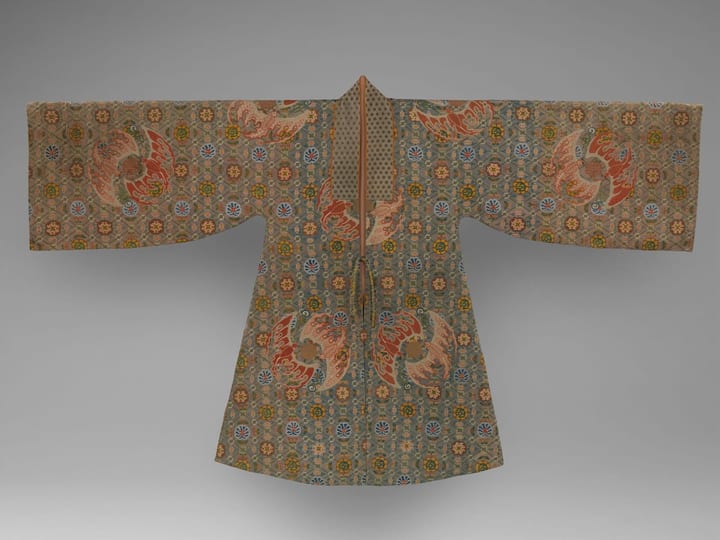
The Met’s Theatrical Robe for a Male Role, accession 32.30.10, dates to the second half of the eighteenth century. Its record describes an elite male character’s casual clothing and compares its embroidery with Qing court theatrical costumes. It offers historical context for how dress presents a stage character.
The catalogue does not assign this robe a specific Sheng subtype or a named Peking-opera production. The photograph is therefore a costume example, not a diagram of the four categories. For the broader art and its relationship to Kunqu, continue through the related guides.
Images and credits
Historical theatre costume: Theatrical Robe for a Male Role, China, second half of the eighteenth century, silk embroidery on silk gauze. The Metropolitan Museum of Art, 32.30.10, public domain/CC0. The museum identifies a male role and compares the robe with Qing court theatrical dress; it does not identify a particular Peking-opera production or one of the Sheng subtypes.