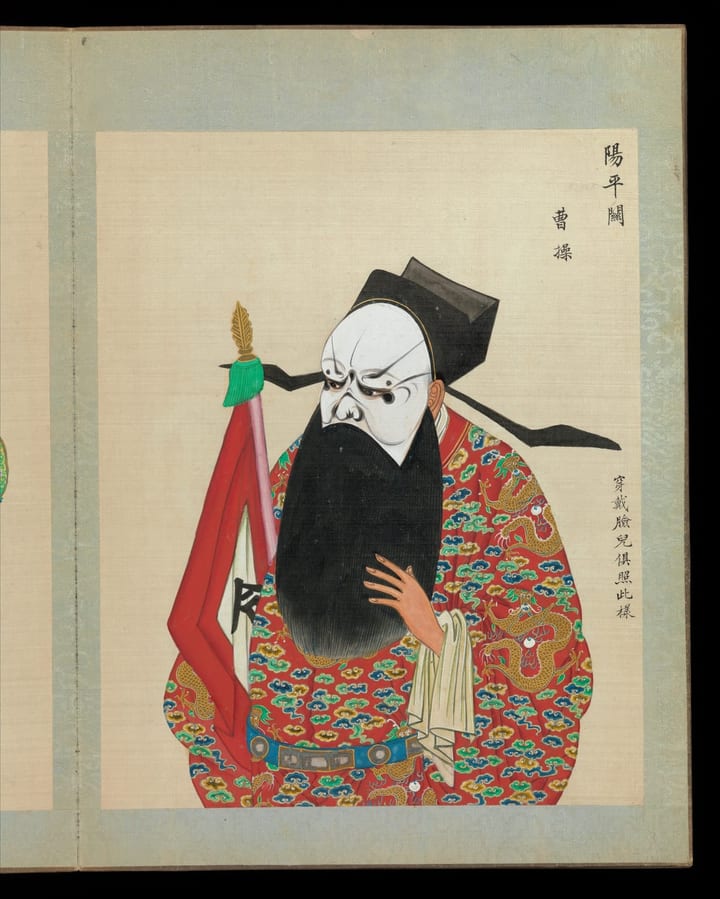
Peking opera face painting is a pattern system
Lianpu is closely associated with Jing, the painted-face performing category, and with the distinctive makeup of Chou roles. The related role-types guide explains those specializations. Here, the focus is the organization and application of the design itself.
Keep two kinds of description separate. A term may describe how colour is applied, while another names the arrangement of coloured areas and lines. The National Academy of Chinese Theatre Arts museum separates application types, principal colours, patterns within a play and named artists’ versions in its collection.
Read the arrangement before decoding a colour
Beijing Opera Theatre describes zhenglian, a whole-face arrangement built around a principal colour with the features delineated. In sankuaiwa, often translated as three-tile face, the treatment of brows, eyes and nose sets off three major areas: the forehead and two cheeks.
Shizimen organizes the face differently. Its vertical strip through the forehead and nose meets the eye-area treatment to produce a cross-like arrangement. These names describe relationships across the face. They are more informative than identifying a design as simply red, black or white.
The theatre also describes suilian, a more complex broken-up arrangement, as occurring with both positive and negative characters. A pattern family therefore cannot be used as a universal judgment of moral worth.
Painting method and finished pattern are different
The academy’s collection lists rou, gou, mo and po as basic categories. A CCTV opera explainer gives practical detail for the first two. In rou, colour is spread over the face with the fingers, followed by stronger definition of brows, eyes and facial lines.
In gou, a brush draws the brows, eyes and facial markings, with the main face areas filled to complete the pattern. This explains why a familiar finished design still involves learned handling of colour and line. The method’s name is not interchangeable with a compositional term such as three-tile face.
Colour conventions need named examples and context
There are established associations. Beijing Opera Theatre describes red in connection with loyalty and black with forthright strength. These are theatrical conventions that help characterize a part. They should be read with the arrangement, other colours and the named person in the story.
White shows the limits of a simple chart particularly clearly. CCTV’s account gives several contexts, including deceitful characters, elderly heroes and martial monks; it names Lu Zhishen among the latter. Reducing every white-painted face to villainy would erase distinctions present in the documented repertory.
Even the application matters: the theatre distinguishes water-white and oil-white treatments within its explanation. A broad English colour label does not preserve all the information carried by the theatrical vocabulary.
Motifs belong to a larger reading
A 2021 study published by Renmin University’s Digital Humanities Research treats pattern, ornament, colour, pattern type and characterization as distinct elements for annotation. Its approach supports careful comparison across several features instead of relying on one isolated visual cue.
For a viewer, the corresponding questions are practical: how are the main colour fields divided, what shapes surround the eyes, what occupies the forehead, and which character and play are identified? Record what the source actually names before assigning a symbolic explanation to a decorative mark.
Versions and the surrounding cast matter
The academy’s digital museum preserves more than one artist-associated design for the same character. Its red-face listing includes Zou Zhenbiao in Hongliu Cun in versions associated with Hou Xirui and Hao Shouchen. Such records preserve an attribution as well as a character name.
Another section groups faces within individual plays, including historical groupings for Yanyang Lou. This makes the scene a useful unit of comparison. A face belongs alongside the other characters and their stage relationships, while a recorded version should retain its play and artistic attribution.
Historical illustrations are evidence of stage appearance
The Met’s One hundred portraits of Peking opera characters dates to the late nineteenth or early twentieth century. The museum describes an album of fifty leaves recording makeup and costume for one hundred characters from nine plays. Inscriptions identify the characters, with play titles on selected leaves.
Our image is a complete official photograph of one of those historical illustrations. It records a painted interpretation of theatrical appearance. It is not a modern performer photograph, a backstage application sequence or a universal diagram of lianpu. The museum’s record and the academy’s attributed patterns provide complementary kinds of evidence.
Images and credits
Historical album illustration from One hundred portraits of Peking opera characters, China, late 19th–early 20th century; ink, colour and gold on silk. Unidentified artist. The Metropolitan Museum of Art, 30.76.299a–xx, Rogers Fund, 1930. Public domain/CC0. Official photograph DP280111, complete and uncropped. The leaf is inscribed Cao Cao; it is a painted record of stage appearance, not a modern performer photograph or backstage application sequence. Resized for display.
