Peking opera costumes belong to an organized wardrobe
Xingtou can mean more than clothing alone. An explanation from Fujian Peking Opera Theatre, published by the provincial culture department, describes six working divisions: major robes, martial clothing, footwear and underlayers, headdresses, weapons, and flags or scenic equipment. The divisions connect what the audience sees to backstage responsibilities.
A robe is therefore one component of an assembled appearance. Hat, belt, boots and other items must be considered with it. A photograph of one garment cannot supply the complete stage image or identify every performing specialization.
The stage transforms historical clothing
Beijing Opera Theatre explains that theatrical dress draws especially on Ming- and Qing-period clothing while inheriting earlier theatrical practice. Makers and performers adapted those elements for a singing and dancing stage. Decoration, movement and convention govern the result.
This makes a costume’s dramatic function more informative than assigning it a dynasty from its outline. The theatre even notes that the Qing-derived magua jacket can appear in stories set in other periods. A traditional stage wardrobe should be distinguished from an archaeological reconstruction of what a historical person wore.
Mang and pei: formal presentation and domestic dress
Mang (蟒) is the ceremonial robe associated with rulers, high officials and other elevated characters. The Palace Museum’s account of Qing theatrical dress describes its round neck, broad sleeves, embroidered surface and extended sleeve ends. Female forms are shorter and have their own arrangement. Shape and ornament establish a substantial, formal presence.
Pei (帔) is a different form: a broad-collared robe opening down the centre front, with wide sleeves and side slits. The museum identifies it as informal clothing for characters including rulers, officials and wealthy householders. Informal here describes the represented occasion; it does not mean undecorated or socially humble. Look at the opening and silhouette alongside the embroidery.
Xuezi can cross social categories
The National Peking Opera Company describes xuezi (褶子) as common everyday clothing for ordinary characters and informal dress for officials or aristocrats. Its examples distinguish a young scholar’s decorated garment, plain clothing for other male characters and a plain blue form for a married woman of ordinary means.
The company illustrates Wang Baochuan in plain clothing during hardship and an elaborate mang after becoming a princess. That documented change gives dress a narrative function: clothing can mark a changed situation within the story.
Kao makes martial presence visible
Kao (靠) is theatrical armour for warrior characters. Beijing Opera Theatre distinguishes hard, soft and modified forms. The hard form carries back flags; other forms need not. The National Peking Opera Company describes these flags as decorative equipment that also assists performance.
The word armour therefore needs a theatrical reading. Its silhouette, ornament and attachments contribute to the portrayal of a commander. They should not be treated as proof of the protective construction or battlefield effectiveness of historical military equipment.
Clothing changes how movement is presented
Hong Kong’s official 2026 Chinese Opera Festival programme gives a useful Peking-opera example. It distinguishes changkao wusheng, wearing full armour and thick-soled boots, from duanda wusheng in fitted clothing and lighter footwear. The former combines a commander’s bearing with combat techniques; the latter emphasizes agile fighting movement.
Sleeves offer another connection between dress and technique. An account published by the National Peking Opera Company explains water sleeves as exaggerated sleeve extensions whose manipulation is a trained skill. Their movement helps convey the character’s feelings and develops the visual line of the dance.
Read conventions with the scene
Garment type, colour, pattern, headwear and action should be read together. The National Peking Opera Company discusses costume conventions alongside later modified mang and kao designs. The system has supported artistic changes through stage practice, rather than requiring every production to reproduce one unchanging wardrobe.
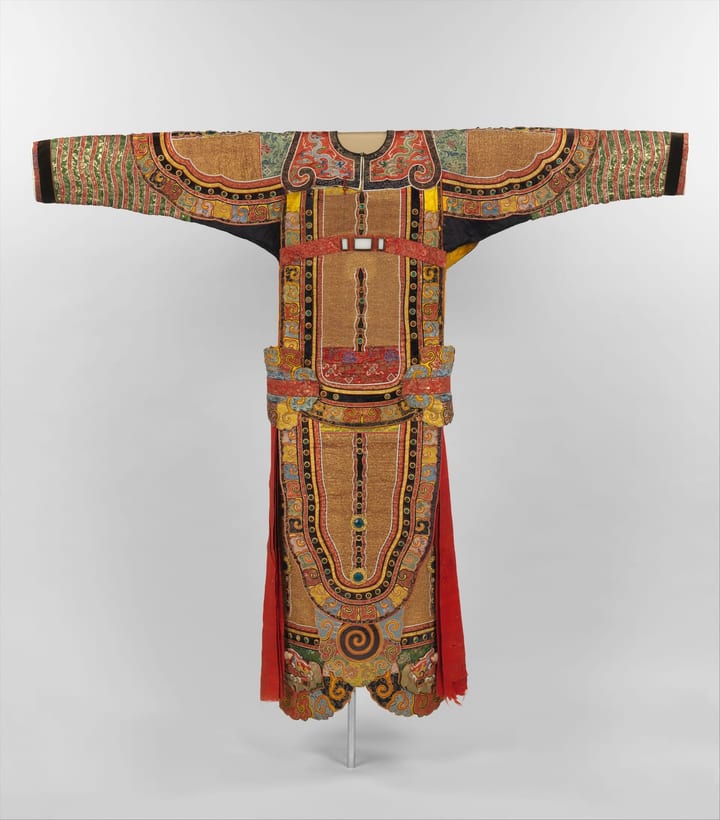
The photograph here shows The Met’s eighteenth-century Chinese Theatrical Costume for the Role of a Warrior, accession 46.187.1a, b. The museum identifies a high-ranking warrior and compares the object with Qing court theatrical dress. It does not name a Peking-opera production or classify this garment as one of the contemporary kao forms. The image supplies historical theatrical context; the linked performing bodies explain Peking-opera practice.
Images and credits
Historical Chinese theatrical dress: Theatrical Costume for the Role of a Warrior, 18th century; silk, metallic thread, metal and glass. The Metropolitan Museum of Art, 46.187.1a, b, public domain/CC0. The catalogue identifies a high-ranking warrior and a Qing court comparison, not a named Peking-opera production or a specific modern kao form. Complete official photograph; no crop.
