Follow the crossing threads, not only the holes
The China National Silk Museum explains sha and luo through gauze structures in which warp threads cross while weft threads run across them. This crossing-warp principle is often discussed as leno structure. To understand it, distinguish the lengthwise warp system from the weft inserted across the cloth.
Openness alone is insufficient evidence. A useful close examination follows the path of a thread through successive intersections: does it change sides relative to another warp thread? A photograph may suggest where to look, but a small hole, a transparent patch or a worn area cannot supply a complete weave analysis.
Why sha does not always give one structural answer
The museum’s terminology account also notes that some loose plain-weave textiles, without crossing warp threads, can be called ping sha, 平纱. A name involving sha therefore does not necessarily establish the crossing structure described above. Nor should a historical fabric name be assumed to have one fixed meaning in every catalogue.
Keep three observations separate when reading a label: what the textile is called, how its threads interlace, and how transparent it appears. This is particularly useful when comparing English gauze descriptions with Chinese names. If a catalogue supplies a detailed weave description, retain that information alongside the broader fabric term.
Gauze has a history beyond a modern fabric swatch
The China National Silk Museum catalogues a Blue Gauze Robe, inventory 2506, to the eighth or ninth century of the Tang dynasty. Its accompanying account discusses gauze as a material for outer clothing and robes. The object is a historical reference here; it is separate from the later embroidered panel pictured on this page.
An existing garment adds questions that a loose swatch cannot answer. How was the cloth shaped and assembled? Where was openness useful within the whole object? Those questions connect weaving with dress without making every transparent garment the same material. The Tang example also should not be used to date an unknown gauze textile merely because it looks fine or delicate.
An uncut Qing panel separates ground from embroidery
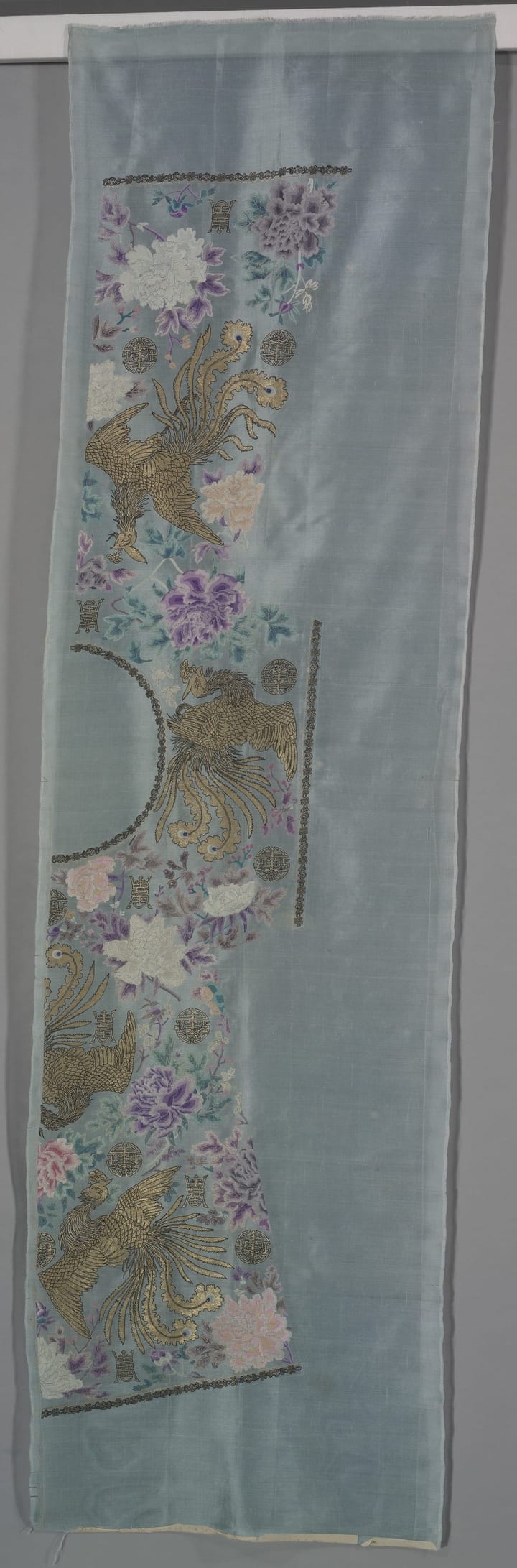
The Cleveland Museum of Art’s Uncut Robe: Proper Left Front and Back Panel, accession 1976.1088.c, is catalogued as Chinese work from about the 1890s, in embroidered silk with a gauze weave. It is one of three panels intended to be cut and sewn into a gown, rather than a complete robe.
The photograph preserves that unfinished arrangement. Compare the embroidered designs with the surrounding ground. The museum’s gauze label belongs to the woven fabric, while embroidery identifies another operation on it. Its record does not name Hangluo or specify a particular number of crossing warp threads, and neither attribution is added here.
Hangluo supplies a specific regional working account
The silk museum’s IIDOS heritage entry describes Hangluo from Hangzhou as combining plain weave and gauze structure in mulberry silk. It records regularly spaced openings arranged in lines and uses including curtains, summer shirts and informal clothing. Hangluo is a regional example, not a synonym for every Chinese gauze.
The account follows inspected silk through preparation, drying and winding, then weaving, scouring and dyeing. This makes clear that the finished openness depends on a wider production sequence. These stages introduce the documented practice; they do not establish how the photographed Qing panel was woven or where its workshop was located.
Keep weave, ornament and thread preparation distinct
Damask directs attention to the relation between a woven ground and pattern. Kesi builds areas of color with locally worked wefts. Embroidery adds needlework to a supporting fabric. These topics meet within textile history, but the presence of a flower or a sheen does not make their structures interchangeable.
The neighboring guides below provide those comparisons in more detail. For gauze, begin with the ground and any documented crossing threads, then ask about added decoration, garment assembly and regional attribution. A precise object description can contain several compatible techniques, as the uncut embroidered panel demonstrates.
Images and credits
Uncut Robe: Proper Left Front and Back Panel, China, Qing dynasty, about the 1890s. Embroidered silk, gauze weave. Cleveland Museum of Art, 1976.1088.c; Gift of C. L. Burton. This is an uncut fabric panel intended for a gown, not a complete garment or an attributed Hangluo sample. CC0; full photograph converted from TIFF to JPEG without enlargement. Resized for display.