Chinese kesi silk tapestry starts with continuous warp
Warp threads provide the lengthwise framework. Colored wefts cross them only where a particular part of the design requires that color. The China National Silk Museum calls this continuous warp and discontinuous weft: the colored thread does not have to travel across the full width of the textile.
Tokyo National Museum explains that each local weft turns back when its area reaches the required width. Small gaps can occur between adjoining color areas. This helps explain the slit-tapestry description often used for kesi.
The maker works the image area by area
The Chinese museum's account describes placing a pattern beneath the warp and marking its outlines, then working colored silk with small shuttles. A flower, figure, or background is therefore a set of weaving decisions, rather than an image applied after a plain cloth has been completed.
Notice how this changes the job of color planning. The maker must decide where each thread works and where it returns. Looking at the meeting of two colors can reveal more about the construction than identifying the depicted subject alone.
Kesi, embroidery, and brocade need different labels
Embroidery builds ornament with needlework on a ground. Kesi creates its colored areas by interlacing local wefts with warp at the loom. A needlelike line in a picture is not enough to call the textile embroidered.
Brocade is another patterned-weaving context, but using silk or producing a rich image does not make all patterned cloth the same technique. Keep the catalogue's construction term attached to the object. Our brocade-versus-embroidery guide explains that broader distinction; kesi deserves its more specific tapestry label.
Museum objects show more than one purpose
The Met catalogues an eighteenth-century Chinese women's robe with roundels as tapestry-woven kesi, in silk and metallic thread, object 38.74.1. This is clothing rather than a freestanding textile picture, showing why kesi should not be defined only by a display format.
The same museum's Kangxi-period rank badge, object 30.75.830, is also silk and metallic-thread kesi. It offers a different scale and function. Our Chinese rank-badges guide explores how a textile technique can carry information about official dress.
Look for construction before interpreting a gap
At a permitted viewing distance, follow a color boundary and compare it with a larger area of the weave. Is the thread turning within a motif? Does the record identify silk tapestry? These are useful questions for reading the object together with its museum description.
A small opening is not automatically damage, but neither does every hole prove kesi. Condition, mounting, and repairs require their own documentation. Do not pull threads or move a displayed textile to investigate its reverse. A photograph records only the view it shows.
A historical technique remains a subject of teaching
Kesi also appears in contemporary craft teaching. The China National Silk Museum's June 2025 report of an exhibition in Kazakhstan describes demonstrations and visitor experiences that included kesi alongside other textile skills. This is a documented public event, rather than a current workshop booking offer.
When learning about a contemporary piece, ask who wove it, which materials were used, and how the design was developed. A historical museum example can explain structure, while a present-day maker's account explains the decisions behind a particular new work.
Museum photographs and credits
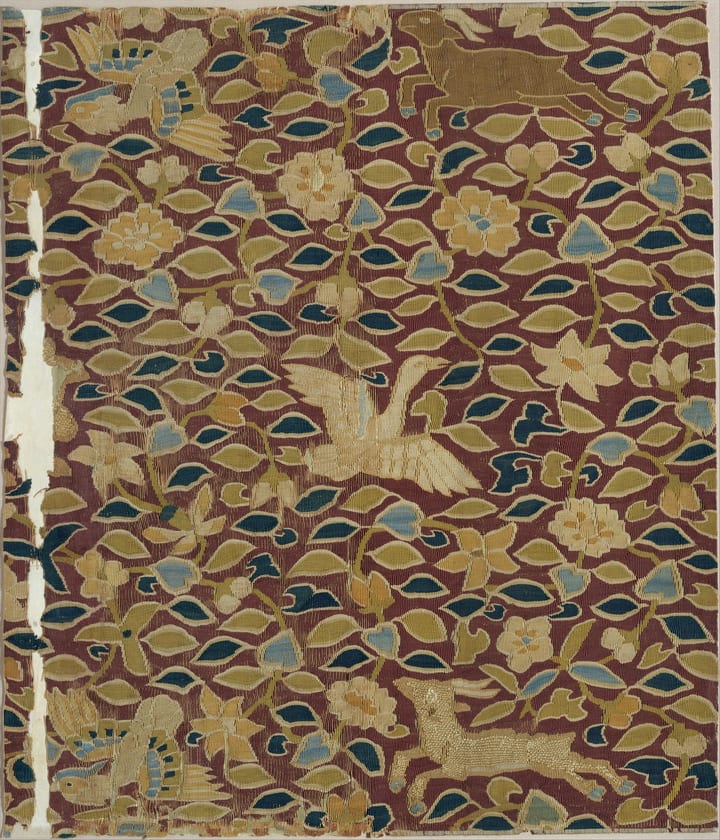
Chinese scroll cover, 11th–12th century, catalogued as silk tapestry (kesi). The Met, 1983.105; public domain/CC0, resized. Changes: EXIF orientation applied, resized without upscaling, metadata stripped, JPEG optimized. Source and rights links appear below. No museum endorsement is implied.
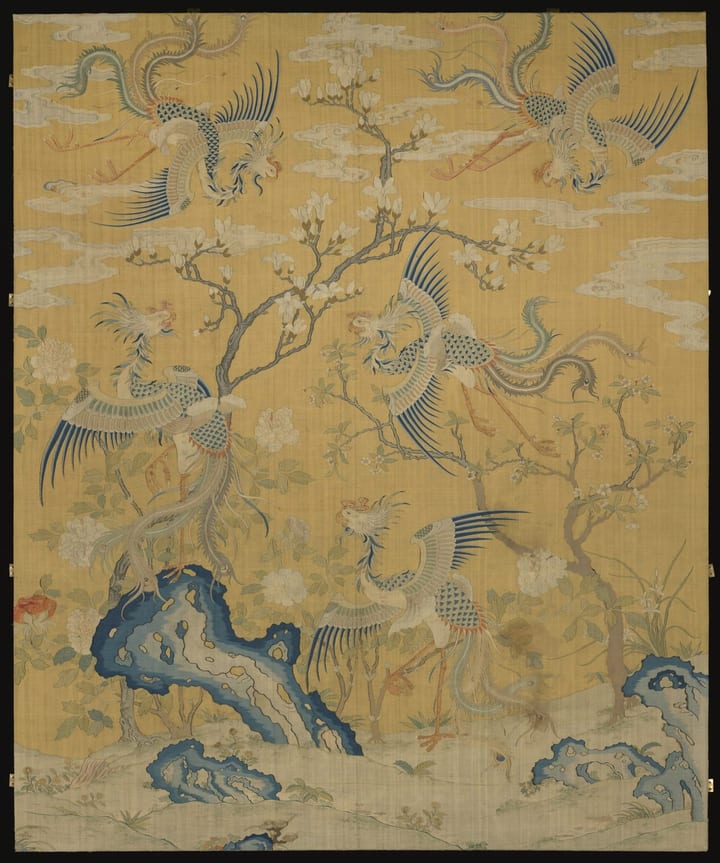
Chinese panel with five phoenixes in a garden, 18th century, catalogued as silk tapestry (kesi). The Met, 25.109.2; public domain/CC0, outer background cropped and image resized. Changes: Cropped as disclosed; EXIF orientation applied, resized without upscaling, metadata stripped, JPEG optimized. Source and rights links appear below. No museum endorsement is implied.
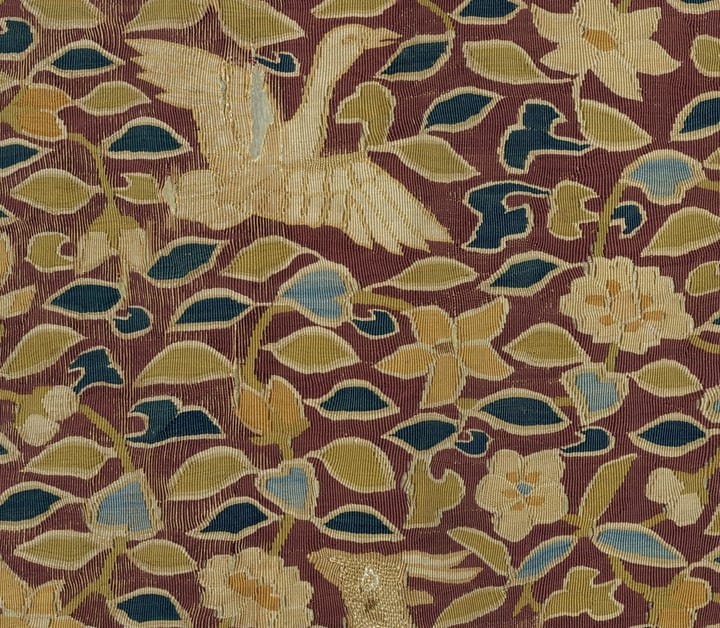
Detail crop from the same Song scroll-cover photograph, showing its animal and floral pattern. The Met, 1983.105; public domain/CC0, cropped and resized. This is the same object as the main image. Changes: Cropped as disclosed; EXIF orientation applied, resized without upscaling, metadata stripped, JPEG optimized. Source and rights links appear below. No museum endorsement is implied.