Brocade vs embroidery: where does the pattern enter?
Weaving interlaces warp and weft: the lengthwise and crossing thread systems. Brocading makes ornament through that weaving process. The Fitzwilliam Museum defines brocading as weft patterning that produces raised woven patterns. This is a useful starting point, rather than a complete classification of every fabric called jin in Chinese.
Embroidery instead works stitches on a supporting ground. The ground may itself be woven cloth, so embroidery and weaving are not opposing materials. One describes added needlework; the other describes the construction of the fabric beneath it.
Nanjing Yunjin makes the loom's role visible
The national heritage record describes traditional Yunjin production on a large wooden loom operated by two cooperating craftspeople. Pattern control, selecting colors, and passing the weft are coordinated parts of producing the patterned cloth.
The China National Silk Museum explains Yunjin zhuanghua through additional colored wefts placed where the pattern is required. Those decorative threads can sit above a ground structure, which helps explain why a woven motif may look like surface needlework. Appearance alone does not tell you which tool placed the thread.
Embroidery has its own relationship with the ground
The V&A distinguishes counted-thread embroidery, organized around threads in the foundation, from freestyle work that is not constrained by counting the weave. A design can therefore follow a regular grid or move across the ground more freely.
The official Su embroidery record also describes several approaches within one regional tradition, including traditional fine work, realistic embroidery, and random-stitch embroidery. A painterly image is not the definition of all embroidery. Nor does a repeated geometric design automatically establish that a textile was woven as brocade.
One documented object can contain both
The Metropolitan Museum of Art's eighteenth-century Chinese theatrical skirt with peacock-feather designs is catalogued as silk and metallic-thread embroidery on silk satin, with brocade borders. Its description identifies distinct techniques within the same garment instead of forcing the whole object into one category.
That example offers a practical reading method. Begin with the main fabric, then examine the motif, border, lining, and attached sections separately. A museum label may name several materials because the maker combined them for different visual or structural purposes.
A shiny or raised motif is not a reliable shortcut
The Met's Chinese chair strip with dragons is catalogued as silk satin with supplementary-weft patterning and gold-thread brocade. The theatrical skirt uses metallic thread in embroidery. Shimmering thread is therefore compatible with either method.
Look for the documented technique and, where the display permits, how pattern threads relate to the ground. Never pull a loose thread or turn a museum object over yourself. A photograph may help pose a question, but a close-up without a catalogue record cannot supply every construction detail.
Neither word is a quality ranking
Brocade does not mean all weaving: a plain woven fabric need not have a brocaded pattern. Embroidery likewise covers many stitch systems, materials, and scales of work. Compare an object with its intended use and documented construction rather than treating one word as more prestigious.
These skills also remain part of contemporary design conversations. The China National Silk Museum's 2025 Hanfu program brought brocade and embroidery into discussions and reconstructions of dress. That dated example shows continuing interpretation, without making every modern patterned garment a heritage textile.
Photographs, credits and reading boundaries
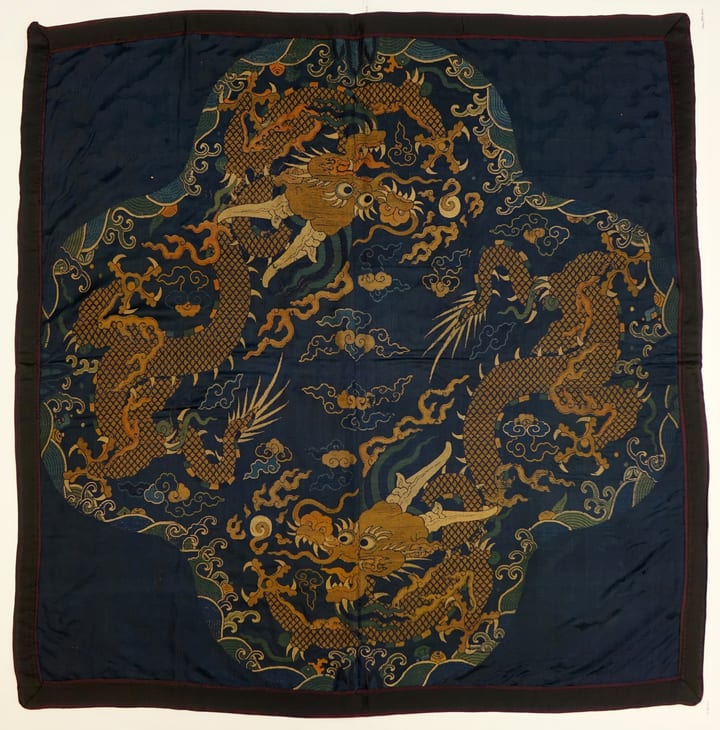
Chinese robe fabric, 17th century: silk satin damask brocaded with silk and metal thread. The Met, 1977.264.2; public domain/CC0, resized. EXIF orientation applied, resized without upscaling, metadata stripped and JPEG optimized. Source and license links are below. No photographer or museum endorsement is implied.
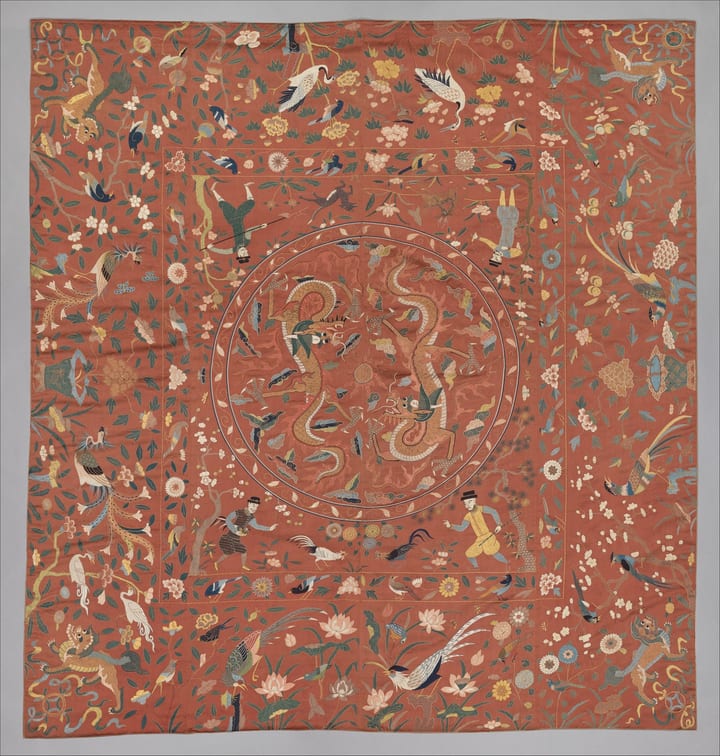
Chinese export coverlet, 17th century: silk satin embroidered with silk and gilt-paper-wrapped thread. The Met, 1975.208d; public domain/CC0, resized. EXIF orientation applied, resized without upscaling, metadata stripped and JPEG optimized. Source and license links are below. No photographer or museum endorsement is implied.
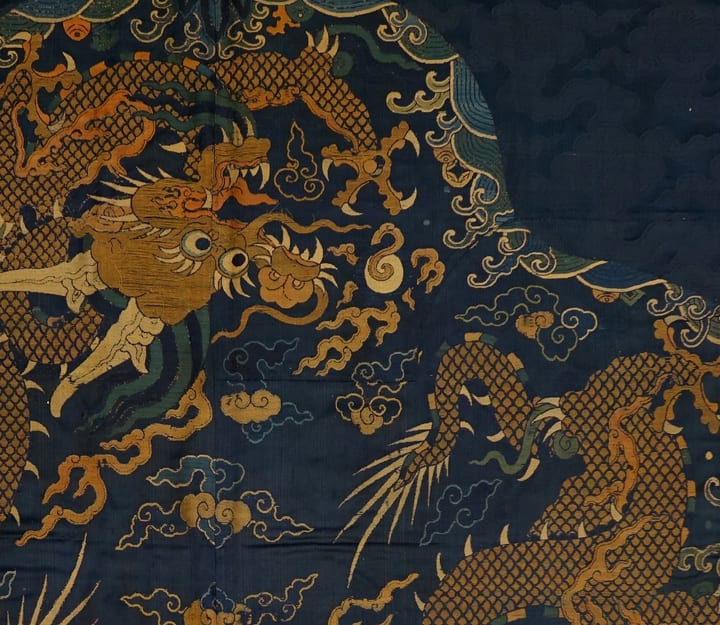
Detail crop of the same 17th-century brocaded robe fabric. The catalog identifies silk-and-metal-thread brocading on satin damask. The Met, 1977.264.2; public domain/CC0, cropped and resized. Cropped, EXIF orientation applied, resized without upscaling, metadata stripped and JPEG optimized. Source and license links are below. No photographer or museum endorsement is implied.