Begin with the ground and the patterned area
Warp runs lengthwise through the cloth; weft crosses it. A useful first question is how those systems interlace in the background and how their relationship changes in the motif. A flower can be produced through weaving, embroidered onto woven cloth, or made by another method. Its outline alone does not identify the structure.
The China National Silk Museum discusses plain weave, twill and satin as basic structures. Its account of patterned satin explains how warp-faced and weft-faced satin can form contrasting ground and pattern within one layer. This gives a concrete mechanism for a design that appears through the woven surface rather than through added needlework.
Ling and qi need historical context
The museum characterizes ling through twill and distinguishes plain ling from patterned ling. In the patterned form, the ground is twill. Its explanation of historical qi describes a plain-weave ground carrying a pattern formed through twill or another variation. These descriptions distinguish the underlying structures, not simply two degrees of luxury.
The same account notes a later complication: in Ming and Qing painting-and-calligraphy mounting, cloth called ling could use satin rather than twill. It points to Huzhou mounting fabrics as an example. Ling therefore cannot safely be translated as one unchanging weave across all periods and uses.
A Tang object gives the terminology a specific setting
The China National Silk Museum’s small-diamond-pattern ling is catalogued as a Tang silk textile, yellow, measuring 47 by 20 centimeters. The record describes small twill diamonds appearing against a yellow twill ground. This is a particular example of pattern and ground being explained together, rather than a loose label for shiny cloth.
That object is discussed here as a separate museum record; it is not one of this page’s two photographs. Its description is especially useful when reading the word ling. Start with the stated ground, then consider the pattern. Do not assume that the same structural description belongs to a later mounting silk merely because the name recurs.
Two photographed fragments, two documented weaves
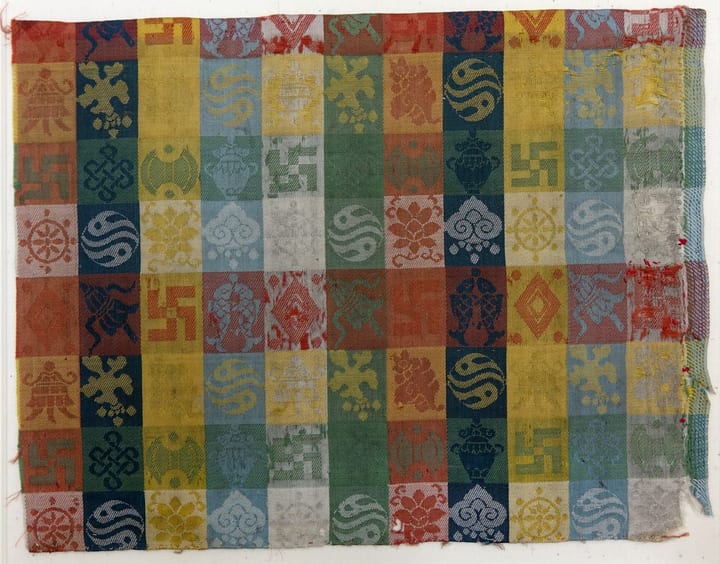
The Metropolitan Museum of Art identifies its fragment with auspicious symbols, accession 31.74, as Chinese silk twill damask from the late seventeenth or eighteenth century. The photograph shows repeated symbols within colored blocks. The catalogue’s technical label and the visible palette belong together: this damask should not be described as necessarily single-colored.
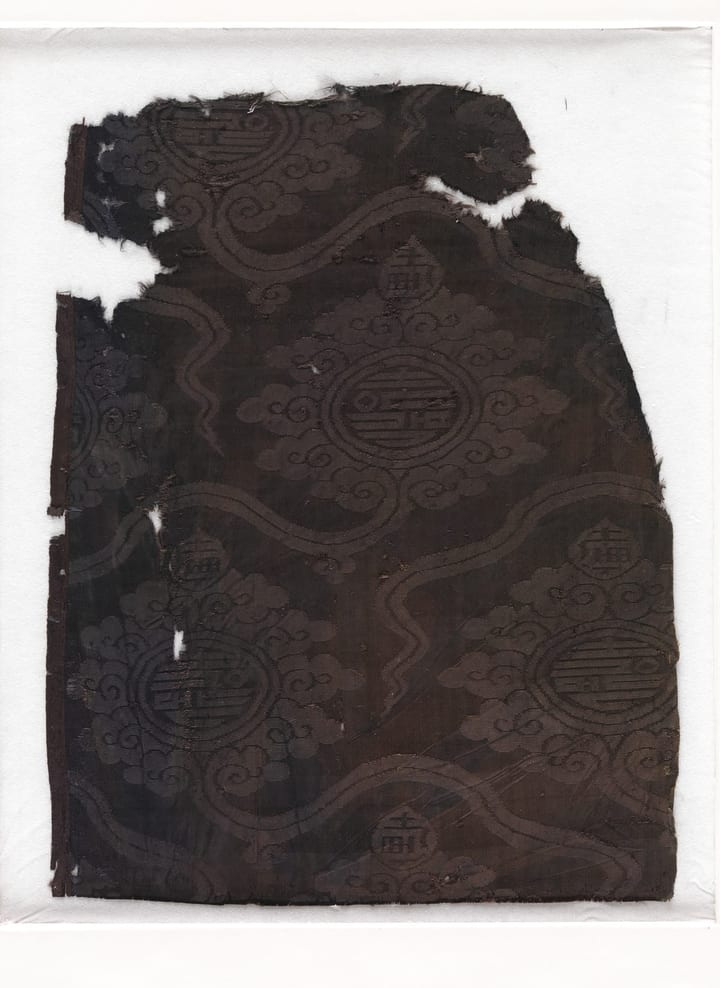
The second photograph shows a different object, accession 46.156.20: a fourteenth-century Chinese silk satin damask with cloud palmettes and longevity characters, shou. The Met says the textile has darkened from its original blue. Its current dark appearance should not be presented as the maker’s intended black palette. Neither photograph is a modern reconstruction or a view of the Tang diamond-pattern textile.
A woven surface can carry a traveling design
The Met’s account of the fourteenth-century fragment connects its palmettes with Central Asian and eastern Iranian design, while identifying Chinese cloud borders and longevity characters. It also reports that the piece was found in Egypt. This is a documented history of one fragment, not an origin story for every textile called damask.
Look at the distinction between the design’s vocabulary and the cloth’s construction. A palmette describes a motif; satin damask describes a weave. Keeping those questions separate allows a textile to have a Chinese attribution while also participating in exchanges of patterns and objects. The surviving fragment does not reveal the complete original furnishing or garment.
How damask differs from the neighboring silk topics
Satin names a structure; patterned satin is one documented damask context. Brocading can add another kind of woven ornament: the existing brocade-versus-embroidery guide includes a robe fabric catalogued as satin damask brocaded with silk and metal thread. A long material label may therefore describe combined techniques rather than contradictory alternatives.
Kesi has a different construction, using colored wefts locally across a continuous warp. Reeling and spinning address how thread is prepared before cloth is woven. These distinctions help locate damask within silk knowledge without turning every silk term into a competing fabric name. Follow the specific material record, then compare the ground, pattern and any added decoration.
Images and credits
Textile fragment with auspicious symbols, China, late seventeenth–eighteenth century. Silk twill damask. The Metropolitan Museum of Art, 31.74; Gift of Herbert Weissberger, 1931. Public domain/CC0; full photograph proportionally resized and JPEG-optimized.
Textile fragment with cloud palmettes and characters of longevity (shou), China, fourteenth century. Silk satin damask; the museum describes it as darkened from its original blue. This is a different object from the colored twill fragment. The Metropolitan Museum of Art, 46.156.20; Fletcher Fund, 1946. Public domain/CC0; full photograph proportionally resized and JPEG-optimized.