How a pile rises from the woven ground
Te Papa’s museum terminology defines velvet as a warp-pile weave. A supplementary warp is raised over rods, producing loops above the textile’s surface. This provides a useful way to understand the fabric: the ground holds the cloth together, while the pile warp supplies the raised surface. The pile belongs to the woven construction rather than being a layer of loose fibers attached afterward.
The Metropolitan Museum of Art’s technical account explains that the rods are removed as weaving progresses, leaving loops that can remain intact or be cut. Their treatment changes the surface that catches the light. Silk velvet’s apparent depth and changing sheen are therefore related to structure and viewing conditions, alongside the colors of its threads. A photograph can show these effects without revealing every detail of the weave.
Cut velvet and uncut loops
Cut pile exposes many short thread ends. Uncut pile retains the curved loops. These are choices within the construction and finishing of a pile fabric; a raised floral design does not by itself make the textile embroidery. The difference becomes particularly useful when both treatments appear in one patterned cloth.
The Palace Museum’s definition of zhangrong describes warp loops formed over pile rods, followed by drawing a design and cutting selected loops. Contrasting looped and cut surfaces bring out the pattern. Here the cutting is controlled work on an already woven surface: the design depends on deciding which loops to open and which to preserve.
What the name zhangrong tells us
The Palace Museum connects the name zhangrong with Zhangzhou in Fujian, a celebrated production center. Its definition describes a particular patterned pile textile, rather than a geographical label that can be assigned to every Chinese velvet. A museum catalogue that says only ‘silk cut velvet’ leaves its workshop and regional terminology open.
The China National Silk Museum’s account of a Qing zhangrong fragment supplies a more specific example. Weavers first made the looped fabric, then cut the planned design to create a roundel of five bats surrounding the character shou, or longevity. The museum interprets the composition as a wish for abundant blessings and long life. The same broad family of auspicious motifs could appear in other textile techniques; its meaning does not identify the weave.
A satin ground with flowers in relief
A Qianlong-period textile in the Palace Museum, accession 故00023031, makes the relationship between ground and pile especially clear. Catalogued as green-ground zhangduan with multicolored scrolling peonies, it has a green satin ground and colored pile warps. The museum explains that the flower outlines retain loops, while the remaining floral pile was cut. Raised flowers and their looped edges consequently create differences in texture and light.
This textile was made by the Jiangning weaving establishment, in present-day Nanjing. The record also connects the name zhangduan with the fame of Zhangzhou products. It shows why a textile’s name and its documented place of manufacture should be read together. It also answers a structural question: satin and velvet need not be competing descriptions when satin forms the ground beneath a pile pattern.
Velvet in furnishings and celebrations
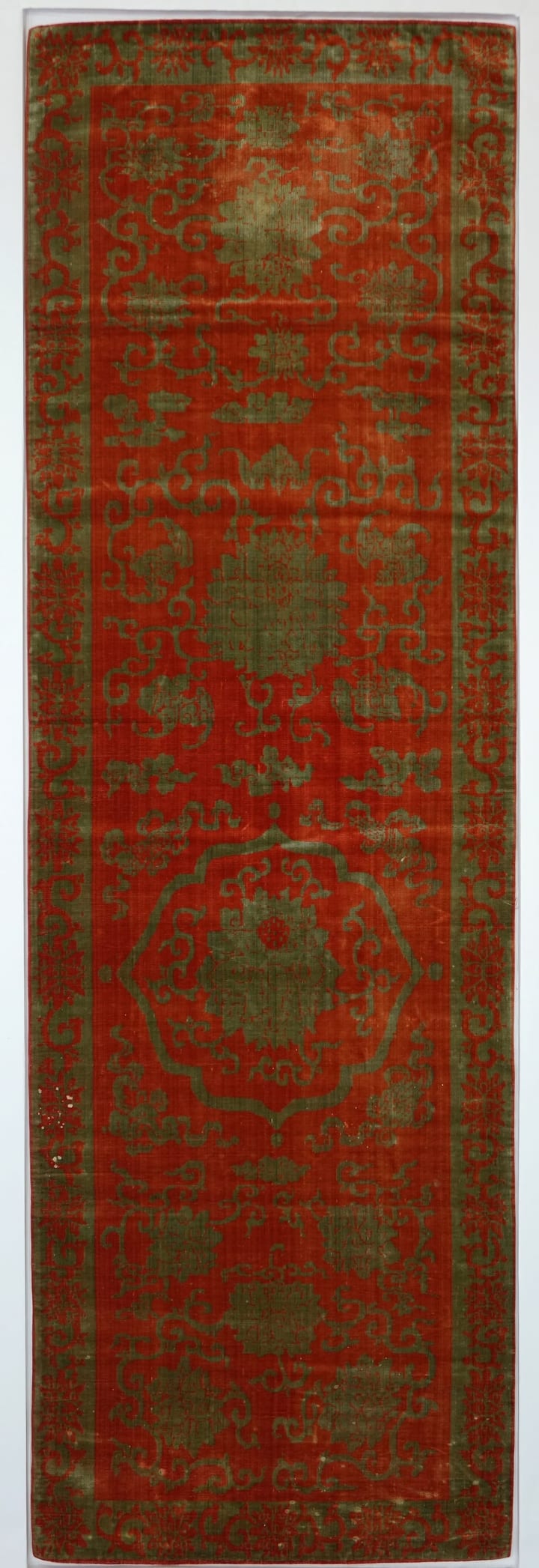
The photographed chair strip belongs to The Metropolitan Museum of Art, accession 1986.186.3. The museum identifies it as Chinese, eighteenth century, and silk cut velvet. Its long furnishing format and floral pattern offer a concrete example of this fabric beyond clothing. The catalogue does not identify it as the Palace Museum’s zhangduan or assign it to Zhangzhou.
A separate wedding altar frontal in the Saint Louis Art Museum, accession 38:1917, is catalogued as Chinese cut silk velvet from the mid- to late eighteenth century. Its record describes red and green pile on a ribbed ground, lotus designs and doubled happiness characters. These features place the textile in a celebratory setting. The museum also records fading from red to tawny brown before acquisition, a reminder that surviving color is part of an object’s history.
Images and credits
Chair strip with floral pattern, China, Qing dynasty, 18th century. Silk cut velvet. The Metropolitan Museum of Art, 1986.186.3; Gift of Robert Hatfield Ellsworth, in memory of Pauline Simmons, 1986. CC0. Full museum photograph; orientation normalized, no crop or enlargement. Resized for display.