Silk and satin answer different questions
The Museum of Fine Arts Boston’s CAMEO database lists silk, acetate and rayon among fibers used for satin. Satin therefore does not establish silk content by itself. A catalogue’s phrase “silk satin” is useful because it supplies both material and construction, rather than two interchangeable names for the same quality.
Begin with those two questions before judging brightness or price. What are the threads made from, and how are they interlaced? A further label such as embroidery describes another operation. Keeping these observations separate makes a long museum description easier to read.
A float carries a thread across several crossings
Warp is the lengthwise system prepared on the loom; weft runs across it. Getty’s conservation glossary explains weaving as the binding relationship between these systems. It also notes that thread count, yarn fineness and weave type affect a fabric’s compactness. A weave name alone consequently cannot supply every detail of its weight or density.
Getty’s Art & Architecture Thesaurus describes satin through long warp floats that create a smooth, shining face. A floating thread travels across several threads of the other system before interlacing again. Its general explanation mentions a warp passing over four or more weft threads and then under one. This introduces the principle without making that sequence a diagnosis for every Chinese satin.
There is more than one satin repeat
The Palace Museum’s terminology for satin distinguishes several forms, including five-, six-, seven- and eight-thread orders. Its explanation links longer warp floats with increased sheen and softness, while noting a reduction in strength. Smoothness involves a structural trade-off, rather than automatically indicating a stronger or more expensive cloth.
A separate Palace Museum entry describes an irregular six-thread warp-faced satin. It distinguishes regular and irregular structures and identifies six warp and six weft threads in that particular unit. The example is a reminder to retain technical qualifiers. A catalogue that says only “satin weave” does not authorize assigning its fabric this six-thread structure.
Read duan in its historical setting
The China National Silk Museum explains that the fabric name duan (缎) became prominent in Ming and Qing writing. Its account also discusses the name zhusi (纻丝) in Song and Yuan contexts. Earlier occurrences of the character 段 can concern a quantity of cloth, so recognizing the written form is not sufficient to identify a weave.
The museum distinguishes plain satin from patterned satin. In the patterned construction it describes, contrasting warp-faced and weft-faced satin form the ground and design within a single layer. A woven motif therefore need not be embroidery. Our damask guide follows that ground-and-pattern relationship further; here the starting point is recognizing satin as a structure that can take several forms.
Separate the satin ground from added needlework
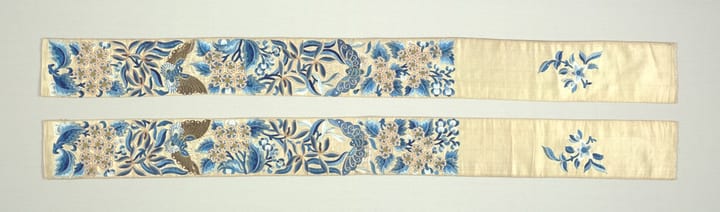
The photographed Pair of Sleeve Bands is Chinese, Qing dynasty, nineteenth century, in the Cleveland Museum of Art. Its material label records silk, satin weave and embroidery. These are two decorated bands, not a complete robe. Their relatively exposed ground provides a useful contrast to the blue needlework.
Follow the boundary between a worked flower and the surrounding cloth. The two areas ask different questions: how does thread make the image, and how is the supporting fabric woven? Neither a motif nor this overall photograph identifies the precise satin repeat or an individual stitch.
A complete textile can combine several structures
Conservator Kristine Kamiya’s 2017 account for The Met describes microscopic examination of a nineteenth-century Tibetan appliquéd thangka of Kurukulla. Its assembled fabrics include satin, damask and brocades alongside embroidery and painted details. Those findings belong to the studied object; they do not turn all its components into one uniform fabric.
When addressing a later repair, the conservators considered weave structure, thread count, density and color. The case shows why matching a blue appearance alone was inadequate. For a museum visitor, it suggests a practical habit: read the material record, distinguish adjacent components, and leave unresolved technical details open when no close analysis is available.
Images and credits
Pair of Sleeve Bands, China, Qing dynasty, 1800s. Silk, satin weave, embroidery. Cleveland Museum of Art, 1921.919; Gift of Mrs. Charles William Wason. CC0. Complete museum photograph, uncropped and resized for display.