Start with the shape described by the label
The Getty catalogue calls the angular harp shu konghou and the arched form fengshou konghou. Look for a more specific form in a catalogue when a historical record gives only the shared name.
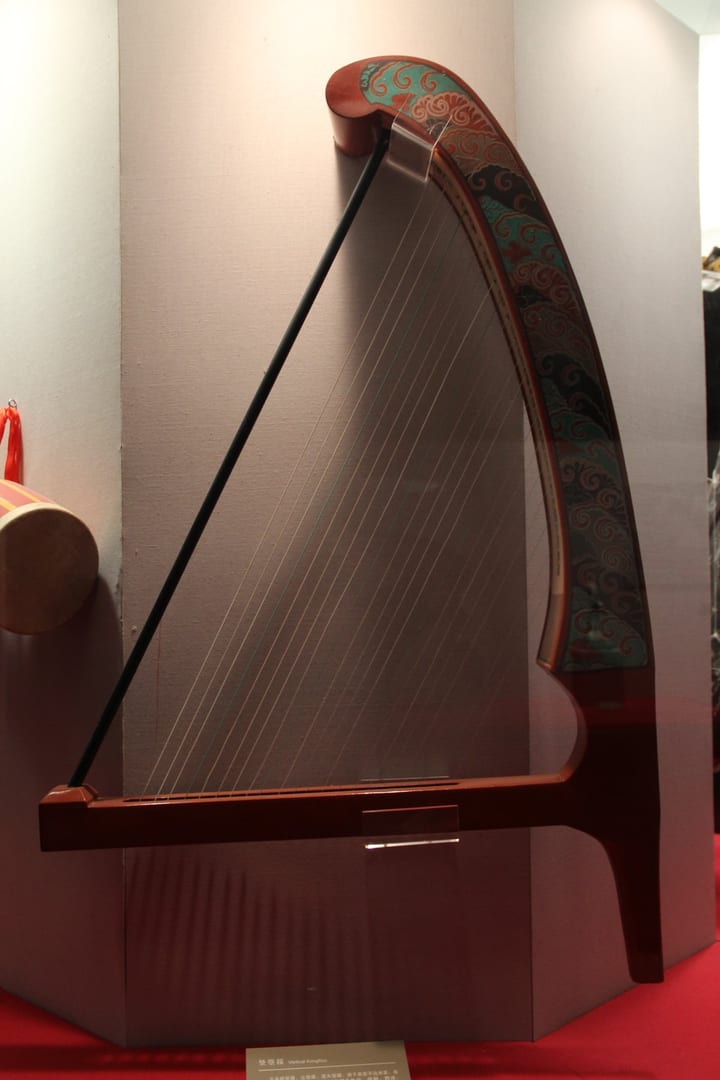
The photograph shows the vertical konghou display at Gansu Provincial Museum, as identified by its placard and photographer. Follow the strings through the open triangle to the decorated curved section and the lower bar. The source identifies the exhibit and the date it was photographed.
Excavated wood and skin document construction
Qiemo County’s cultural bureau records two harps excavated at Zaghunluq in 1996 and describes them as about 2,700 years old. Their overall lengths are 61.6 and 87.6 centimetres. The account identifies three components, a soundbox, a neck and a string rod. It also records a circular opening in the base.
The excavated construction supplies a material comparison with the display photograph. Read the find location and catalogue description when comparing the structural parts of either example.
Tang imagery shows musicians together
The Met’s late seventh-century earthenware figure 23.180.7 depicts a woman with a harp. The museum presents it as part of a small group that includes a pipa player, cymbals and clapping. The figure helps place the harp among performers, while the object record identifies its own material as pigmented earthenware.
A Dunhuang account identifies an upright konghou among the musicians in Mogao Cave 220, alongside pipa, transverse flute and drums. A painted group helps a reader see where artists placed the harp in an ensemble. Follow the forms and playing positions the picture actually shows.
Modern builders worked with a new design
Wenzhuo Zhang’s Rochester research describes the Suzhou team studying historical images and the Western concert harp as it developed a modern instrument. In the design she documents, two parallel string sets flank the central structure. A player can reach a set with each hand, and separate small bridges support individual strings on the soundboard.
The same account describes pedals for chromatic playing. Those details explain why a present-day score can ask for resources beyond the outline preserved by an older image. Check the instrument named in a current performance before using a historical illustration to infer its setup.
Wu Lin’s programme offers three ways to listen
A report published by China’s Ministry of Culture describes Wu Lin’s concert at the National Centre for the Performing Arts on 13 June 2014. The programme included the solo Three Variations on Plum Blossom, a duo with Western harp and concertos written for the modern konghou. Each setting places a different demand on the player.
The report names techniques including slides, harmonics, chords and tremolo in the new concertos. In a recording of a modern performance, follow one gesture through a phrase and listen for the way other instruments answer or support it.
Images and credits
Vertical konghou on display at Gansu Provincial Museum, Lanzhou. Photographed by Gary Todd on 10 May 2013. CC0. Complete photograph resized for display.
