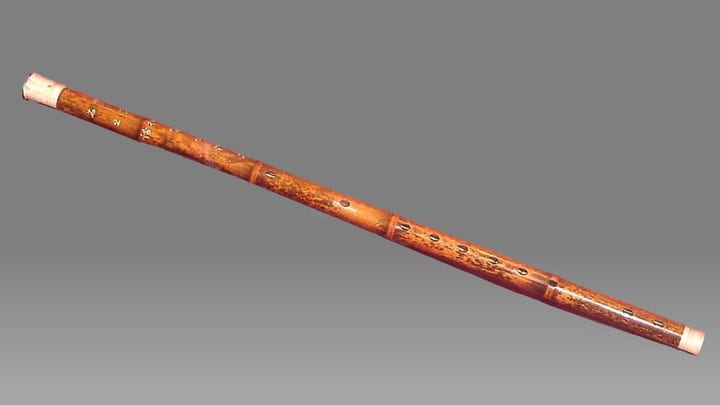
Chinese dizi and xiao: begin with playing position
A Hong Kong Chinese Orchestra note by Chow Fan-fu makes a useful first distinction: the di, also called dizi, is held horizontally, while the xiao is played vertically. The note was written for a December 2011 wind concert featuring several members of both families.
It also describes the dizi sound as the combination of the bamboo tube’s resonance and the membrane’s vibration. These are connected parts of the instrument’s voice. Looking only for a bamboo tube can obscure the differences between flutes that work and sound differently.
The holes have different jobs
Grinnell College’s instrument entry describes a cylindrical bamboo bore, six finger holes and a separate membrane opening between the blowing hole and the first finger hole. Opening finger holes changes the sounding air column; overblowing accesses higher partials.
A hole covered by membrane is therefore not another finger position. Identify the blowing opening, membrane opening and finger holes separately before comparing the design with a different flute.
What does the dimo membrane change?
The B.C. Chinese Music Association calls the membrane dimo (笛膜). Its account describes a thin reed shaving stretched and attached over the opening between the blowing and fingering holes. Wrinkles contribute to the buzzing quality.
The membrane can be adjusted to change brightness and the amount of buzz. This makes preparation part of shaping tone, rather than merely fitting a decorative cover. Listen for that textured edge within a sustained note.
Bangdi and qudi describe useful contrasts
The same association contrasts the generally shorter, higher-pitched northern bangdi (梆笛) with the longer, lower-pitched southern qudi (曲笛). It associates the former with brisk, rhythmic playing and the latter with a more lyrical character.
These are broad stylistic comparisons. They provide a starting point for listening, while the individual work and performer still determine what happens in a passage.
Breath and fingers work together
Xinmeng Luan and colleagues’ acoustic study, published in the Journal of the Acoustical Society of America in 2025, describes half-holing, cross-fingering and overblowing among dizi techniques. Half-holing partly covers a hole and requires careful finger placement and ear training; cross-fingerings serve particular notes, including in fast passages.
Overblowing extends the range into higher octaves. More than lifting fingers in order is involved: the player coordinates the air and chosen fingering to reach and tune the intended note. These descriptions explain musical resources, not a complete fingering lesson for every flute.
A historical flute also carries writing
The Met’s accession 89.4.62 is a Chinese bamboo dizi dated to the late nineteenth century. The museum connects instruments of this kind with Kunqu opera. It also identifies two inscribed lines from a poem by Wang Wei and a signature by the calligrapher and/or carver Wen Shan.
This object brings a musical instrument and literary inscription together. The qualified credit does not identify Wen Shan as the flute maker. Its catalogue date and material describe this particular surviving instrument, rather than every dizi used today.
Choose the flute family as well as the part
Hong Kong Chinese Orchestra’s 2025 instrumentation chart distinguishes bangdi, qudi and xindi/dadi parts. Its notes explicitly separate the non-membrane xindi from the membrane-bearing dadi. The presence of a membrane is important, but it should not become a claim that every flute grouped with dizi must have one.
The chart also describes traditional non-keyed dizi as principally diatonic, with limited chromatic capability. A composer or arranger needs the appropriate instrument and its working range; one generic flute label does not settle those choices.
Repertory can carry regional character into a recital
An October 2026 Hong Kong government announcement for a November dizi recital offers a concrete programming example. It names bangdi, qudi and dadi, with collaborators on bowed and plucked strings, percussion and piano.
The announced programme includes a Zhejiang-style opening, music drawing on Shanxi opera, and a piece paired with bangu that emphasizes Zhejiang Wuju character. These are choices within that planned recital. They show how different musical sources and accompanying forces can shape an evening of dizi music without defining all its repertory.
A focused way to start listening
Begin with one phrase: notice its sustained tone, its changes of pitch and the points where the line becomes more animated. Then compare a solo passage with the flute inside an ensemble. The question becomes how the player uses the instrument in that setting, rather than whether every performance matches one description.
The Peking-opera instruments guide follows ensemble jobs; Nanyin introduces a tradition centered on dongxiao and other instruments. Keeping those specific contexts alongside a dizi guide makes comparison more precise.
Images and credits
Dizi, China, late nineteenth century; bamboo. The Met, 89.4.62, The Crosby Brown Collection of Musical Instruments, 1889. Public domain, CC0. Complete museum photograph, uncropped and resized for display.