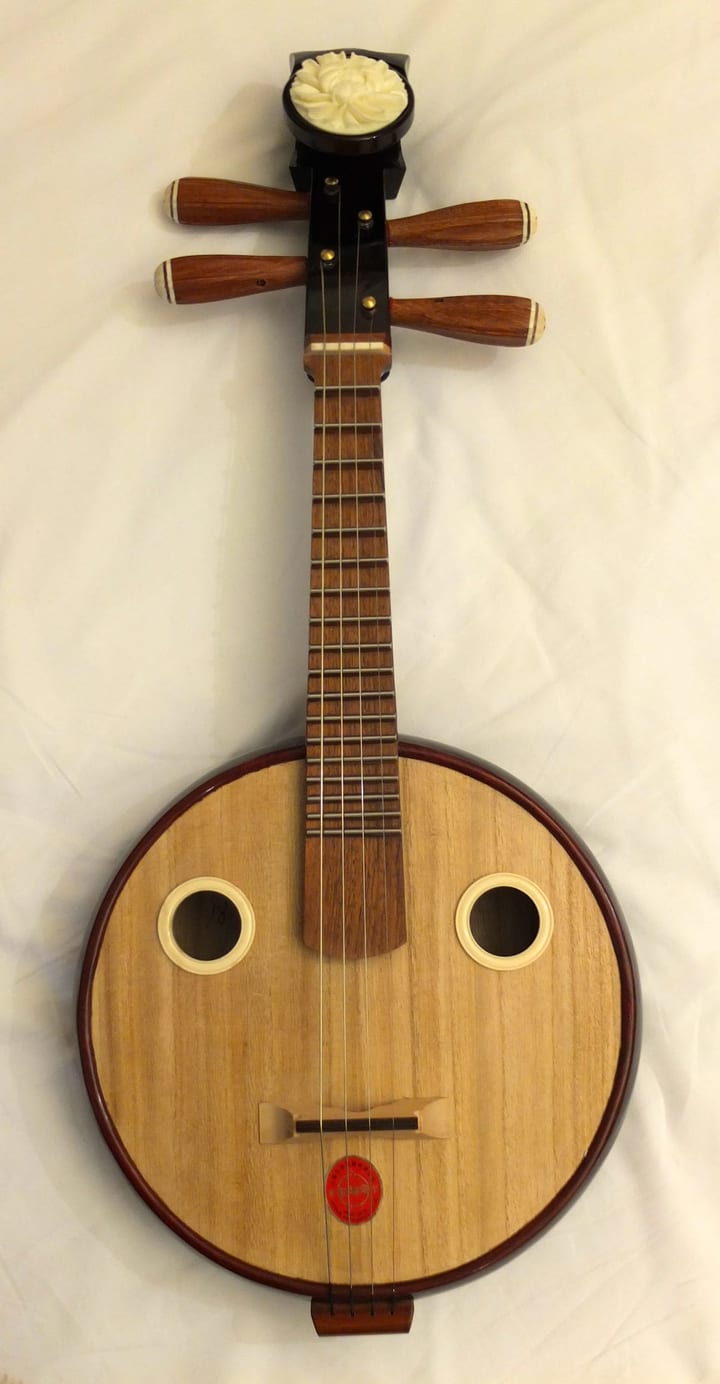
A family of round-bodied lutes
The B.C. Chinese Music Association gives G–D–G–D for zhongruan, or middle ruan, and D–A–D–A for the larger daruan. Treat these as typical tunings of the named forms, then check the actual instrument.
Compare its circular outline with the pear-shaped body of the pipa described in the related guide.
One historical instrument reveals its construction
Hartenberger catalogue AS-CHLT-58-14 records a Chinese ruan from the late nineteenth century. Its description distinguishes a hardwood neck and rim from the softer, lighter wood of the front and back. Seventeen raised ivory frets extend from the neck toward the soundboard.
Four pegs control four steel strings, which pass over a bamboo bridge. The catalogue also describes a curled peghead with gold-painted decoration. These details help readers examine a particular surviving instrument without assuming that every ruan has the same frets, decoration or materials.
Ruan and yueqin need separate labels
The Palace Museum describes its Qing yueqin as a descendant of the earlier ruan, with a short neck and a moon-shaped resonating body. On this particular museum example, four strings form two unison pairs, and the two pairs are tuned a fifth apart. The record lists nine fret positions.
The museum places yueqin alongside jinghu and jing-erhu in Peking opera accompaniment. A rounded body therefore does not by itself identify a modern ruan. Check the name, neck, string arrangement and musical context, especially when a translated label simply says moon lute.
Historical images carry a different kind of evidence
Ingrid Furniss’s research abstract for Music & Ritual examines the round-bodied, long-necked lute through fourth- to eighth-century funerary art. It proposes a connection with the cultivation of male Chinese elites, reaching back to the third century. This is an interpretation grounded in a defined group of historical representations.
Such imagery can address an instrument’s social associations without supplying a modern playing manual. It should not be used to assign the tuning of a present-day zhongruan to every early pictured lute, or to turn a historical association into a single documented invention date.
Learn the relationship between the hands
The Hong Kong Music Office’s zhongruan syllabus, revised in September 2024, starts with structure, care, posture, basic hand techniques, rhythm and numbered notation. It later develops shifting between positions, string crossing, natural harmonics and left-hand slides.
The progression joins physical control to reading and musical understanding. A learner can move from a secure note toward an ornamented phrase through guided practice. These are stages in that published teaching programme, rather than a promise that a short written introduction replaces practical instruction.
Listen for the instrument within the arrangement
The Hong Kong orchestra groups ruan with other plucked and struck strings, while distinguishing their ways of producing an attack. Within that section, a named zhongruan or daruan part tells the player more than the broad label Chinese strings.
For a listener, start with the credited instrument and follow when its line enters, joins other parts or comes forward. The section list describes one orchestra’s working configuration; it does not require every ruan ensemble to use the same forces.
A trio programme shows several musical roles
For HKCO4U – Ruan Trio on 25 February 2023, the Hong Kong Chinese Orchestra credited Fung Yin Lam, Wu Man-lin and Ng Kai Hei as ruan players. Its programme included zhongruan solos, ruan ensemble pieces, a zhongruan-and-percussion work and a pairing with yangqin.
The listed repertoire included Ho Man-hin’s The City in Rain and an arranged version of Vivaldi’s Winter. These examples document that concert’s range of combinations, rather than one obligatory repertoire. Composer, arranger, instrument and ensemble credits explain what the performers were asked to bring together.
Care begins with the actual instrument
The Music Office advises checking a zhongruan’s soundboard for cracks and its pegs for looseness or difficult adjustment. It recommends a protective case for transport, spare strings and, where available, a tuner.
The same guidance notes that thick strings can be demanding for beginners to stop. Suitable construction and advice from an instructor matter alongside practice. Treat these as checks for an instrument in use, rather than instructions to repair a damaged historical object.
Images and credits
Small ruan (小阮), photographed by Piccolist, 19 December 2012. Source: Wikimedia Commons, “小阮(阮咸).JPG”. CC BY-SA 3.0. Complete photograph, uncropped and resized for display; these image versions remain under CC BY-SA 3.0. The source identifies a small modern ruan; its maker, materials and manufacturing date are not established here.
