Chinese yuhuchun vases begin with the profile
Follow the outline down from the outward-turning mouth, through the slim neck and into the expanded body. The small foot completes the form. The Palace Museum notes that its curves and proportions vary by period; the category does not require one fixed height or neck-to-body ratio.
A useful comparison starts with the silhouette before the pattern. Locate the widest part of each body and the point where its curve starts narrowing toward the neck. This separates changes of shape from changes of glaze or painted subject.
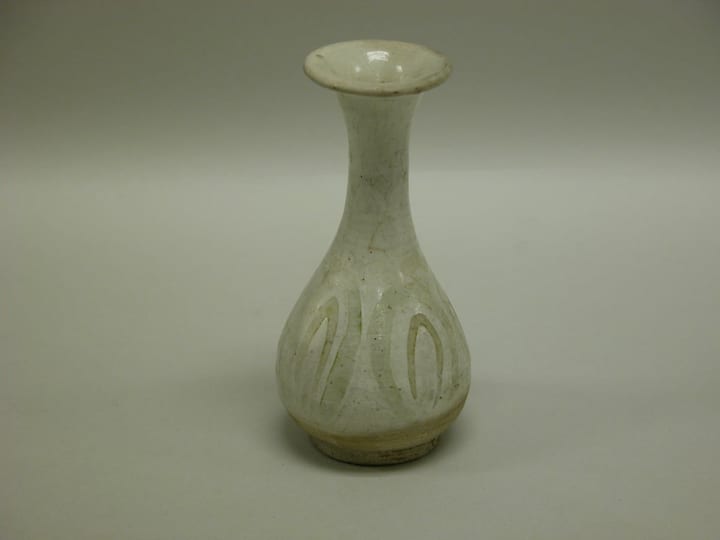
The illustrated example is Cizhou stoneware
The Met’s Yuhuchun vase with lotus petals, 15.124, is dated to the thirteenth–fourteenth century, Yuan dynasty. Its medium is stoneware with incised decoration, identified as Cizhou ware. At 12.1 centimeters high, it gives the form a compact scale.
Compare the large petal outlines with the swelling body they occupy. The catalogue establishes the ware and technique; the photograph supplies one view of the completed object, rather than a record of its forming sequence.
A celadon version can include handles
The Palace Museum’s Song Yaozhou vase, 新00155617, is explicitly described as a yuhuchun form. It combines a flared mouth, slender neck, rounded body and ring foot with a pair of dragon-shaped handles.
Carved lotus designs occupy the lower body, while raised horizontal lines divide the upper area. Celadon glaze covers the vessel, with an unglazed exterior base. The handles add another feature without removing the profile from the museum’s named form family.
A Qing vase looks back to Ding ware
A Kangxi-period Palace Museum vase, 故00146295, imitates Ding ware. White glaze covers the body, and incised floral scrolls lie below it. The record identifies a copper fitting at the mouth as a reference to Song Ding ceramics.
This is a Qing interpretation of an earlier tradition, rather than a Song vessel dated by its pale surface. The label separates the object’s own period from the ware it emulates. Shape, glaze and a metal component can all contribute to that historical reference.
A documented wheel-thrown example
LACMA’s Bottle Vase (Yuhuchun), M.88.63, is dated about 1000–1100 and attributed to China, probably Hebei Province. Its medium explicitly identifies wheel-thrown Ding-type stoneware with transparent glaze.
That record supplies evidence for one forming method within the family. It does not establish the construction of every yuhuchun. Keep the probable place attribution visible and compare it with the more specifically named kiln traditions in the other records.
Compare a form with a decorating technique
The underglaze copper-red guide follows a copper-bearing painted design beneath glaze. Its Hongwu-period yuhuchun example shows how decorative bands and flower sprays can be distributed around this profile. Copper red names the treatment; yuhuchun names the vessel shape.
When reading a label, identify the form, then add the ceramic body, surface treatment and date. This order allows an incised stoneware bottle and a painted porcelain vase to share a form name without becoming the same ware or manufacturing tradition.
Images and credits
Yuhuchun vase with lotus petals, China, 13th–14th century. Cizhou stoneware with incised decoration. The Met, 15.124; Rogers Fund, 1915. CC0. Complete photograph, resized.