Chinese Yaozhou ware: place and the green-ware tradition
The National Museum of China locates the kiln area around Huangbao in present-day Tongchuan, Shaanxi. Its account emphasises carved and impressed celadon during the Song period. This northern production context helps distinguish Yaozhou from the Longquan celadon tradition further south.
The works discussed here have different dates and forms. Cleveland’s lion-spouted ewer is assigned to the 900s–1000s, Five Dynasties or Northern Song, while its Bowl with Peonies is catalogued around the 1100s under the Jin dynasty. Keeping those labels visible gives the regional name a more useful history than a single date.
Carving creates planes for the glaze to reveal
The Palace Museum’s Northern Song carved vase, 新00143910, carries scrolling peonies and lotus-petal bands. The catalogue describes deep, slanting cuts. Glaze gathers more darkly in the cut areas while the raised portions remain lighter, giving the ornament a stronger sense of relief.
To understand that effect, follow one petal from its raised edge into a hollow. A carved line has width and depth as well as direction. Then return to the whole vase: the narrow neck, broad shoulder and tapering body give the flower pattern a changing field. The decoration and the container have been planned together.
Moulding transfers a design into a new bowl
The Smithsonian’s twelfth-century Bowl with molded decoration, F1917.512, is attributed to the Yaozhou kilns at Huangbao. Its label explains that a damp bowl was pressed against a reusable mould carrying a carved design. A related bowl in the collection bears an identical pattern.
This is a different route from cutting each design directly into each vessel. The decorated mould stores work that can be transferred again, while the potter still has to form and finish the bowl. Look at how the pattern occupies the curved interior rather than assuming that repetition makes the finished object visually simple.
A peony bowl offers a complete interior design
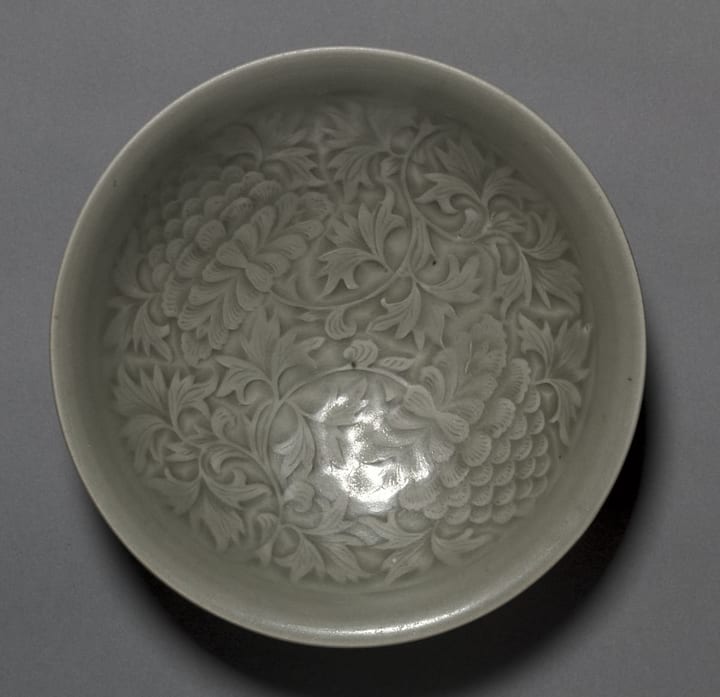
Cleveland’s Bowl with Peonies, 2001.107, is catalogued as green-glazed stoneware with moulded decoration, Yaozhou ware. Its record gives Tongchuan, Huangbaozhen in Shaanxi and a date around the 1100s, Jin dynasty. It supplies a concrete example of the moulded route discussed above.
Follow the floral arrangement across the inner wall, then look at its relation to the bowl’s circular centre. A close view reveals individual edges; a complete view explains the spacing and rhythm. Both matter when discussing a design that has to occupy a curved surface rather than a flat sheet.
A phoenix ewer brings decoration into the structure
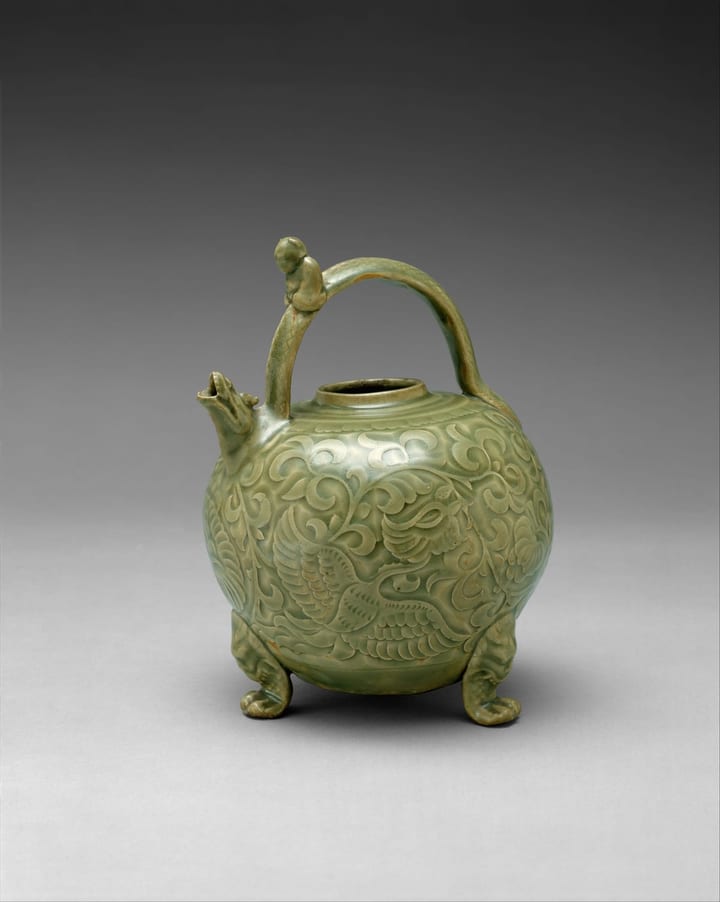
The Met’s Ewer with phoenix, 26.292.73, dates to the eleventh–twelfth century, Northern Song. Its medium is stoneware with incised and carved decoration beneath celadon glaze. The museum also draws attention to a small figure on the handle and to the elaborate spout and feet.
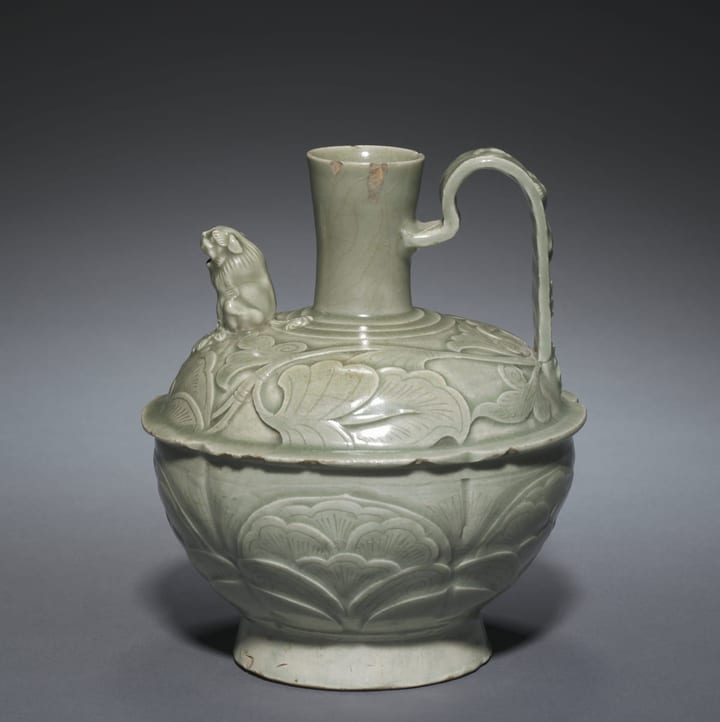
Cleveland’s Ewer with a Lion-shaped Spout, 1948.220, supplies another approach to an elaborate pouring vessel. Its record preserves the earlier 900s–1000s, Five Dynasties-or-Northern-Song attribution and specifies modelled, carved and incised decoration on green-glazed porcelaneous stoneware. Compare the projecting animal spout and handle with the Met’s ewer before isolating their surface patterns.
An incense burner gives carving another arrangement
The National Museum of China’s Song Yaozhou incense burner has two handles, three animal-shaped feet and carved lotus-petal and scrolling-foliage decoration. Its structure provides a further comparison with the ewer: both extend beyond a simple bowl profile, but their openings and supports are arranged differently.
Look for changes between a broad decorated wall and a narrow supporting part. A pattern that works across the main body need not continue unchanged onto a foot or handle. These transitions are useful places to see how a maker relates ornament to the construction of an object.
Compare the making decisions, then the finished surface
For a focused comparison, place one directly carved object beside a moulded bowl. First identify where the design was established; then follow what the glaze does over it. This separates the creation of the relief from the fired colour and sheen without losing their combined effect.
Our Ding ware guide offers another context for carved and moulded decoration. The Cizhou guide examines slip layers, cutting and painting, while Longquan provides a separate celadon tradition. None of those categories is interchangeable with Yaozhou simply because a surface is pale, green or decorated before firing.
Museum photographs and credits
Ewer with phoenix, China, Northern Song dynasty, 11th–12th century; stoneware with incised and carved decoration under celadon glaze (Yaozhou ware). The Metropolitan Museum of Art, 26.292.73. CC0.
Bowl with Peonies, Tongchuan, Huangbaozhen, Shaanxi, China, c. 1100s, Jin dynasty; green-glazed stoneware with molded decoration, Yaozhou ware. Official alternate photograph showing the interior from above. The Cleveland Museum of Art, 2001.107. CC0.
Ewer with a Lion-shaped Spout, Tongchuan, Huangbaozhen, Shaanxi, China, 900s–1000s; Five Dynasties period or Northern Song dynasty. Green-glazed porcelaneous stoneware with modeled, carved and incised decoration, Yaozhou ware. The Cleveland Museum of Art, 1948.220. CC0.