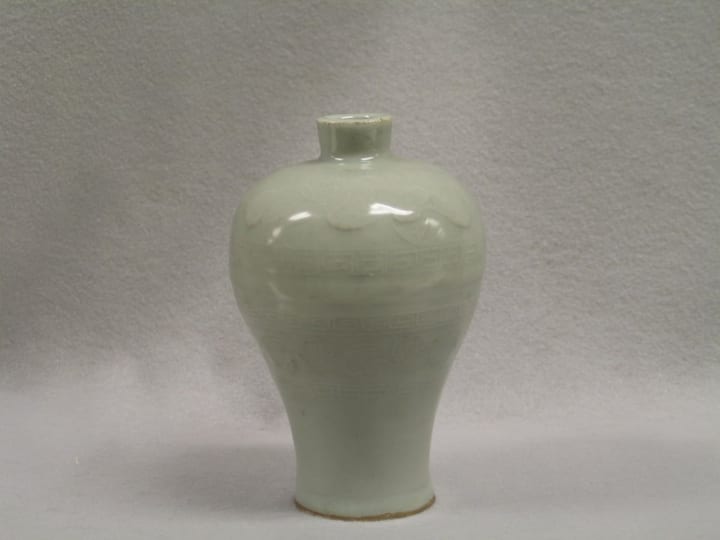
Chinese meiping vases place volume near the shoulder
The Palace Museum’s form glossary describes a narrow opening, short neck, full shoulder, tapering body and ring foot; some examples have covers. It also notes that proportions changed, with later examples becoming broader and more substantial than earlier slender types.
Begin by locating the widest part of the body. Then follow the change from shoulder to neck and from shoulder toward the foot. This makes the profile easier to compare than beginning with a painted flower or the color of the glaze.
The illustrated vase is Longquan stoneware
The Met’s Meiping vase with floral patterns, 34.113.15, is dated to the thirteenth–fourteenth century, Yuan dynasty. The catalogue specifies Longquan stoneware with incised decoration beneath celadon glaze. It is 15.1 centimeters high.
The photograph presents one view of the completed vessel.
A wheel-thrown example with horizontal ribs
LACMA’s Prunus Vase (Meiping) with Horizontal Ribs, AC1994.191.1, is assigned to the late Southern Song, about 1200–1279. Its place attribution is Zhejiang or Jiangxi Province; that uncertainty should remain visible.
The record explicitly identifies wheel-thrown Longquan stoneware with green glaze. Horizontal ribs give the surface another rhythm around its changing diameter. This is direct documentary evidence for one forming method, rather than proof that every meiping was made identically.
An unglazed vase makes the body important
UMMA’s Vase, 1985/2.129, is described as a late-Yuan or early-Ming meiping in gray stoneware. Its physical description records an unglazed, wheel-thrown surface with coarse inclusions, an uneven contour and visible throwing lines.
Here the material and forming traces contribute to the visible object without a colored glaze covering them. The example is useful when comparing labels: neither porcelain nor a particular glaze is a requirement of the form name.
A painted meiping carries a Daoist subject
The Met’s Vase in Meiping Shape with Daoist Immortal Zhongli Quan, 2010.312, dates to the second half of the fifteenth century. Its medium is Jingdezhen porcelain painted with cobalt blue beneath transparent glaze.
The museum identifies Zhongli Quan through the leaf in his hand and the gourd at his belt. These details belong to this vessel’s pictorial subject. They distinguish its decoration from the incised floral treatment of the illustrated Longquan example, while both retain the meiping form name.
Compare meiping with the yuhuchun profile
The yuhuchun guide follows an outward-flaring mouth and slender neck above a full lower body. Meiping places a short neck above fuller shoulders. Compare those transitions before using glaze or painted ornament to sort the vessels.
Neither name fixes an exact original use for every surviving example. Keep the museum’s date, material and attribution alongside the form label. The Longquan and Qingbai guides offer further context for individual wares, while this comparison stays focused on the outline.
Images and credits
Meiping vase with floral patterns, China, 13th–14th century. Longquan stoneware with incised decoration beneath celadon glaze. The Met, 34.113.15; Fletcher Fund, 1934. CC0. Complete photograph, resized.