Chinese underglaze copper-red porcelain: the layer sequence
The Palace Museum defines yulihong as an underglaze technique: copper oxide supplies the colourant in painting on the body, glaze follows, and firing produces the finished surface. The University Museum and Art Gallery at the University of Hong Kong likewise places copper pigment below transparent glaze.
This gives a useful order for looking: identify the container, follow the painted design, then consider the glazed surface covering it. The decoration belongs to the vessel’s making sequence. It is not a red picture added indiscriminately to any finished white object.
Plan a design around a changing profile
HKU’s digital exhibition includes a Jingdezhen yuhuchun vase assigned to the Hongwu period, 1368–98. Its catalogue separates the decoration into zones, including plantain leaves near the neck, several narrow bands and flower sprays on the body. That organisation gives the viewer a route down the vessel.
Try tracing a narrow band around the neck, then comparing it with a broader body motif. A border marks a transition; a larger spray occupies a swelling field. Thinking in these terms connects brushwork with the shape being decorated, rather than treating the design as a flat pattern detached from its support.
A dragon water pot shows that softness can serve an image
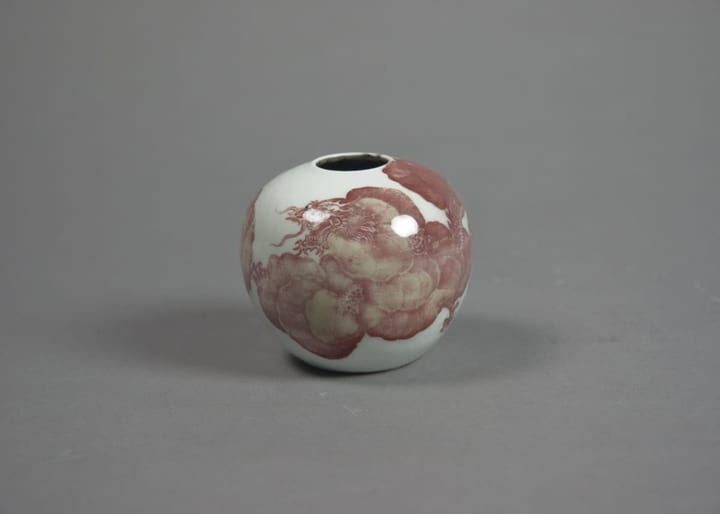
The Met’s Water pot with dragons among clouds, 14.40.90, is a Qianlong-period Jingdezhen piece, dated 1736–95 and painted in underglaze copper red. The museum suggests a brush-and-ink writing use for this seven-centimetre-high object.
The museum interprets its murky dragon as intentional, evoking distance or clouds. Softness can therefore serve an image. Compare the areas where a motif gathers and dissolves rather than treating every indistinct passage as a defect or assuming that sharp outlines were always the painter’s goal.
A miniature flower bottle changes the viewing scale
The Met’s eighteenth-century Miniature bottle with flowers, 1993.386.22, is also seven centimetres high and catalogued as Jingdezhen porcelain painted in underglaze copper red. The floral subject offers a contrast with the dragon water pot without changing the basic placement of the colour beneath the glaze.
A useful comparison begins with the full profile and the distribution of the decoration. Where is the broadest painted area in relation to the shoulder and neck? How much pale ground remains visible? Those questions work even when a photograph does not resolve every individual brush mark.
Copper red can be combined with cobalt blue
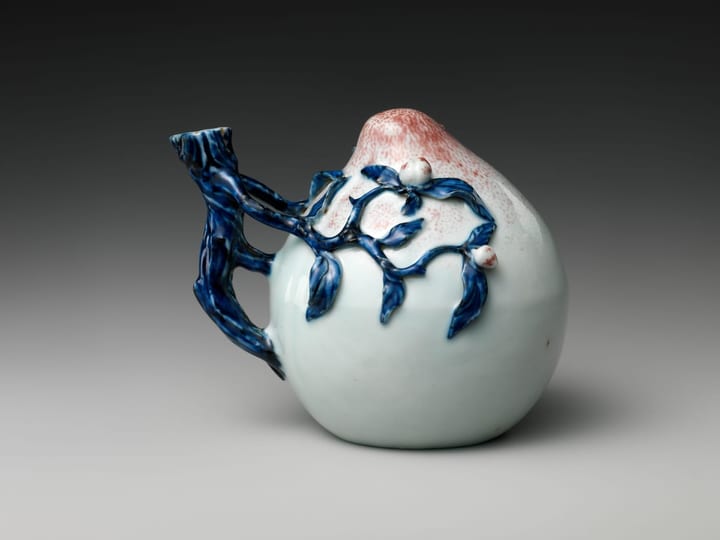
The Met’s nineteenth-century Ewer in the shape of a peach, 24.80.239, is explicitly catalogued with underglaze copper red and cobalt blue. Its Chinese title also identifies the combination as qinghua yulihong, 青花釉里紅. It therefore provides a documented example of two colourants used in one decorative scheme.
Begin with the peach-shaped container, its opening and its handle, then follow how the coloured areas relate to that form. This is a different visual problem from arranging horizontal bands on a tall vase. The museum’s technical attribution, rather than a guess from red-and-blue appearance, establishes the decorating category.
Separate painted copper red from other red surfaces
Three distinctions help when comparing labels. Underglaze copper red places a copper-bearing design beneath glaze. A monochrome red-glazed vessel uses a coloured glaze as the surface treatment. Overglaze red decoration sits above the glaze. A similar-looking red need not share the same material or layer sequence.
The V&A describes underglaze as decoration protected by the glaze above it. The Palace Museum also stresses the sensitivity of copper colour to kiln conditions. That need for control does not translate into one temperature or firing formula for every period, body and glaze. A photograph alone cannot recover a workshop recipe.
Compare techniques through the decisions makers made
Our blue-and-white porcelain guide follows cobalt-based painting beneath glaze; the Jingdezhen guide provides the broader production context. Comparing them with copper red is most useful when attention stays on forming, painting, coating and firing.
Dehua porcelain offers a further comparison through pale bodies, glazes and sculptural modelling. Across these guides, ask what creates the main effect: the shape itself, a painted design beneath glaze, or the glaze’s colour. That question gives a clear purpose to comparing different ceramic traditions.
Museum photographs and credits
Water pot with dragons among clouds, China, Qing dynasty, Qianlong period (1736–95); porcelain painted in underglaze copper red (Jingdezhen ware). The Metropolitan Museum of Art, 14.40.90. CC0.
Ewer in the shape of a peach, China, Qing dynasty, 19th century; porcelain painted with underglaze copper red and cobalt blue glaze (Jingdezhen ware). The Metropolitan Museum of Art, 24.80.239. CC0.