Chinese Ding ware: a kiln tradition, not any white porcelain
The Palace Museum places the Ding kiln site at Jianci village in Quyang, Hebei. Its overview lists incised, carved, molded and modeled decoration, with bowls and dishes among the common forms. The definition combines place and craft history, not simply a pale color.
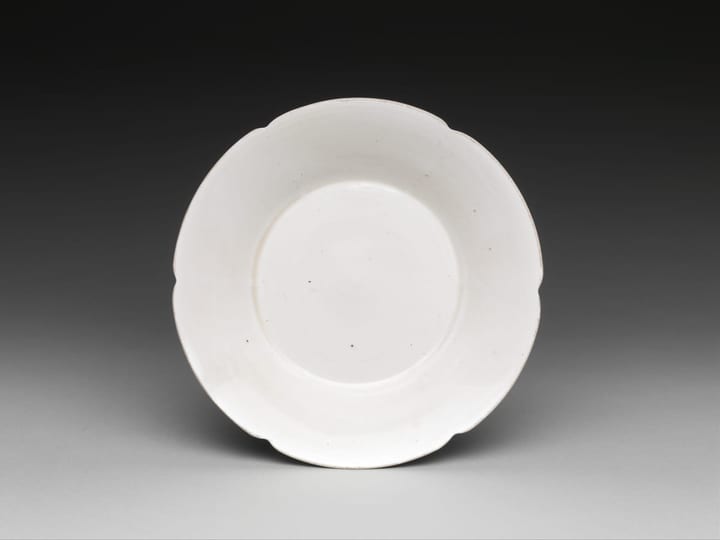
The Met's eleventh-century Dish with Scalloped Rim, 1991.253.16, is explicitly catalogued as porcelain with ivory glaze, Ding ware. Its outline provides one way to begin looking: follow the shaped rim, then consider how the wall and well continue that form. A softly colored glaze does not make a vessel visually featureless.
Decoration can be read through relief and light
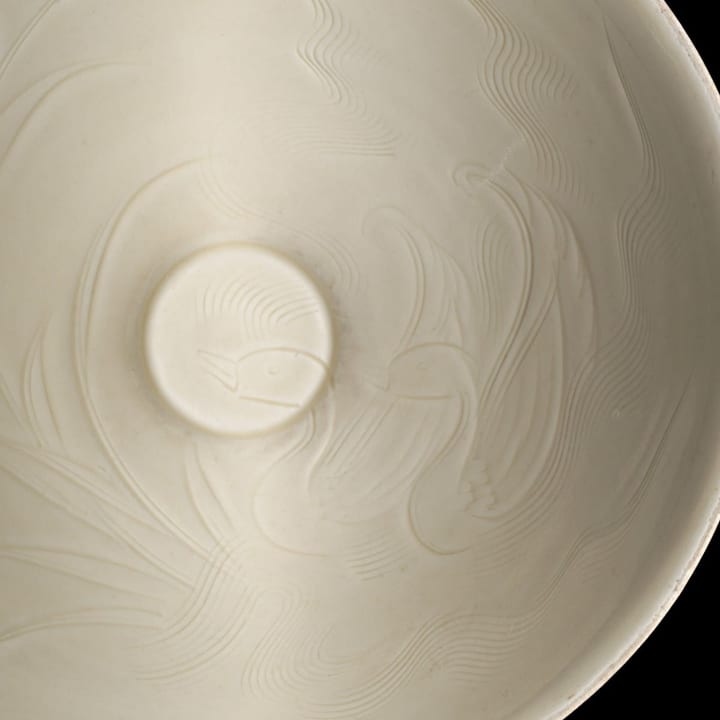
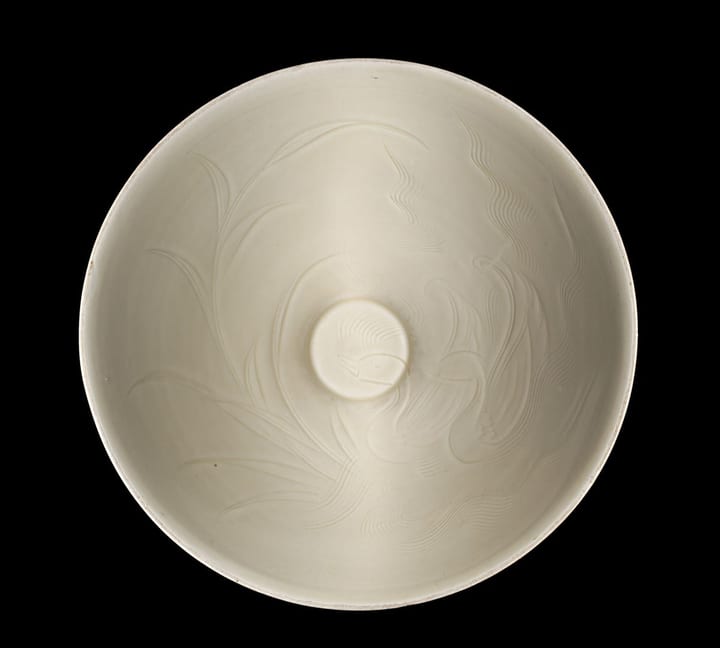
Cleveland Museum of Art's Bowl with Ducks among Waves and Reeds, 1929.995, is attributed to Quyang and the Northern Song dynasty, with a date in the 1100s. Its medium identifies cream-glazed porcelain with incised decoration.
Follow one duck, a reed, and a passage of water rather than expecting the image to behave like painted blue lines. Then compare the density of the design near the center and wall. The catalogue establishes that the decoration is incised; changing light and viewing angle help reveal how those lines organize a pale surface.
Mold-impressed patterns represent another making choice
The Met's Dish with Lion among Floral Sprays, 50.145.320, is dated to the twelfth–thirteenth century, in the Jin dynasty. Its recorded decoration is mold-impressed beneath an ivory glaze. The museum explains how molds could produce both vessel shape and design.
This gives a useful comparison with the incised duck bowl. Ask how closely spaced motifs fill the available surface and how the rim frames the image. Do not turn a difference in method into a quality ranking: these are different ways to coordinate a vessel and its decoration.
Why an unglazed rim needs a specific explanation
Cleveland's account of the duck bowl connects upside-down firing with an unglazed rim, which could be covered by a metal band. Read the top edge and the base together: the place where a vessel met its support affects where glaze could safely remain.
Keep the material of any binding separate from the porcelain. Its presence is something to describe and investigate, not automatic evidence for a particular original owner. The individual record should establish the metal, date or condition when that information is available.
Not every Ding vessel was fired upside down
The Palace Museum's Five Dynasties white-glazed Ding bowl provides an important counterexample. Its account describes upright firing in a protective container, with glaze covering the mouth rim while the bottom remains unglazed. The visible contrast follows a different firing arrangement.
The National Museum of China's account of a Jin Ding dragon dish adds further variety. It describes both continued upside-down firing and another practice in which a ring of glaze was removed from a vessel's inner base to receive the foot of a piece stacked above. These examples make a single universal firing story unsuitable for all Ding ware.
Use the whole object for comparison
Compare profile, decoration, glazed and unglazed areas, and the catalogue's date before grouping objects together. The Met notes that Ding was emulated by later ceramic traditions. An ivory-colored surface therefore does not establish an early date or production at Quyang on its own.
Our Ru guide follows another northern tradition through glaze coverage and small firing contacts. Longquan celadon and Jingdezhen porcelain provide further comparisons of form, body, glaze and place. These links help explain the distinctions among ceramic traditions without making color an origin test.
Museum photographs and credits
Ding-ware bowl with ducks among waves and reeds, 1100s, Northern Song; Quyang, Hebei. Cleveland Museum of Art, 1929.995; CC0.
Ding-ware dish with a scalloped rim, China, 11th century, Northern Song. The Met, 1991.253.16; public domain/CC0.
Detail crop from the same Ding-bowl interior photograph, showing its incised decoration. Cleveland Museum of Art, 1929.995; CC0. This is the same object as the main image.